



Have you ever had a situation where, despite having carefully created a document, users say it is "hard to understand" or it is not utilized as you had anticipated?
"It is important to think from the user's perspective."
That is often said, but in reality, it is not easy.
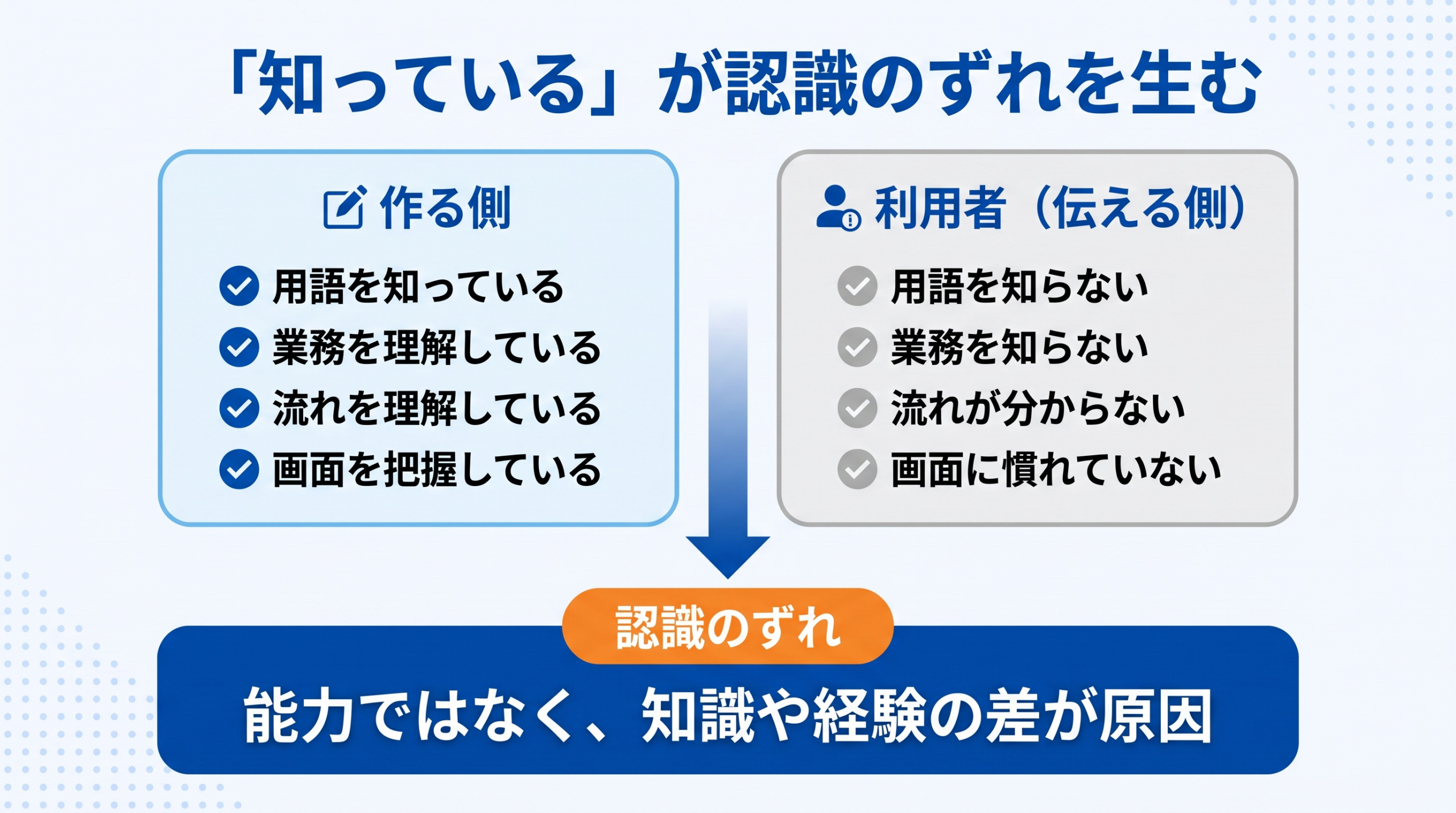
This is because the creators understand the product and the work.
Having knowledge is a strength, but precisely because of that knowledge, it can be difficult to notice where users might get confused.
This time, I would like to consider the reasons why the perceptions of the creators and the users differ.
- Table of Contents
1. The creators "know"
People who create documents often know the subject well and make an effort to learn in order to create the documents.
Knowledge and experience are indispensable for document creation.
Creators may have the following kinds of knowledge and experience.
・Know the points to be careful about
・Know common inquiries
・Know the criteria for prioritizing information
・Know which screen to open
・Know the meanings of terms
・Know the workflow
etc.
On the other hand, users usually do not have that knowledge or experience. Therefore, there can be a gap in understanding between the creators and the users.
2. What users "want to know"
The creators tend to think more in terms of individual functions the more they know about them.
However, users want information to achieve the following kinds of goals, and it is probably less common for them to think, "I want to understand the ○○ function."
・Want to log in
・Want to apply/approve
・Want to make a reservation
・Want to check necessary information in a list
・Want to print out
Therefore, even if the creators write detailed explanations of the functions, there are times when it does not align with what the users actually want to know.
3. Things that become taken for granted
For example, suppose it says, "Every month, submit the sales report as data."
Those who are familiar with it might understand what to do just from these words.
However, for first-timers, there are many things they do not understand.
・What exactly is a "sales report"?
・When, to whom, by whom, and how is the data submitted?
・What happens as a result of submitting it?
The more knowledge and experience you gain, the less often you consciously think about how you understood something.
・This term should be understandable
・This screen should be understandable just by looking at it
・This process should be naturally understood
What is naturally understood by those with knowledge and experience is not necessarily so for first-timers.
Since the creators already understand it, it becomes difficult to see where users might get confused, and explanations may be omitted.
This is also one of the reasons why explanations exist but fail to be conveyed.
4. Because they know, they want to write
On the other hand, having knowledge and experience can also lead to an increase in explanations.
・Let's include this explanation as well
・I also want to convey this exception
・I want you to be aware of this caution
As you think this way and continue adding information, the content may increase.
Of course, sometimes it is necessary information.
However, it does not always match what the user wants to know right now.
As a result,
・The amount of text increases
・Necessary information gets buried
・Users give up before reading
These kinds of issues can occur.
5. Sometimes Inquiries Provide Hints
When you look at the content of inquiries, haven’t you ever wondered, "Why do they get confused here?"
However, it may not be that the users are special, but rather points that the creators hadn’t noticed.
The things we understand well are the ones most likely to be left unexplained.
Also, the places where users get confused are often completely different from what the creators had imagined.
6. To Adopt the User's Perspective
Adopting the user's perspective does not mean discarding your own knowledge.
Rather, it means being aware of the differences between what you know and what the user knows.
The information users want to know and need varies depending on the user.
Let's consider the user's situation.
・New employees
・Business staff
・Managers
・People who use it only a few times a year
・People who use it every day

What new employees want to know may be different from what managers want to know.
People who use the system daily seek information that helps save time, while those who use it only a few times a year may want to check how to log in.
In this way, it is easy to imagine that the necessary information varies depending on the user.
Therefore, it is important to consider not only "what you want to convey" but also "what the users want to know."
There are the following perspectives to consider what users want to know.
・What does the user want to achieve?
・What does the user know?
・What does the user not know?
6-1. To Notice Misunderstandings
Creators cannot revert to the same level of knowledge as the users.
Therefore, even if you think something is easy to understand, it may not be conveyed to the users.
When you are unsure about your explanation or find it difficult to judge by yourself, it is also effective to have someone close to the actual users review it.
In particular, the following points can be difficult to notice on your own.
・Do users understand this terminology?
・Are we asking for too much prerequisite knowledge?
・Is the content designed so that users can achieve their goals?
The reaction of "I don't understand" is not a failure but an important clue to discovering gaps in understanding with users.
Reviewing inquiry content or checking with people close to actual users may lead to unexpected insights.
[Related Sites]
>Manual Evaluation, Analysis, and Improvement Proposal Service
7. Summary
The gap in understanding between creators and users is not due to the creators’ lack of ability.
Rather, it can occur precisely because they have a deep understanding of the product or operations.
Knowledge and experience are indispensable for document creation.
However, precisely because of that knowledge and experience, there are times when "things that are not obvious to users are omitted" or "the creator writes what they want to convey rather than what the user wants to know."
What users know, what they do not know, and what they want to achieve.
Being aware of these differences may lead to creating documents that effectively communicate to users.
Up to this point, we have discussed various forms of information provision, such as simple manuals, start guides, FAQs, checklists, and videos.
By being aware that there are differences in perception between users and creators, you may discover ways of communication that suit each individual.
[Related Services]
When you are unsure which method is best—such as a simple manual, start guide, FAQ, checklist, or video—incorporating a third-party perspective can sometimes help organize your approach more easily.
If you are having trouble considering the structure or production of manuals, please also make use of Human Science's manual production services.
Learning from Other Companies
How to Proceed with Manual Creation











































































 Business Manual
 Operation Manual
 Manual creation
 Web Manual
 Director, Writer
 In-house Support
 Video
Video Manual
 Manual Creation
 One-Stop Service for Manual Creation
 Manuals and Documents
 Document Solutions for IT Companies
 Improving Manual UX through UX Writing
 Knowledge Management
 Jamstack
 GitHub/Markdown
 Return to the top of the page

 +81 35-321-3111[Tokyo Headquarters]
  Contact Us
 Resources