


* This is about focused materials such as simple manuals and start guides. (Materials that need to cover all functions, such as product manuals, are excluded.)
When inquiries arise, it is not uncommon to think, "Is the manual's explanation insufficient?" and consider, "Let's add this explanation," "Let's include more detailed precautions," or "Let's also include exception patterns."
Of course, if the information that users want to know is not posted anywhere, it is necessary to add that information first. Also, if the explanation is difficult to understand or causes misunderstandings, it is important to review the way the explanation is given.
However, even when the necessary information is included, users may still get confused for reasons such as "not being able to find it" or "not understanding which content applies to them."
In such cases, simply adding more information to the manual may not lead to a solution.
Depending on the situation, it is necessary to consider better solutions such as "changing the title," "creating additional materials," "developing a searchable system," "reconsidering the structure," or "changing the manual format." However, the more you know about the product's features and usage, the more you tend to think, "I want to convey this information too." I understand. Adding more information does not necessarily make it easier to use.
This time, rather than discussing making major changes, I would like to consider information provision for users from the perspective of not only "what to write" but also "what not to write" when adding information.
When you find yourself thinking "I want to convey this information too," here are some points to pause and consider.
- Table of Contents
-
- 1. What Happens When You Increase Information
- 2. Why Do We Feel the Need to Add Information?
- 3. What Do Users Want to Do?
- 4. Adding Information Is Not Always the Best Solution
4-1. Considering Whether Additional Notes Are Really Necessary
4-2. What to Do with Information That Is Not Written? - 5. Summary
1. What Happens When You Increase Information
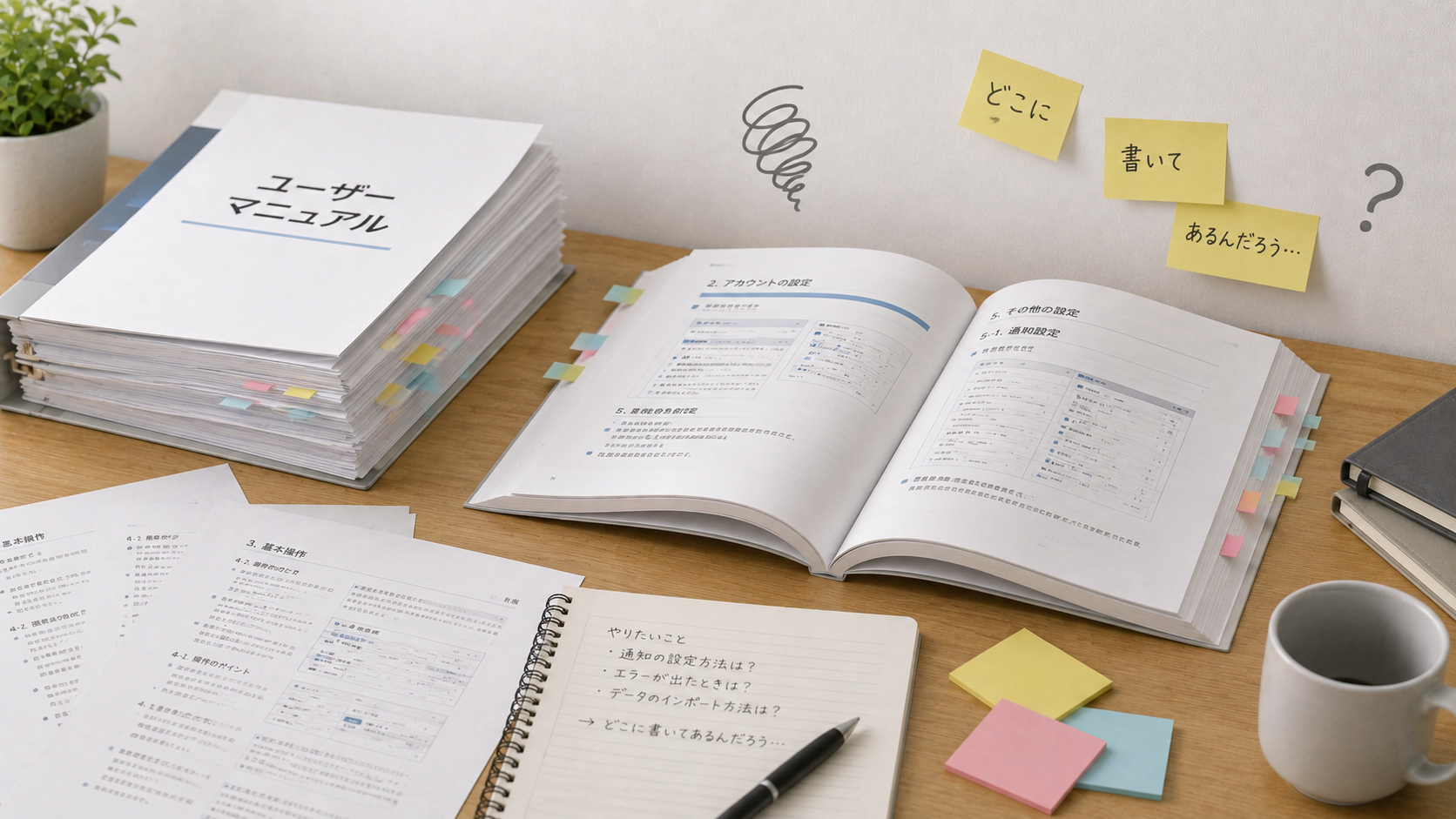
When you add information,
・The manual becomes longer, and the number of pages increases
・It becomes harder to find the necessary information
・Important information gets buried
・The burden on the reader increases
These are some of the things that can happen.
What is important for users is not the amount of information, but that they can "find the information necessary to achieve their goals" "when they need it."
2. Why Do We Feel the Need to Add Information?
There are reasons why you want to add information.
・You don’t want users to fail.
・You want to reduce inquiries.
・You want users to know about useful features.
・You want to prevent future problems.
All of these are important ways of thinking.
When inquiries arise, there is sometimes a desire to reflect their content in the manual.
However, it is necessary to distinguish whether the inquiry is a common issue for other users or a problem that only some users face.
3. What Do Users Want to Do?
For example, it is often the case that what users want to know is not the detailed specifications of a feature, but the information necessary to achieve their own goals.
For example, their goals might be as follows.
・Want to log in
・Want to submit an application
・Want to resolve an error
・Want to complete the tasks they are responsible for
・Want to operate equipment following the correct procedures
and so on
It is important not only to organize information from the perspective of the creators (communicators) who want to explain "this function," but also from the perspective of "what the users want to do."
4. Adding information is not always the best solution
Including all information such as rarely used details, unnecessary specifics for the user, or explanations unrelated to the current purpose can actually make it harder to find important information.
Deciding "not to write" may require a bit of courage, but not adding information can sometimes lead to better outcomes for users.
4-1. Consider whether additional information is truly necessary
First, let's check whether additional information is really needed.
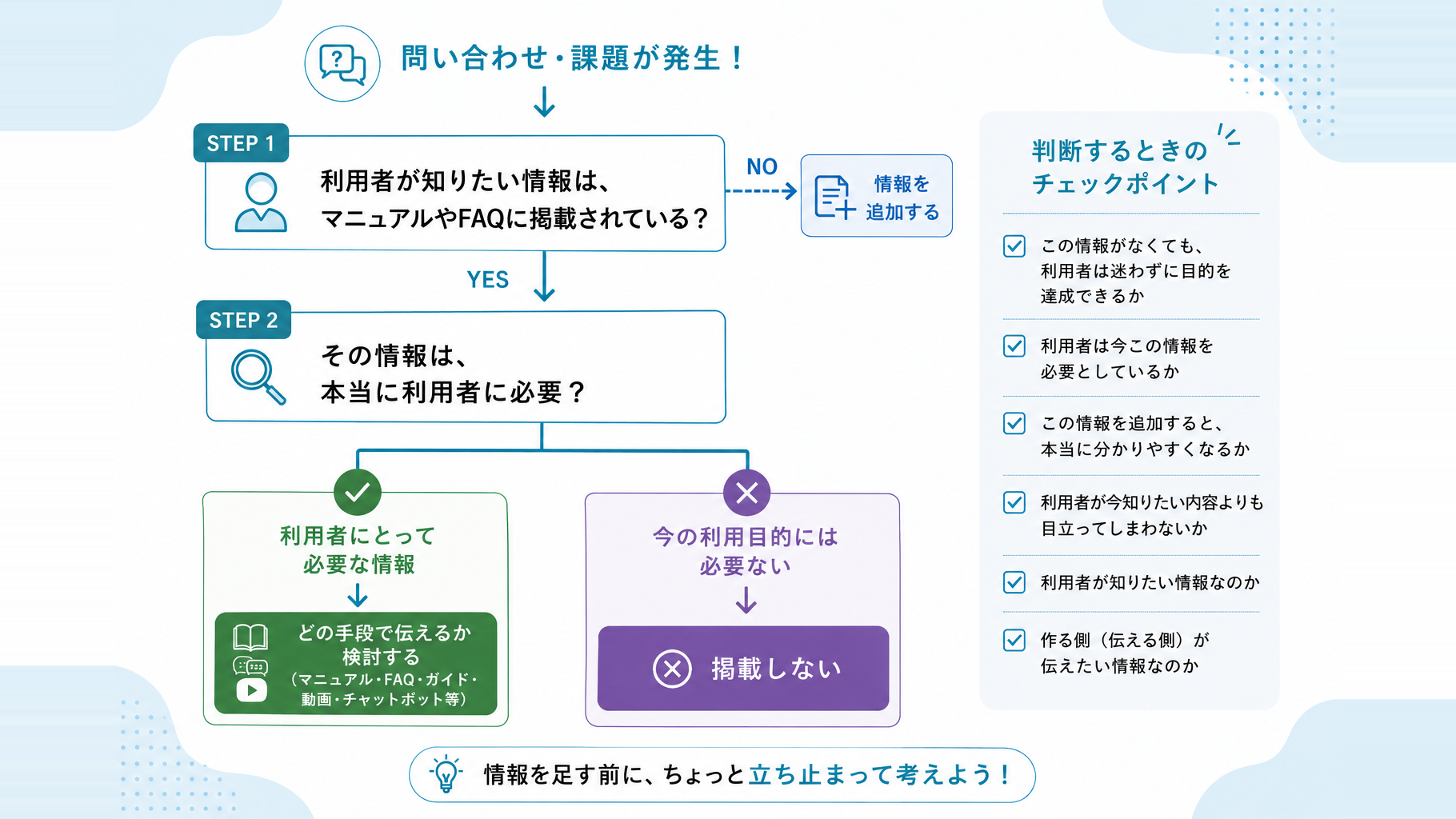
Step 1: Is the information the user wants to know really included?
Not included → Add the information
Included → Go to Step 2
Step 2: Consider Whether It Is Really Necessary to Include
There are various ways to respond depending on the content of the inquiry, but first, before adding information, pause for a moment and consider whether that information is truly necessary for the user.
・Can users achieve their goals without this information without hesitation?
・Do users currently need this information?
・Will adding this information truly make things easier to understand?
・Will this information overshadow what users currently want to know?
・Is this information what users want to know?
・Is this information what the creators (communicators) want to convey?
As a result,
・If the information is currently necessary for the user, include it
・If another method conveys the information more effectively, consider alternatives such as FAQs or guides
・If it is determined that the information is not needed for the current purpose, do not include it
This is also an option to consider.
4-2. What to do with information not written?</h>
You might wonder, "Is it really okay not to write the content we've decided not to include?"
Product manuals, for example, are often created as comprehensive documents covering functions and specifications (all-function comprehensive manuals).
The term "not writing" here does not mean losing necessary information.
If the information needed by users is not provided anywhere, it is first necessary to supplement that information.
On the other hand, even if the information is necessary, simply adding more content is not always the solution.
By narrowing down what is written, supplementary information or content that is used infrequently can sometimes be conveyed more effectively by changing where it is placed.
If you think, "Maybe this is a bit too much information," "There probably aren't many people looking for this right now," "But it’s convenient to know...," or "I definitely want to convey this information," and there is no need to add it to the same document, depending on the content and situation, there may be an option to provide it by another method.
For example, if the same inquiry occurs repeatedly, an FAQ might be more suitable.
If you want to convey the overall approach and flow of the work, a guide might be easier to understand.
If you want to communicate usage scenarios or operational images, videos can sometimes be effective.
You don’t have to give up on conveying that passionate feeling.
5. Summary
Adding to the manual is one effective improvement measure.
However, the more information you add, the easier it is to use does not necessarily follow.
What is important is to consider:
・What the user wants to do
・Which method will effectively convey the information
・Whether it is truly necessary to convey that information right now
Deciding "what not to write" is a task more difficult than writing itself. Especially for those who deal with products and operations daily, it tends to be challenging to objectively narrow down the information.
In such cases, it might be helpful to incorporate a third-party perspective.
We have shared the criteria for selecting information.
Next time, we would like to consider the "gap in understanding between the creators (communicators) and the users."
[Related Services]
If you have trouble with structuring or producing manuals, please also make use of Human Science's manual production services.
Learning from Other Companies
How to Proceed with Manual Creation




































































 Business Manual
 Operation Manual
 Manual creation
 Web Manual
 Director, Writer
 In-house Support
 Video
Video Manual
 Manual Creation
 One-Stop Service for Manual Creation
 Manuals and Documents
 Document Solutions for IT Companies
 Improving Manual UX through UX Writing
 Knowledge Management
 Jamstack
 GitHub/Markdown
 Return to the top of the page
 +81 35-321-3111[Tokyo Headquarters]
  Contact Us
 Resources