


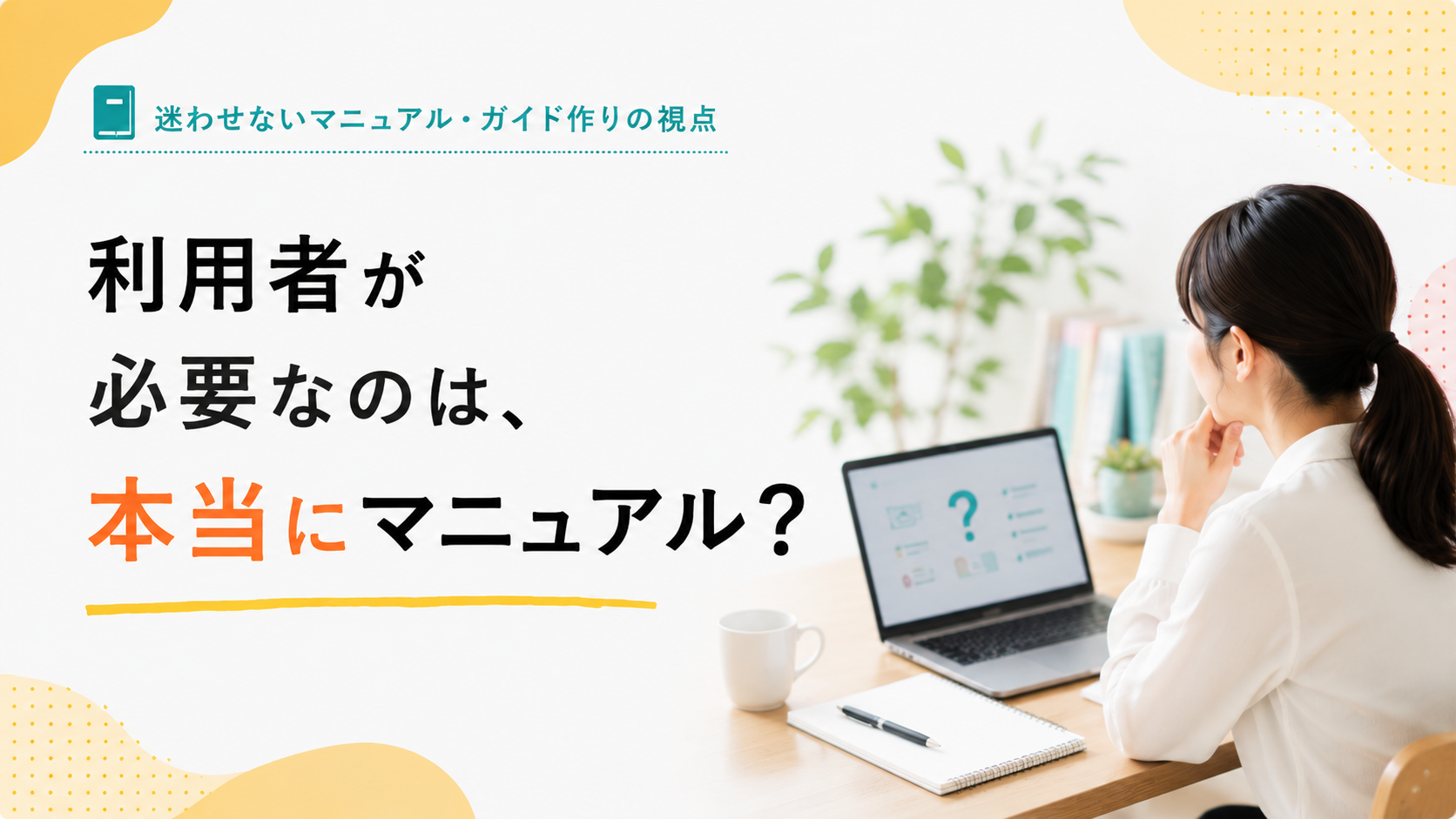
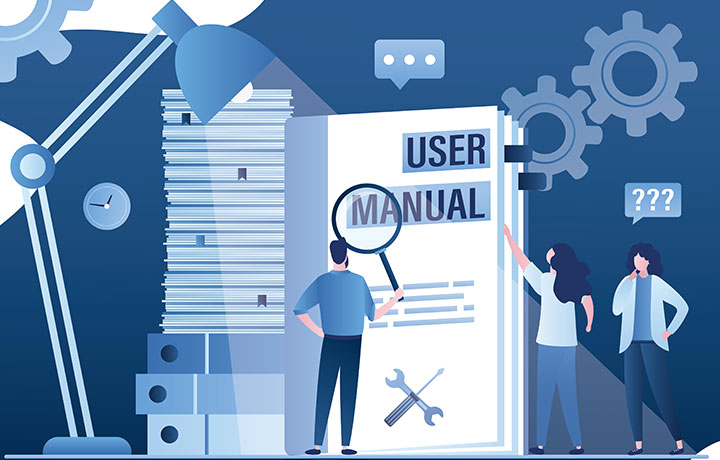
The reasons why users get confused with operations or issues are not necessarily only due to a lack of information written in manuals or other documents.
I think new features and products are often created to solve users' goals and problems.
However, when creating manuals, guides, FAQs, and the like, the explanations sometimes focus more on the functions themselves rather than on explanations tailored to the users' purposes.
If users do not understand "what the function is used for," it can be difficult for them to judge whether that information is necessary for themselves.
Ideally, there are issues that can be resolved by improving the UI, screen transitions, or business workflows. However, it is not always possible to immediately change the system or product.
Of course, manuals are indispensable for users to check the information they need. However, when users are struggling, is an operation manual really what they need?
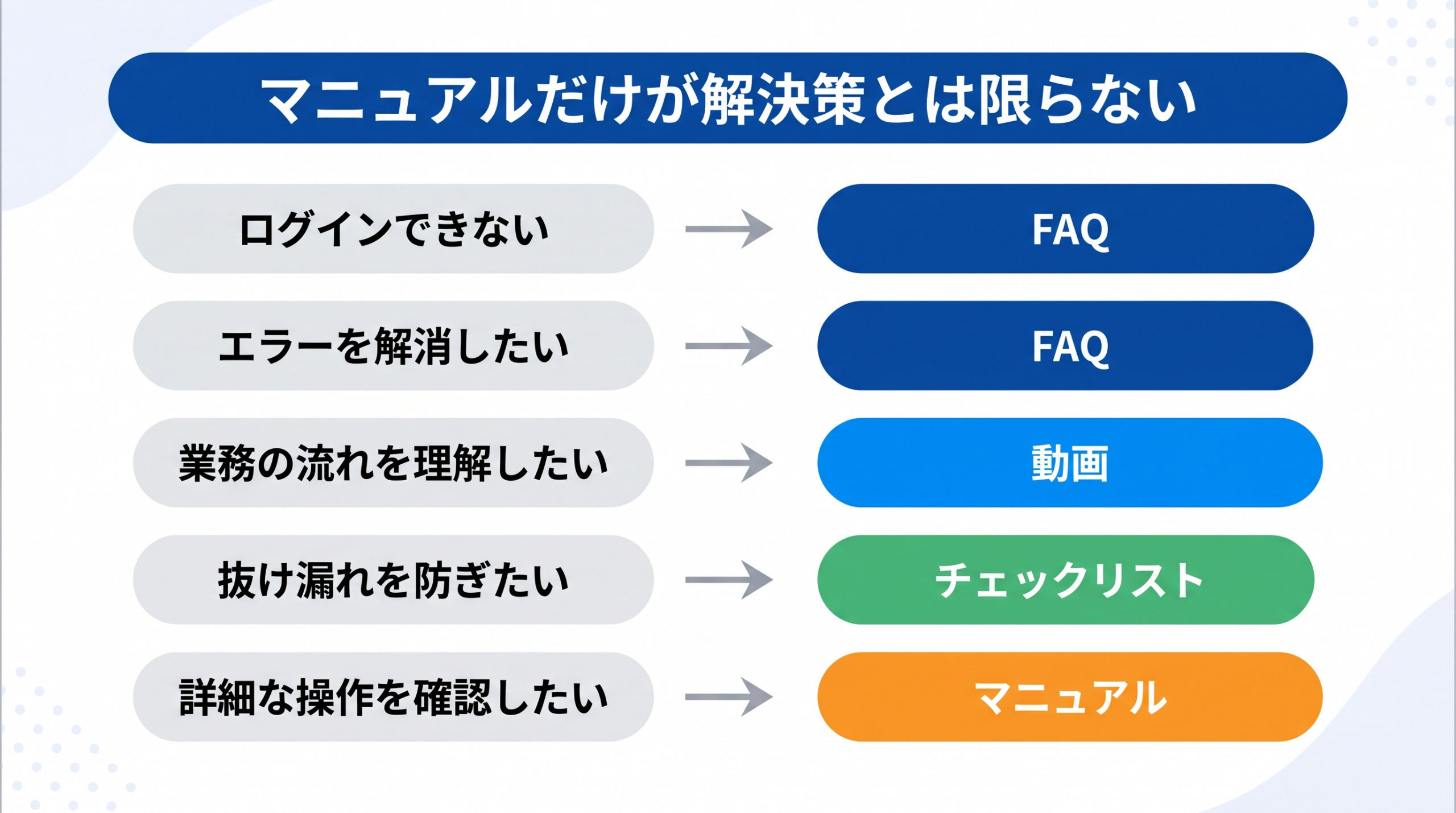
Depending on the issues users face, methods other than manuals may be more suitable. Utilizing checklists, FAQs, videos, and the like might also be effective.
This time, rather than focusing on "which functions to explain," we will consider how to provide information from the perspective of "what the user wants to do."
[Related Sites]
>Improving Manual UX through UX Writing
- Table of Contents
-
- 1. Even though a manual was created, inquiries do not decrease
- 2. Is the real reason users get confused really a lack of explanation?
2-1. "No information" and "Cannot find information" are different - 3. What Users Really Want to Know
- 4. Documents Tailored to Users
4-1. Checklists Can Sometimes Be More Useful
4-2. FAQs or Chatbots May Sometimes Be More Suitable
4-3. Videos Can Sometimes Convey Information More Smoothly - 5. Organizing What Can Be Improved with Documentation
- 6. Summary
1. Even though a manual was created, inquiries do not decrease
In actual workplaces,
there are quite a few cases where "even though manuals were prepared, inquiries did not decrease."
There are various reasons, but common examples include the following situations.
・The existence of the manual is not known
・Users do not know where to find the necessary information
・Users give up before reading (difficult to read)
・The content users want to know is not written
As such, the cause of inquiries is not necessarily whether the information is included in the manual or not, but sometimes the problem lies in users being unable to reach the necessary information. Simply increasing the amount of information does not lead to a solution.
2. Is the reason users get confused really due to insufficient explanation?
When inquiries increase or users say "I don't understand," it is sometimes thought that "the explanation might be insufficient." However, is that really the only cause?
For example, suppose there are many inquiries from users saying, "I don't understand how to operate it."
In this case, it is common to think, "Isn't the explanation insufficient?" but in reality, there may be other hidden causes.
Here are some examples.
・Don’t know where the necessary information is
・Many technical terms make it difficult to understand
・Don’t understand the overall picture of the work
・Menus on the system or control panel are hard to understand
2-1. "No Information" and "Cannot Find Information" Are Different
What is especially easy to overlook is the case of
not "no information," but "cannot find information"
.
There are cases where an extensive operation manual exists, and users find themselves in a situation where they don't know "which part to read." On the other hand, even if the manual is not that thick, if users can quickly reach the necessary information, they have no trouble at all.
Instead of immediately increasing the amount of information just because there are many inquiries, it is important to consider from the perspective of "whether users can find the information."
Related Blog Posts
3. What Users Really Want to Know
When creating a manual, the creators (the communicators) tend to focus on "what they want to convey."
However, what users want to know is "what they are currently struggling with."
・How to respond when you cannot log in
・How to cancel an application
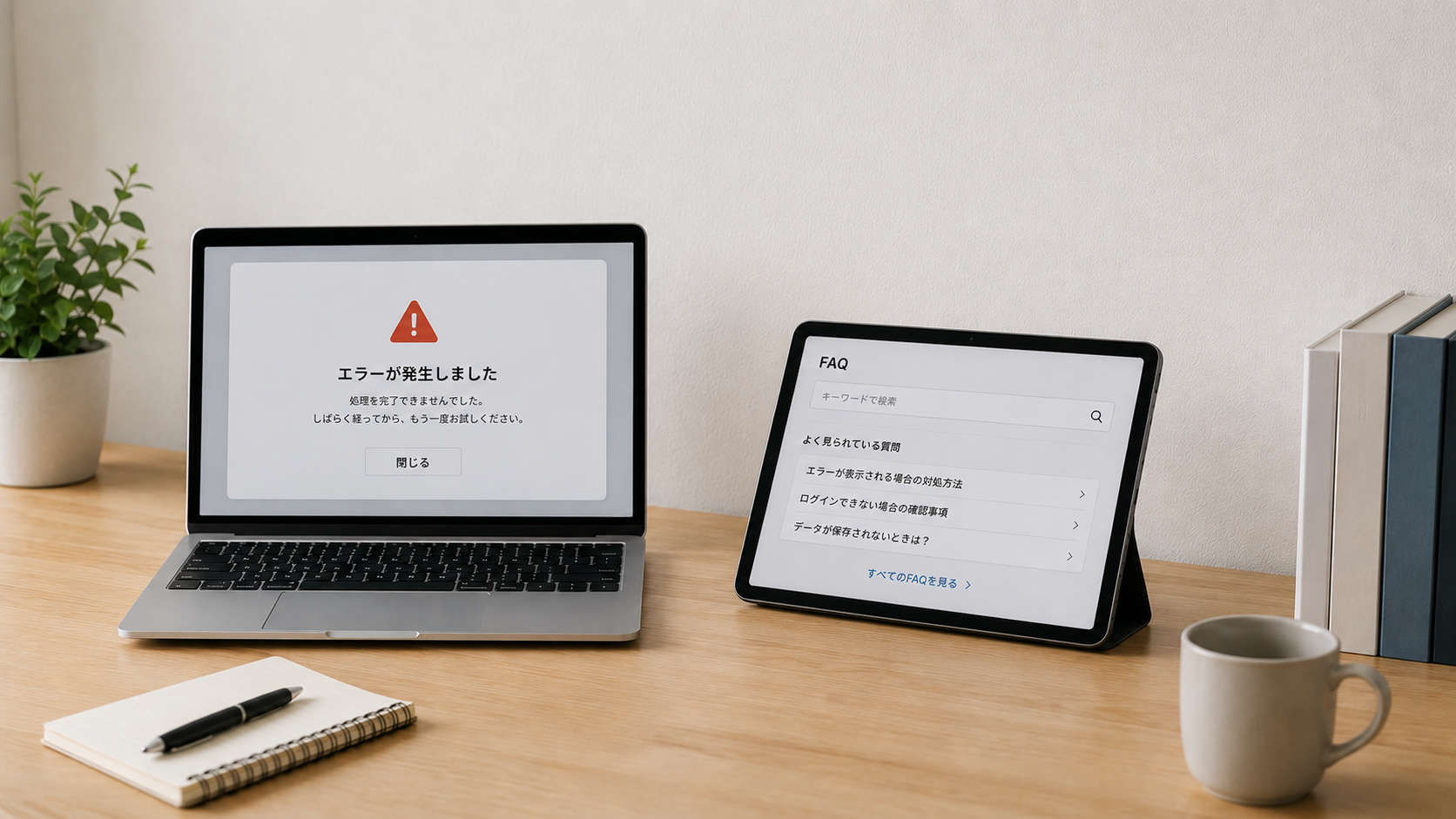
・How to respond when an error is displayed
・Contact information when equipment stops
These are the kinds of things they might want to know.
4. Documents Tailored to Users
Some people want to know how to proceed with their tasks, while others just want to solve the problem they are currently facing.
There are also those who already understand the work and want to carry out their tasks without any omissions.
Since the information users seek varies, the form of useful documents also changes.
4-1. Sometimes a checklist is more helpful
For example, let's consider routine tasks performed every month.
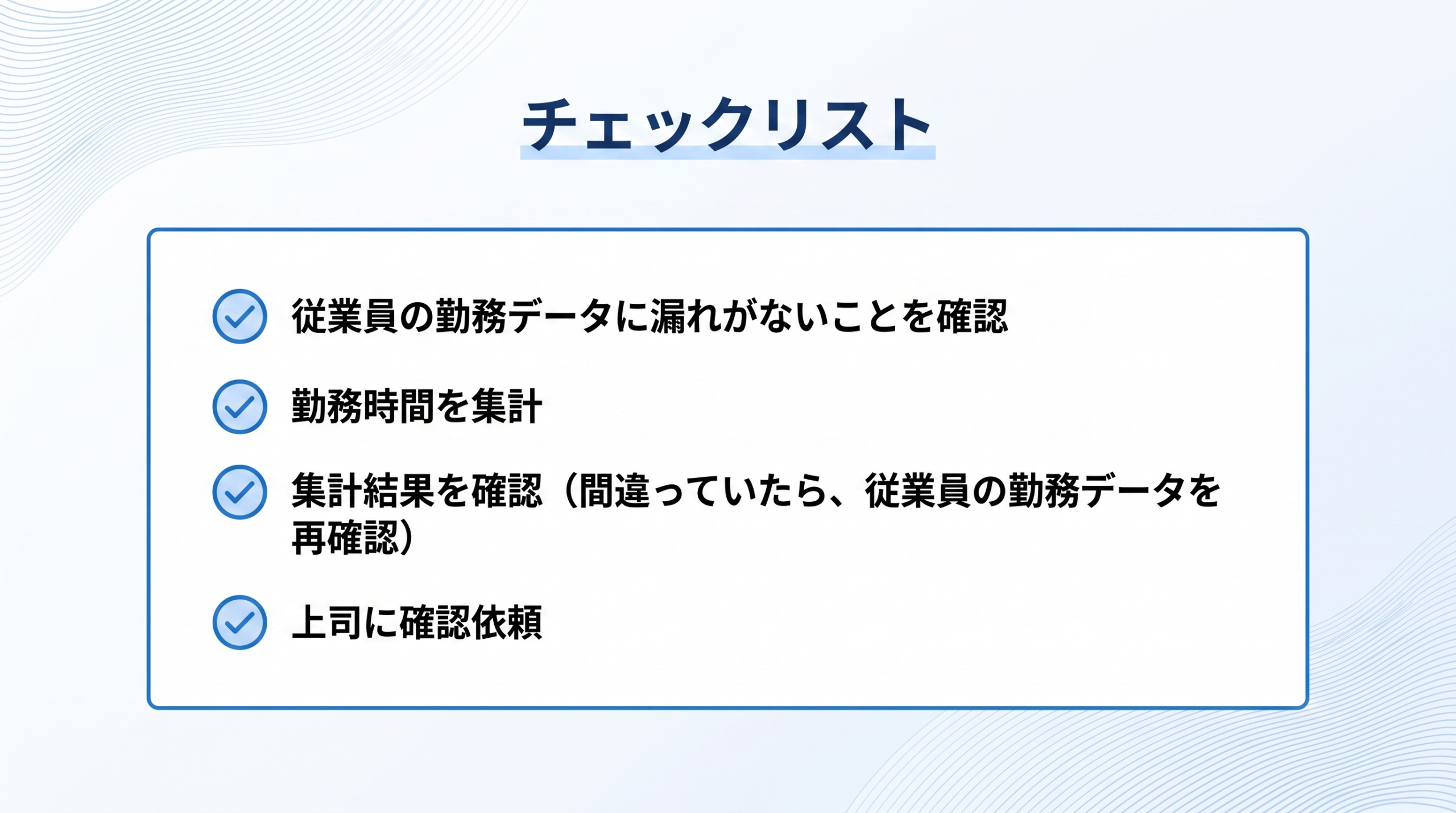
For a person in charge who understands the work content, rather than not knowing "how to do it," what they need might be a "system to prevent omissions", right?
In such cases, a checklist like the following can be more helpful.
4-2. Sometimes FAQs or chatbots are more suitable
Do you often receive the same kinds of inquiries?
For example
・Forgot login ID or password
・What should be entered in this field?
・An error was displayed
・Want to change email address
In such cases, if the manual is designed with features that help you find the relevant section by opening the operation manual, that is still acceptable; however, compiling the information as an FAQ or chatbot can often resolve issues more quickly.
What users are seeking is not an understanding of the entire operation, but rather a solution to the problem they are currently facing.
Related Blog Posts
4-3. Sometimes Videos Convey Information More Smoothly
Videos are effective when you want to quickly convey content that is difficult to express with text alone, such as the flow of operations, the image of procedures, or usage scenarios.
In the following cases, videos can be more effective.
・Want viewers to watch casually (easier than reading text in manuals or other documents)
・Want them to grasp the overall workflow
・Want to share the content of verbal explanations in a form that can be watched repeatedly
・Want to convey the information in a way that leaves a lasting impression on users
Videos have a lower psychological barrier than reading text, making them easier to watch. Additionally, by combining screen movements and audio, the content tends to be more memorable, making videos effective for conveying workflows and overall concepts in a short amount of time.
[Related Sites]
>Creating Video Manuals – Introducing Cases and Samples|Human Science with Over 2,854 Achievements
5. Organizing What Can Be Improved with Documentation
When inquiries increase, let's check if there is anything that can be improved with documentation.
The response you take will vary depending on the cause of the inquiries.
First, it is important to distinguish whether the information itself is insufficient or if there are issues with how the information is presented or communicated.
1. Is there any missing information?
If the information users want to know is not written anywhere, it is necessary to add that information to manuals, FAQs, or similar resources.
2. Is the information difficult to find?
Although the information exists, if users cannot find it,
・Review the table of contents
・Improve searchability
・Organize the FAQ
may be more effective.
3. Is the way of communicating effective?
Are users looking for a manual, a video, a checklist, or an FAQ?
There is also a possibility that methods other than manuals are more suitable.
6. Summary
When inquiries increase and you start thinking, "Wouldn't creating a manual solve the problem?", first try to consider the cause of the inquiries.
For example
・Lack of information
・Difficulty in finding information
・Mismatch in understanding with users
・Mismatch in communication methods
and so on
First, organize the issues and consider what difficulties the users are facing and what they want to achieve. Then, how about thinking about whether to create a manual or if there might be another way to solve the problem?
Now that we understand how to convey information, next time we would like to consider whether increasing information truly benefits the users.
[Related Services]
When considering which method—manuals, FAQs, checklists, videos, etc.—is suitable for users, it is important to organize the users’ goals and issues.
At Human Science, we provide support for information delivery that includes not only manuals but also FAQs and videos.
Hints for Considering CX
Content Creation Support Services and Case Studies





































































 Business Manual
 Operation Manual
 Manual creation
 Web Manual
 Director, Writer
 In-house Support
 Video
Video Manual
 Manual Creation
 One-Stop Service for Manual Creation
 Manuals and Documents
 Document Solutions for IT Companies
 Improving Manual UX through UX Writing
 Knowledge Management
 Jamstack
 GitHub/Markdown
 Return to the top of the page
 +81 35-321-3111[Tokyo Headquarters]
  Contact Us
 Resources