


Even if a product manual is provided, users may have difficulty finding the information they need or locating content relevant to themselves. In such cases, a "simple manual" may be created separately from the product manual, tailored to specific users or usage purposes.
・First Step Guide
・Administrator Guide
・Task-specific Guide
・Frequently Used Operation Guide
・Quick Reference
・FAQ Collection
etc.
In reality, there are simplified manuals that are about 1 to 2 pages long, as well as simplified manuals that exceed 40 pages. The content included and the way it is written also vary widely.
It depends on the purpose for which the "simplified manual" is created, but the name "simplified manual" often leads people to think it is just a shortened version of the product manual. However, this is not necessarily the case.
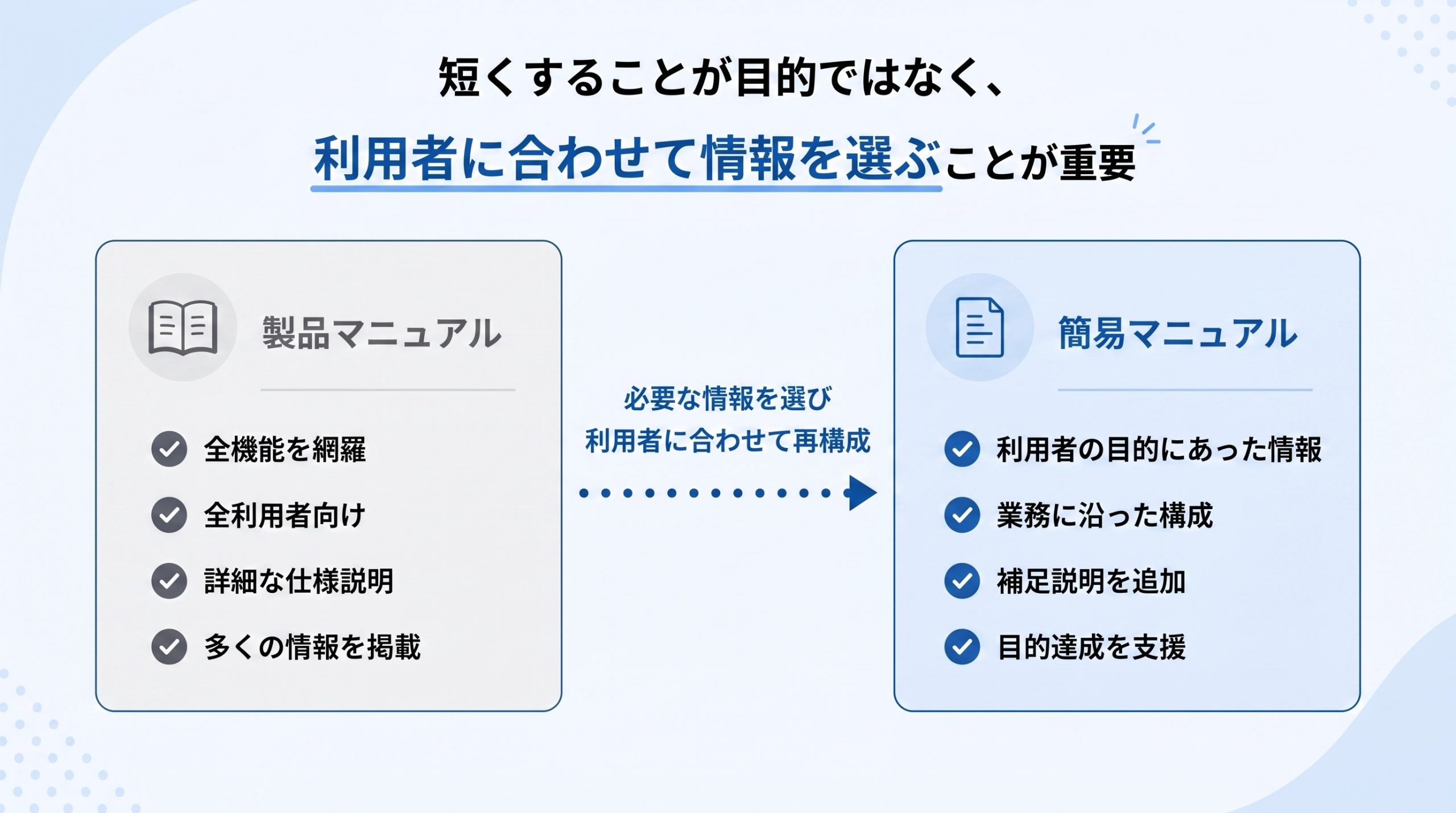
General manuals are also created according to the target audience, but especially in the case of "simple manuals," selecting the necessary information based on the user's purpose and tasks, and reorganizing it in the order the user actually performs, makes the material easier to use.
If a product manual is considered a "document explaining the product," then a simple manual can be understood as a "document that selects the information necessary for the user to achieve their goals and organizes it in an easy-to-use format."
Here, we will explain the role of simplified manuals and the way of thinking when selecting the information to include.
- Table of Contents
-
- 1. Let's create it according to the user's situation
- 2. "Choose" information rather than "reduce" it
2-1. Is it okay to omit content included in the product manual?
2-2. Adding information even though omitting... - 3. Selecting and Discarding Information Is Surprisingly Difficult
3-1. Let's Check Before Creating a Simplified Manual - 4. Let's Reorganize to Make It Easier for Users to Use
- 5. Summary
1. Let's create it according to the user's situation
Even with the same product, what users want to know varies.
For example,
First-time users → "Where should I start?"
Administrators → "Initial setup and operation methods"
Persons in charge of specific tasks → "Operations necessary for their own tasks"
and so on.
So, is it sufficient to simply extract the content from the product manual and provide it as a simplified manual?
The product manual contains information for using the entire product. On the other hand, the information that users need is often only a part of that.
Therefore, simply extracting the content as is may not result in materials that are easy for users to use.
2. Choose Information Rather Than "Reduce" It
Now, even if you think, "Let's reduce the information," it can be difficult to decide what to cut.
How about thinking of it not as "reducing information" but as "selecting the information to include"?
Select the necessary information from the following perspectives.
・Is the task impossible without this information?
・Is there a possibility of making mistakes without this information?
・Is the usage frequency high?
・Is it related to the user’s work?
Etc.
2-1. Is it okay to omit content included in the product manual?
Information not included in the simplified manual is not unnecessary information.
However, if it is not essential for the user to achieve their purpose, omitting information that is not needed at the moment makes it easier to find the relevant content.
The following types of information may be subject to omission.
・Functions not necessary to achieve the objective
・Special operations with low usage frequency
・Detailed specification explanations
etc.
However, even the same information may have different levels of necessity depending on the user.
An operation that is infrequently used by one user may be an important, frequently used operation for another user.
Therefore, it is important to make judgments based on the user's goals and tasks, rather than simple decisions like "delete because usage frequency is low" or "include because it is written in the product manual."
2-2. Adding information while omitting...
A simplified manual is not just an excerpt.
To make it easier for users to understand, we add supplementary information and necessary items for operation while checking the actual device and hearing where users get confused.
For example, even if the product manual only includes the operation procedures, it may be better to add the following types of information to help users work without confusion.
・Purpose and reason for the operation
・Criteria for judgment
・Precautions
・Terminology explanations
・Common pitfalls
・Order of operations to achieve the goal and the next steps
etc.
This aims to create materials that users can easily utilize in actual usage scenarios.
Related Blog Posts
>Key Points for Creating Easy-to-Understand Operation Manuals
3. Selecting and Discarding Information Is Surprisingly Difficult
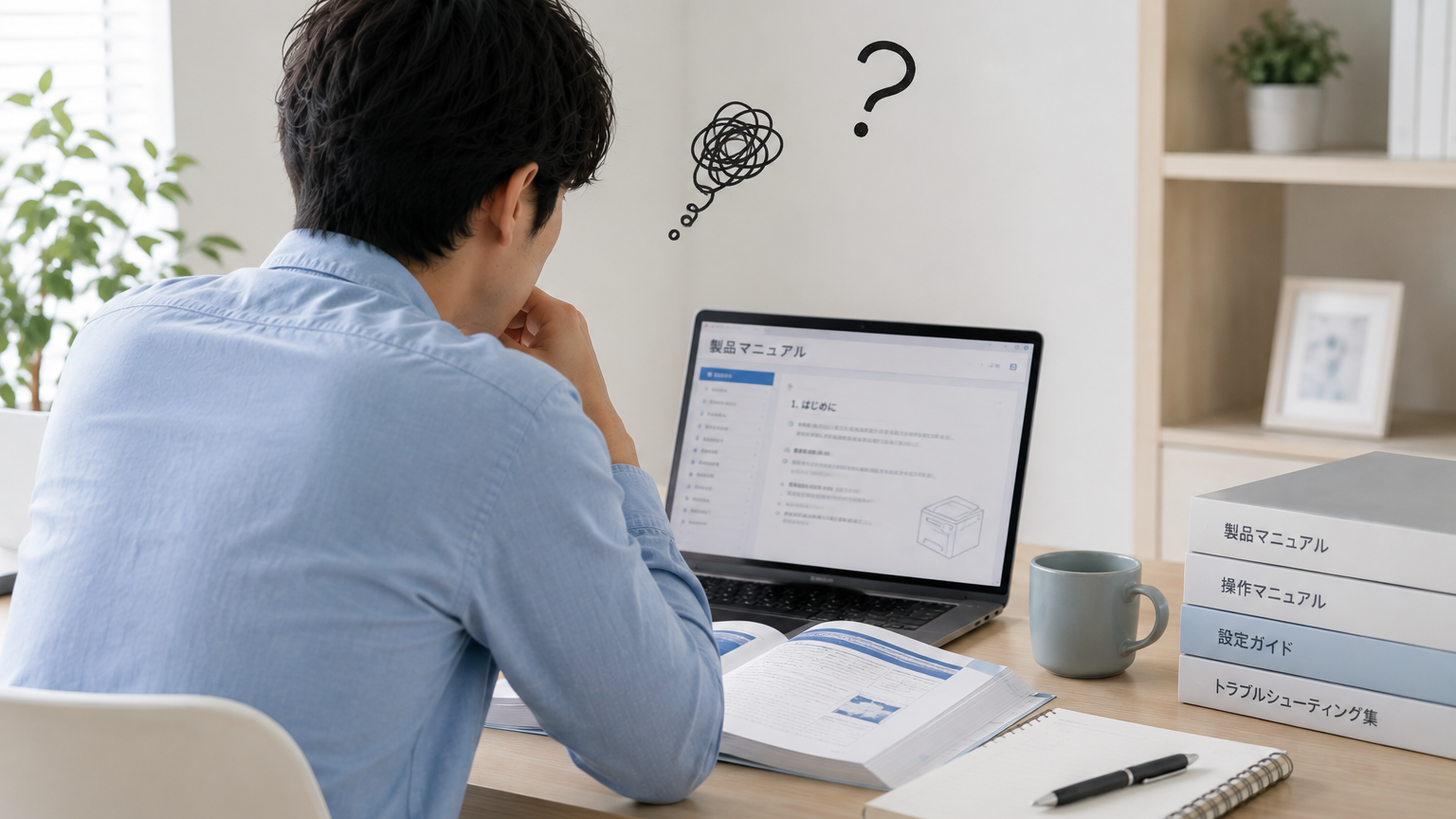
We have talked about not just "reducing information" but "choosing the information to include," and "making judgments based on the user's purpose and tasks," but the task of selecting only the necessary information is not easy.
If you reduce the information too much, users will not be able to perform their tasks, and if there is too much information, the necessary content will get buried.
For example, information that is essential for administrators may be unnecessary for general users. Conversely, content that can be omitted in manuals for administrators may require detailed explanations in manuals for new staff members.
Therefore, it is not enough to just understand the product; you need to select information based on understanding what kind of tasks the users perform, where they get confused, and what kind of decisions they make.
3-1. Let's check before creating a simplified manual
Before creating a simplified manual, it is important to first understand the product, the manual’s users, and the usage scenarios.
If you create a simplified manual without confirming these…
・The content included does not match what the users want to know
・The workflow and the manual’s structure do not align
These kinds of problems are likely to occur.
Therefore, it is important to first understand the users and the usage scenarios.
・Who the users are (whether they are familiar with the product, using the product for the first time, have experience with similar products, are veteran employees, or new employees, etc.)
・What they want to achieve
・When and where
・What kind of issues are currently occurring
and so on
This information changes how explanations are given and the methods of delivery.
(How detailed the explanation needs to be, whether it is better to write more steps, whether it is better to show with a flowchart, whether it should be viewable on a PC, or whether it should be printed out for reference…)
4. Let's Reorganize to Make It Easier for Users to Use
The structure (order of content and presentation) is also important depending on the situation and purpose of using the manual.
By making it easier for users to find information and act without hesitation, the usability of the manual greatly improves.
After deciding on the information to include, it is also important to organize it in a way that is easy for users to find and understand.
・Rearrange explanations by function according to the workflow
・Change system terminology to expressions that users can easily understand
・Group related tasks together
・Include guidance to the next task to be performed
・Make it easy to visualize intuitively
・Prioritize tasks that are frequently used
etc.
5. Summary
A "simple manual" is not necessarily a shortened version of the product manual.
It may be created by selecting and reorganizing the necessary information to help users achieve their goals more easily.
Therefore, it is necessary to understand the situation in which the manual is used and the current issues, and to create it while deciding not only "what to include" but also "what not to include" and "what to supplement."
In simplified manuals, it is more important to ensure that the necessary information reaches the users than to focus on how much content has been reduced.
Also, when creating a simplified manual separately from the product manual, both need to be updated when the product specifications change. When creating a simplified manual, it is reassuring to consider the operational methods (timing and responsibility for updates) along with the effort required for these updates.
The task of "selecting" information is not easy to actually carry out, even if you understand it intellectually. This is because making decisions about what to include and what to exclude requires an understanding of the users and an objective perspective.
When creating a simplified manual, it is important to organize the information while being conscious not only of "what to write" but also "for whom and what to convey."
Among simplified manuals, materials especially for "first-time users" are sometimes called "Start Guides" or "Introductory Guides." Next time, we will consider this "Start Guide."
[Related Services]
If you have trouble with structuring or producing simplified manuals, please also make use of Human Science's manual production services.
Instruction Manual and Manual Production Services
5 Key Points for a Good Manual






























































 Business Manual
 Operation Manual
 Manual creation
 Web Manual
 Director, Writer
 In-house Support
 Video
Video Manual
 Manual Creation
 One-Stop Service for Manual Creation
 Manuals and Documents
 Document Solutions for IT Companies
 Improving Manual UX through UX Writing
 Knowledge Management
 Jamstack
 GitHub/Markdown
 Return to the top of the page
 +81 35-321-3111[Tokyo Headquarters]
  Contact Us
 Resources