




Have you ever created a manual, only to find it’s not being used on site...?
Creating a manual is not the end; it is important to continuously improve it so that it keeps being used. Essential to this is measuring its effectiveness.
In this article, we introduce methods for measuring the effectiveness of manuals, which are indispensable for their operation, along with real case examples.
>>Related Articles
Improve Customer Satisfaction through Content Improvement! Key Points and Success Stories for Enhancing Customer Experience (CX)!
What Is KPI Setting to Achieve Results in Customer Success? Key Points for Goal Setting
- Table of Contents
- 1. What is Effectiveness Measurement
- 1-1. How to Proceed with Effectiveness Measurement
- 1-2. How to Collect Data (Quantitative and Qualitative)
- 2. Manuals Are Difficult to Measure Effectiveness by Access Numbers
- 3. Manual Effectiveness Measurement Methods Possible Even with Few Data
- 3-1. Questionnaire Survey
- 3-2. Usability Test
- 3-3. Comparison of the Number of Inquiries from Readers and the Working Hours for Inquiry Responses
- 4. Case Studies Related to Effect Measurement
- 5. For Consultations on Manual Creation, Effect Measurement, and Improvement, Contact Human Science
1. What is Effectiveness Measurement
Effectiveness measurement is the process of evaluating to what extent the implemented measures have achieved results using numerical values and indicators. It is an important process for identifying areas for improvement and issues, and for linking them to the next measures.
Set KPIs (Key Performance Indicators) and analyze by combining quantitative data (such as number of accesses and sales) and qualitative data (such as user feedback and satisfaction).
1-1. How to Proceed with Effectiveness Measurement
Effect measurement is carried out according to the following process.
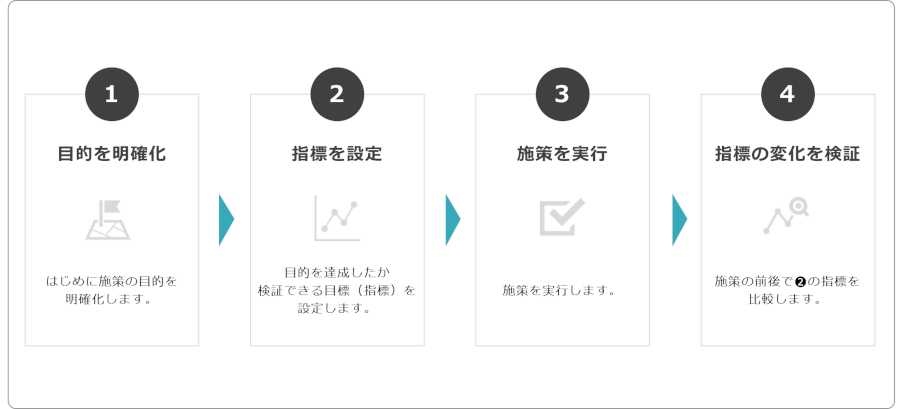
1-2. How to Collect Data (Quantitative and Qualitative)
There are two types of data to be verified in effectiveness measurement: "quantitative" and "qualitative."
・Quantitative data: Data that can be expressed in numbers (e.g., number of accesses, sales amount, test scores)
・Qualitative data: Data that cannot be expressed in numbers, qualitative data (e.g., user feedback, reasons for satisfaction)
Quantitative analysis, which deals with quantitative data, and qualitative analysis, which deals with qualitative data, each have the following characteristics.
| Item | Quantitative Analysis | Qualitative Analysis |
|---|---|---|
| Benefits | ・Objective evaluation is possible | ・Effective analysis can be performed even with a limited amount of data |
| Disadvantages | A certain amount of consolidated data is required | Since there are no clear evaluation criteria, there is a possibility of subjective evaluation |
| Examples of analysis methods | ・Google Analytics | ・Interviews |
2. Manuals Are Difficult to Measure Effectiveness by Access Numbers
Unlike websites and advertisements, manuals have a limited number of readers, so it is difficult to judge their effectiveness based solely on access numbers. Furthermore, numerical data alone cannot capture the background of issues or reader satisfaction.
3. Manual Effectiveness Measurement Methods Possible Even with Few Data
Even with a small amount of data (number of readers), it is possible to measure effectiveness using the following methods.
3-1. Questionnaire Survey
Conduct surveys for the manual's readers and verify the effectiveness based on the survey results. Using survey creation and analysis tools equipped with the following features can also streamline the process.
・Creation of survey forms on the web
・Responding to surveys on the web
・Aggregation and graphing of survey response results
3-2. Usability Test
Decide in advance the parts to be tested, and have readers perform operations according to the manual's instructions. Hear from readers about points that are difficult to understand or where they stumble, and identify issues within the manual. This method has the advantage of easily uncovering problems from the reader's perspective that the manual creators might not notice.
3-3. Comparison of the Number of Inquiries from Readers and the Working Hours for Inquiry Responses
We examine how the number of inquiries from readers and the time spent handling inquiries have changed before and after the manual improvements. This method allows you to verify the effectiveness with numerical data. Based on the verification results, by formulating hypotheses and conducting surveys, you can delve deeper into the background of the issues and link them to the next measures.
4. Case Studies Related to Effect Measurement
We introduce cases where effectiveness was measured based on the time spent on escalations and the number of incoming calls at call centers.
Case Study ②: Reducing Call Volume to the Call Center by Improving the Usability of the Operation Manual
At Human Science, we can support everything from considering indicators for effectiveness measurement to implementation, tailored to your challenges and objectives.
5. For Consultations on Manual Creation, Effect Measurement, and Improvement, Contact Human Science
Human Science also has experience in surveys and usability tests that are not included in the case studies. If you have needs like the following, please feel free to consult with Human Science.
・Want to identify issues with manuals
・Want to request a one-stop service from manual improvement to post-improvement effect measurement and analysis

>>Related Links
Manual Evaluation, Analysis, and Improvement Proposal Service
Manual Creation Outsourcing Service





























































 Business Manual
 Operation Manual
 Manual creation
 Web Manual
 Director, Writer
 In-house Support
 Video
Video Manual
 Manual Creation
 One-Stop Service for Manual Creation
 Manuals and Documents
 Document Solutions for IT Companies
 Improving Manual UX through UX Writing
 Knowledge Management
 Jamstack
 GitHub/Markdown
 Return to the top of the page

 +81 35-321-3111[Tokyo Headquarters]
  Contact Us
 Resources