


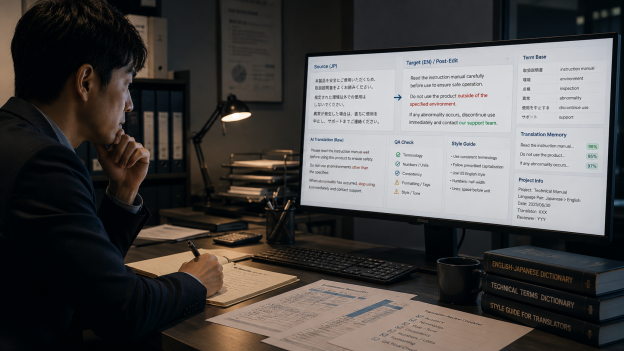
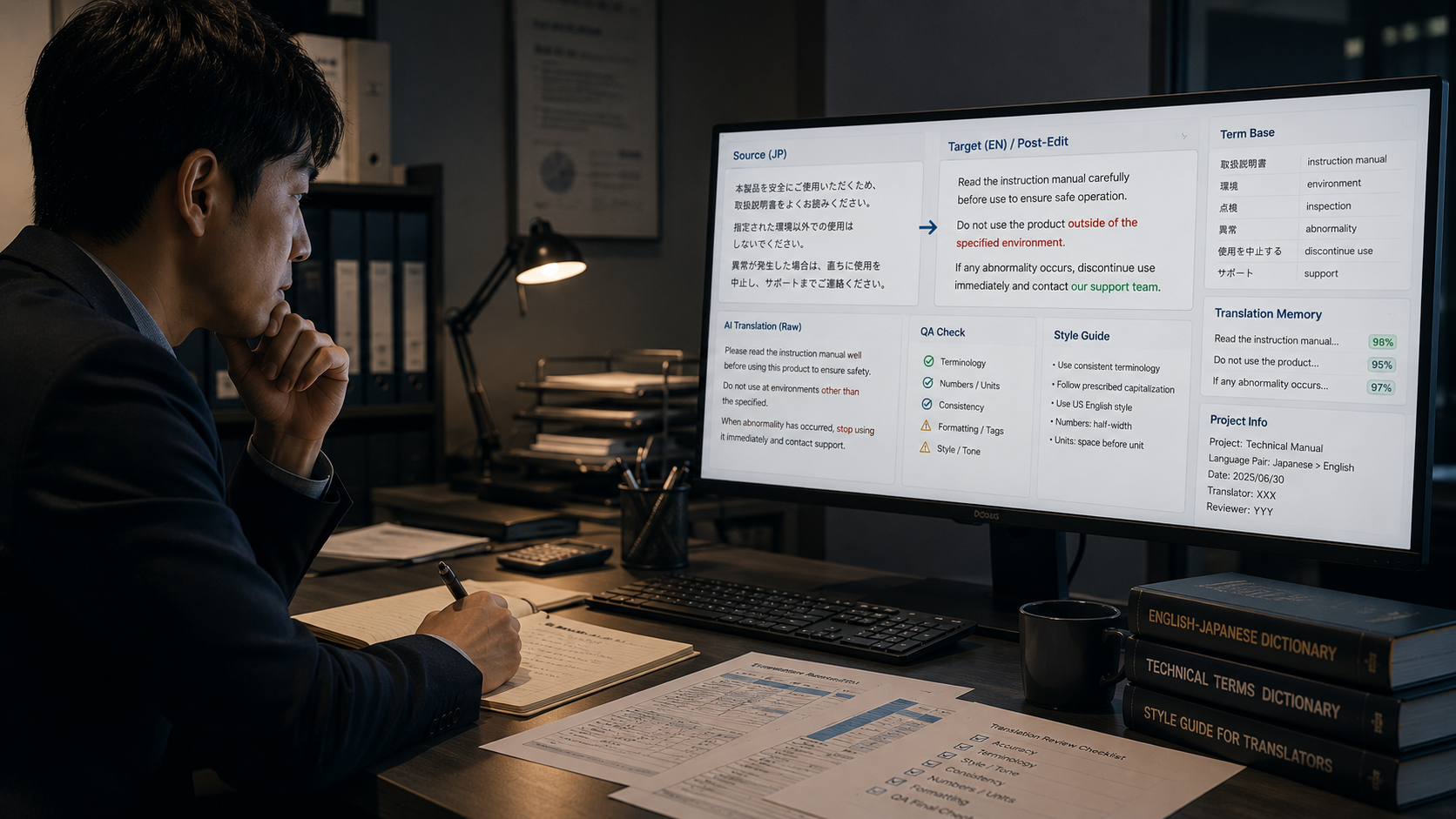
The evolution of AI translation and neural machine translation has significantly changed the environment surrounding translation in recent years. So, what roles will translators be expected to play in the field of Japanese-English translation going forward? Until now, the main skills required of Japanese-English translators have been "accurately understanding the gist and intent of the original text and translating it into natural and accurate English" and "translating in accordance with the style and rules specific to the field." In other words, the ability to construct natural English by selecting appropriate expressions based on the Japanese original text has been emphasized.
However, with the widespread use and improved accuracy of machine translation, this premise is gradually changing. Nowadays, there are increasing cases where translators not only create translations from scratch but also revise and adjust outputs based on machine translation.
Along with these changes, Japanese-English translators are increasingly required not only to play the role of "translators" but also to take on the role of "reviewers who ensure quality."
Therefore, it is more natural to view this as a change in the skills required rather than a disappearance of demand for Japanese-English translators.
This article organizes and introduces four core skills that have become increasingly important in the current Japanese-English translation field, taking these changes into account.
Table of Contents
1. Ability to Adapt to Client-Specific Styles and Rules
The ability to correctly understand the terminology, notation rules, and writing style established by each client, and to create translations accordingly.
In Japanese-to-English translation, simply matching the meaning is not enough.
In addition to being natural English, it is also important to ensure consistency of expression and proper adherence to the style and rules required by the client.
Therefore, it is required to unify not only the use of translation memories and term bases but also the finer details such as capitalization, the presence or absence of hyphens, term distinctions, and the tone of the writing style.
In particular, the importance of this adaptability increases even more when working with machine translation.
Although the output of machine translation may appear natural at first glance, terminology and style tend to vary, so it is necessary to adjust the text to achieve overall consistency in English.
Also, depending on the client, consistency with their unique style and existing documents may take precedence over naturalness as general English.
In such cases, it is important to unify expressions according to the client’s rules and preferences rather than optimizing expressions based on the translator’s personal sense.
Related Blog Posts
2. Inquiry and Handover Skills (Communication Skills)
It is the ability not only to accurately inquire about unclear points without leaving them ambiguous but also to clearly communicate your own judgments and points of caution.
In practical Japanese-to-English translation work, it is not uncommon for the Japanese source text to contain ambiguous expressions, errors, or inconsistencies.
In many cases, it is difficult to produce an accurate English translation as is, so when noticing any awkwardness or unclear points, it is necessary to organize what causes them and respond accordingly.
What is especially important is to properly verbalize the decision-making process and share it as a handover.
Rather than simply asking questions, clearly indicating "where the problem lies, how it was interpreted, and how it was addressed" makes it easier for stakeholders to make decisions.
The following is an example of a handover to the client.
| Source | When connecting the connector, please be careful of pushing it incorrectly. |
|---|---|
| Translation | When connecting the connector, be careful not to insert it into the wrong slot. |
| Details of the Handover | Regarding the original term "pressing error," we have interpreted it to mean "incorrect insertion." Please confirm if this interpretation is acceptable. |
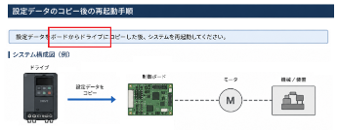
| Source | After copying the configuration data from the board to the drive, please restart the system. |
|---|---|
| Translation | After copying the configuration data from the drive to the board, restart the system. |
| Details of the Handover | The original text states "from the board to the drive," but based on the relevant images and the situation, we have interpreted it to mean "from the drive to the board" and translated it accordingly. Please confirm if this is acceptable. For the relevant section, please refer to the screenshot below. |
 |
* In technical manuals, it is common for the original text to be created by partially modifying similar sentences, which can lead to errors or inconsistencies in the original text as shown above due to overlooked corrections. Therefore, it is important to be mindful of such issues on the source side when translating.
Such accurate handovers prevent misunderstandings in subsequent processes and contribute to the stability of the final quality.
3. Post-Editing Capability (Light & Full)
As translation workflows based on machine translation become more common, the importance of post-editing is increasing.
In Japanese-to-English translation as well, cases where work is carried out based on AI and machine translation outputs are increasing, making it one of the fundamental skills today.
Post-editing can be broadly divided into two types: "light" and "full."
In light post-editing, the focus is on correcting mistranslations, ensuring accuracy of meaning, and improving clearly unnatural expressions—essentially addressing parts that significantly affect readability and accuracy.
On the other hand, full post-editing requires unifying terminology and style, as well as enhancing the naturalness and readability of the text, bringing it to a level where the final deliverable is free of issues.
At first glance, full post-editing may seem more difficult, but in practice, there are often more situations where light post-editing causes uncertainty in judgment.
This is because there is always a need to draw the line on "how far to make corrections."
The more accustomed you are to English, the more you may feel "I want to make this a bit more natural" or "Shouldn't this be corrected?"
However, with light post-editing, it is important to avoid making unnecessary changes and to keep corrections to a minimum.
In other words, not only the ability to determine "what to correct" but also the ability to discern "what to deliberately leave uncorrected" is required.
Additionally, in Japanese-English translation, it is essential to appropriately supplement and adjust omissions of subjects, lack of information, and ambiguous expressions unique to Japanese according to the context.
It is required not just to tidy up the output of machine translation, but to accurately grasp the original intent and produce a form that is natural and accurate in English.
Related Blog Posts
4. Review and QA Capability
The ability to accurately detect errors, inconsistencies, and potential risks in the translation and ensure quality.
As the use of machine translation expands, there are increasing cases where clients create translations using AI and machine translation.
On the other hand, due to concerns about quality, there is also a trend to outsource review and QA processes externally.
Against this backdrop, the importance of the quality assurance process has increased more than ever before.
Therefore, in addition to human review, it is required to efficiently and comprehensively perform checks while appropriately utilizing QA tools.
QA tools such as Xbench and QA Distiller can efficiently perform mechanical checks for inconsistencies in numbers and terminology, as well as tag deficiencies. On the other hand, errors dependent on context, unnatural expressions, and misunderstandings of meaning can only be judged by human eyes. (In recent years, detection using proofreading tools that leverage LLMs has been progressing, but final judgment still requires human verification.)
Related Blog Posts
5. Summary
With the spread of AI translation and machine translation, the role required of Japanese-English translators has expanded from "translating" to "managing the overall quality of the translated text."
From now on, in addition to English proficiency, the ability to properly control quality and consistency through adherence to client-specific rules, appropriate inquiries and handovers, post-editing, review, and QA will become increasingly important.
In Japanese-English translation, it is essential not only to correctly interpret the unique ambiguities and context of Japanese but also to notice errors and inconsistencies in the source text and exercise judgment to refine it into natural and accurate English based on the intended meaning.
Going forward, in a translation environment premised on AI, the ability to consistently control quality while considering the original intent and client requirements will become one of the important values as a translator.
>>Related Services
Translation and Localization Services















 Return to the top of the page

 +81 35-321-3111[Tokyo Headquarters]
  Contact Us
 Request for Information