


For companies advancing global expansion, translation work is one of the indispensable business activities. Documents requiring translation are diverse, including product manuals, technical specifications, contracts, marketing materials, and internal training materials, and the number of languages to be handled is increasing year by year.
However, what many companies face daily is not simply the problem of "not being able to find good translators." The methods differ every time from translation request to delivery, terminology varies by department, quality checks are concentrated on specific personnel, and although AI translation has been introduced, its effectiveness is not visible. These issues scattered throughout the entire workflow, which exist before even considering "translation quality," are the real causes lowering the productivity of translation work.
This article systematically organizes common challenges in in-house translation work, presents solutions, and explains why the approach of having a translation company’s project manager (PM) stationed within the company is effective. At the end of the article, we also introduce the on-site translation PM service provided by Human Science Co., Ltd.
- Table of Contents
1. Situations in Which Companies Require Translation

First, let’s organize the types of business operations within companies where translation occurs.
Product and Technical Documents
Operation manuals, user guides, technical specifications, online help, and similar documents are essential for translating when expanding products into overseas markets. Compliance with international standards such as IEC/IEEE 82079-1 is often required, necessitating not only linguistic accuracy but also expressions and structures that conform to these standards. Additionally, the translation of software UI (user interface) text and e-learning materials is an indispensable element for the global expansion of products.
Business and Legal Documents
Translations of documents related to legal affairs and management, such as contracts, terms of use, NDAs (Non-Disclosure Agreements), IR materials, financial reports, and M&A-related due diligence documents, also frequently occur. Since the accuracy of these translations directly impacts business risks, it is essential that translators with specialized knowledge handle them.
Marketing & Sales
Translations in the marketing field, such as websites, product catalogs, press releases, white papers, advertising copy, and social media content, require more than just "accuracy." They demand a transcreation approach (translation combined with copywriting) that reconstructs expressions to encourage reader action, taking into account the culture and business customs of the target market.
Manufacturing/Quality Management
Documents related to manufacturing sites, such as quality management documents (QMS), ISO-related documents, safety data sheets (SDS), and standard operating procedures (SOP), are also subject to translation. This includes technical instruction manuals for overseas factories and technical communication documents with overseas suppliers. Accurate translation is directly linked to safety and quality, requiring a high level of expertise.
Internal Communication and Training
Training materials, e-learning content, multilingual internal portals, notifications and guidelines for overseas offices are also situations where translation is necessary. In companies with global locations, the volume of translations for internal communication can sometimes be comparable to that of external documents.
2. Six Challenges Faced by In-house Translation Operations

With such a wide range of situations requiring translation, the challenges many companies face lie not so much in the "quality of translation" itself, but in the entire workflow surrounding translation. Here, we highlight six representative challenges.
The translation ordering process is not standardized
The departments requiring translation span a wide range, including development, legal, marketing, and quality control. However, when each department requests translations in its own unique way, the criteria for "what," "by when," and "at what quality level" the translation should be done tend to become unclear.
If the procedures differ with each order, there is no reproducibility, and know-how is lost every time the person in charge is transferred. Responses to urgent cases also become ad hoc, causing unnecessary lead time from obtaining estimates to starting translation. This also leads to the problem of being unable to justify translation costs within the company.
Lack of Consistency in Terminology and Expressions
There are many expressions that companies need to unify, such as product names, technical terms, and brand messages. However, it is not uncommon for terminology glossaries or style guides to be either undeveloped or, even if developed, not updated in a timely manner.
If different translation companies are used for each department, this problem becomes even more serious. Even for explanations of the same product, if the translated terms differ from document to document, it can confuse customers and cause damage to the brand's credibility.
Quality management is personalized
There are many cases where translation quality reviews rely on specific personnel within the company. When that person becomes busy, reviews get delayed, affecting delivery deadlines. If the review criteria are left to individual judgment, quality varies and the feedback content is inconsistent.
If post-translation feedback is not properly shared with translators, the same issues will be repeated, preventing the quality improvement cycle from progressing. This is a significant loss for both companies and translation agencies.
Translation assets are not being accumulated or utilized
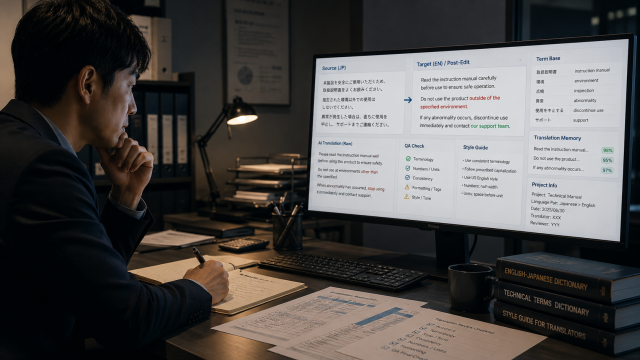
Translation memories (TM) and term bases (TB) are important translation assets that enable the reuse of past translation results, simultaneously improving quality and efficiency. However, in reality, surprisingly few companies strategically build and manage these assets.
If translation memories are not properly maintained, even previously translated sentences must be translated from scratch each time, resulting in wasted costs and time. The efficiency of differential translation accompanying product version upgrades also significantly decreases.
Slow progress or lack of results in AI translation implementation
The accuracy of AI translation (machine translation) has rapidly improved in recent years, and many companies are considering its adoption. However, if implementation is driven solely by the expectation that "AI translation will reduce costs," there are many cases where the anticipated benefits are not realized.
There are limited situations where AI translation output can be used directly as business documents, and in many cases, post-editing (manual correction) is indispensable. How to set quality standards for post-editing, who is responsible, which documents should use AI translation, and which should be entrusted to professional translators—if such operational design is not established, it can actually increase the burden on the field.
Concerns about Handling Confidential Information and Security
Documents requiring translation often include highly confidential materials such as specifications for unreleased products, M&A-related documents, and technical papers prior to patent applications. When using cloud-based AI translation services, it is essential to carefully verify how input data is handled.
In environments that require advanced security, it can be difficult to send documents outside the company itself, which can lead to a vicious cycle where the efficiency of translation work does not improve.
3. Approaches to Solving Issues in the Translation Workflow

None of these issues can be resolved solely by introducing tools or changing translation vendors. It is necessary to review the entire translation workflow and improve it as a process. Here, we introduce specific approaches to solving these problems.
Establishment of Translation Order Guidelines
The first step is to standardize the internal translation ordering process. By defining quality levels for each type of document (for publication, internal reference, overview understanding, etc.) and matching each with the appropriate translation method (professional translation, AI translation + post-editing, AI translation only), you can optimize the balance between cost and quality. Clearly specifying "by when," "who," and "through which route" the request should be made ensures reproducibility of orders and creates a system where work continues smoothly even if the person in charge changes.
Glossary and Style Guide Development and Continuous Operation
Glossaries and style guides are the foundation of translation quality. It is important to establish an operational system that continuously updates them in line with new product releases and organizational changes, rather than creating them once and ending there. Integrating with translation support tools (CAT tools) to enable translators to refer to them in real time during their work is also effective.
Systematization of Quality Management Processes
It is necessary to build quality management as an organizational system rather than relying on specific individuals. Effective measures include formalizing review criteria, establishing a multiple-reviewer system, and creating a database of feedback content. By establishing a feedback loop to translators, repeated issues can be prevented, and quality can be continuously improved.
Strategic Construction of Translation Assets
It is important to position translation memories and glossaries as "intellectual assets of the company" and to build and maintain them systematically. By organizing past translation data and incorporating it into the translation memory, the reuse rate of similar sentences increases, enabling simultaneous reduction of translation costs and stabilization of quality.
Proper Implementation Design of AI Translation
The introduction of AI translation hinges not only on tool selection but also on operational design. Deciding which document types to apply AI translation to, how to set quality standards for post-editing, and how to evaluate and improve the output quality of AI translation—by planning these designs in advance, you can maximize the benefits of implementation.
Establishment of a Security System
In translation processes handling confidential documents, it is necessary to establish information management mechanisms such as NDA management, setting access permissions, and working within an internal security environment. It is also essential to review the data handling policies of AI translation services and verify their consistency with your company's security policies.
4. Why “On-site Translation PM” Can Solve These Challenges

When trying to implement these solutions using only internal resources, it is often the case that there is a lack of the specialized knowledge required for designing the translation process and selecting tools, or that improvement activities are postponed due to being overwhelmed with daily tasks. Therefore, the recommended approach is to have a project manager (PM) from a translation company stationed within the company. By having a translation professional embedded in the internal work environment, many benefits can be realized that cannot be obtained through outsourcing alone.
Translation design based on a deep understanding of internal context
The resident PM absorbs the context such as product development status, business strategy, internal terminology, and organizational culture daily through internal meetings and routine interactions. Since they grasp the background even before translation requests arise, there is no need to ask each time "why this document is being translated," "who will read it," or "what quality level is required." This depth of understanding enhances the accuracy of briefings to translators and directly leads to improved translation quality.
Significant Reduction in Communication Costs
Usually, translation requests go through multiple stages of transmission: "In-house staff → translation company sales → PM → translator." It is not uncommon for information to degrade or for misunderstandings to occur during this process. With an on-site PM, the requester’s intent is conveyed directly to the PM, effectively eliminating miscommunication caused by a game of telephone. Sudden translation needs can be addressed on the spot, and the lead time from estimate to start is greatly shortened.
Standardization of Workflows and Continuous Improvement
A resident PM can closely observe internal business flows and collaboratively establish translation order rules, quality standards, and deadline-setting guidelines with the company. Accessing the "tacit knowledge" within the company, which is difficult for an external PM to see, is a major advantage unique to having a resident PM.
The creation and updating of glossaries and translation memories can be carried out promptly based on the latest internal information, ensuring that translation assets are always up-to-date and continue to function as "living assets."
Process-based Quality Management
The resident PM can analyze feedback from internal reviewers immediately after translation delivery and quickly reflect it in instructions to translators. By shortening the quality improvement cycle, repeated occurrences of the same issues can be eliminated. Establishing a system to measure and report translation quality using objective indicators evolves quality management from a subjective practice to a process-based one.
Support for AI Translation and Tool Implementation
For companies considering the introduction of AI translation or CAT tools, an on-site PM serves as a bridge, combining technical expertise from the translation company side with deep familiarity of the internal IT environment and business workflows. From tool selection to operational design and the establishment of a post-editing system, it is possible to proceed with phased implementation while taking the company's actual situation into account.
Strengthening Confidential Information Management
By having the on-site PM work within the company’s security environment, the risk of taking confidential documents outside the company can be avoided. The PM acts as the point of contact and controls the scope of external parties who have access to confidential information to the minimum necessary, which also leads to better NDA management and reduced risk of information leaks.
Cost Visualization and Optimal Allocation
The on-site PM comprehensively understands the volume of translation orders, unit prices, and quality levels, enabling precise selection of translation methods according to the importance of documents and achieving optimal cost allocation. Visualizing translation costs based on data and reporting to fulfill accountability within the company is also an important role of the on-site PM.
5. Human Science, Inc.'s On-site Translation PM Service

Since its founding in 1985, Human Science Co., Ltd. has provided a wide range of services in the field of technical communication, including manual production, translation and localization, and e-learning development. Since starting its translation services in 1994, the company has accumulated over 20,000 translation projects spanning more than 30 years. With a track record of working with major domestic and global companies such as Apple, Microsoft, Mitsubishi Electric, and Canon, Human Science delivers high-quality translations primarily in the IT, manufacturing, pharmaceutical, and medical device sectors.
Overview of the On-site PM Service
Human Science provides a service where translation project managers and multilingual translation coordinators/directors are stationed within the client's company to support the optimization of the entire translation workflow. The on-site PM is not just a translation contact point but a partner who transforms the client's translation operations from within.
The biggest difference from typical temporary staffing is that behind the on-site staff stands Human Science’s production department as a technical team. This system allows us to provide not only the individual skills of the on-site staff but also the know-how and latest translation technologies that Human Science has cultivated as an organization to our clients.
Tasks Handled by the Resident PM
・Design and Standardization of the Translation Process: From creating order guidelines, setting quality standards, to building workflows, we design everything from scratch tailored to the client's business environment.
・Construction and Operation of Glossaries and Translation Memories: We organize and utilize past translation assets and establish a continuous maintenance system.
・Direction and Coordination of Multilingual Translation: Managing the entire translation project process including selecting and instructing translators, schedule management, quality checks, and layout verification after DTP.
・Support for Introduction of AI Translation and CAT Tools: We provide hands-on support from the introduction to operational design of AI translation tools such as "MTrans Team" and "MTrans for Office," as well as translation support tools like Trados and Phrase.
・Establishment of Quality Management System: Based on project management methods compliant with PMBOK, we realize stable quality control that eliminates dependence on individual skills.
Customer Feedback
We have received the following feedback from customers who are actually using Human Science's on-site PM service.
[Major Medical Device Manufacturer] 25-Language Manual Production Project
"We have been provided with translation coordinators and layout checkers for 25 languages. Even when multiple product development lines run concurrently, by utilizing Human Science as a backstage support, we can place all requests collectively, which helps us focus on our core tasks."
[Major Electronics Manufacturer] Multilingual Manual Production Project
"In order to establish a production system that works with strict confidentiality, we had a translation coordinator dispatched to our office. Originally, we wanted to outsource the work on a contract basis, but due to the high level of security required, we were unable to outsource it externally. By having a translation coordinator from Human Science stationed here, we were able to leverage their many years of experience to smoothly proceed with the production of multiple lines."
[Data Analysis & Analytics Software Company] Web Marketing Localization
"They are exclusively responsible for coordinating and managing all web-related translation projects across APAC. They handle a wide range of tasks including managing translations with external companies, copywriting, SEO measures, updating the glossary, and supporting the implementation of translation systems. They have now become an indispensable presence for our company."
6. Summary
The challenges of in-house translation work extend beyond the quality of the translations themselves to include unestablished ordering processes, inconsistent terminology, reliance on individual quality control, underutilization of translation assets, insufficient operational design for AI translation, and security concerns, spreading throughout the entire workflow.
Rather than addressing these issues individually, taking an overarching view of the entire translation process and improving it is the shortcut to a fundamental solution. The approach of having a project manager from the translation company stationed in-house integrates translation expertise and the internal business context within a single professional, enabling comprehensive resolution of these challenges.
If you are facing challenges in streamlining translation operations, improving quality, or enhancing workflows, please do not hesitate to consult Human Science. We will propose the optimal system tailored to your situation.
















 Return to the top of the page
 +81 35-321-3111[Tokyo Headquarters]
  Contact Us
 Request for Information