


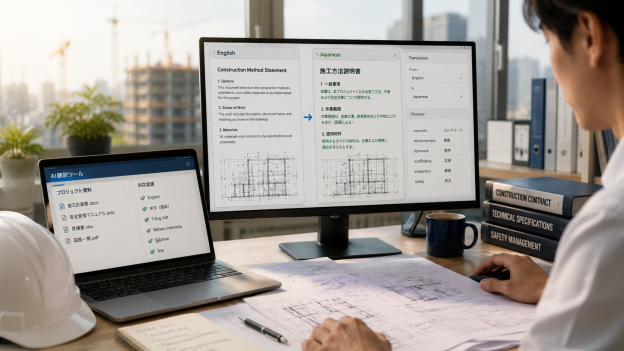
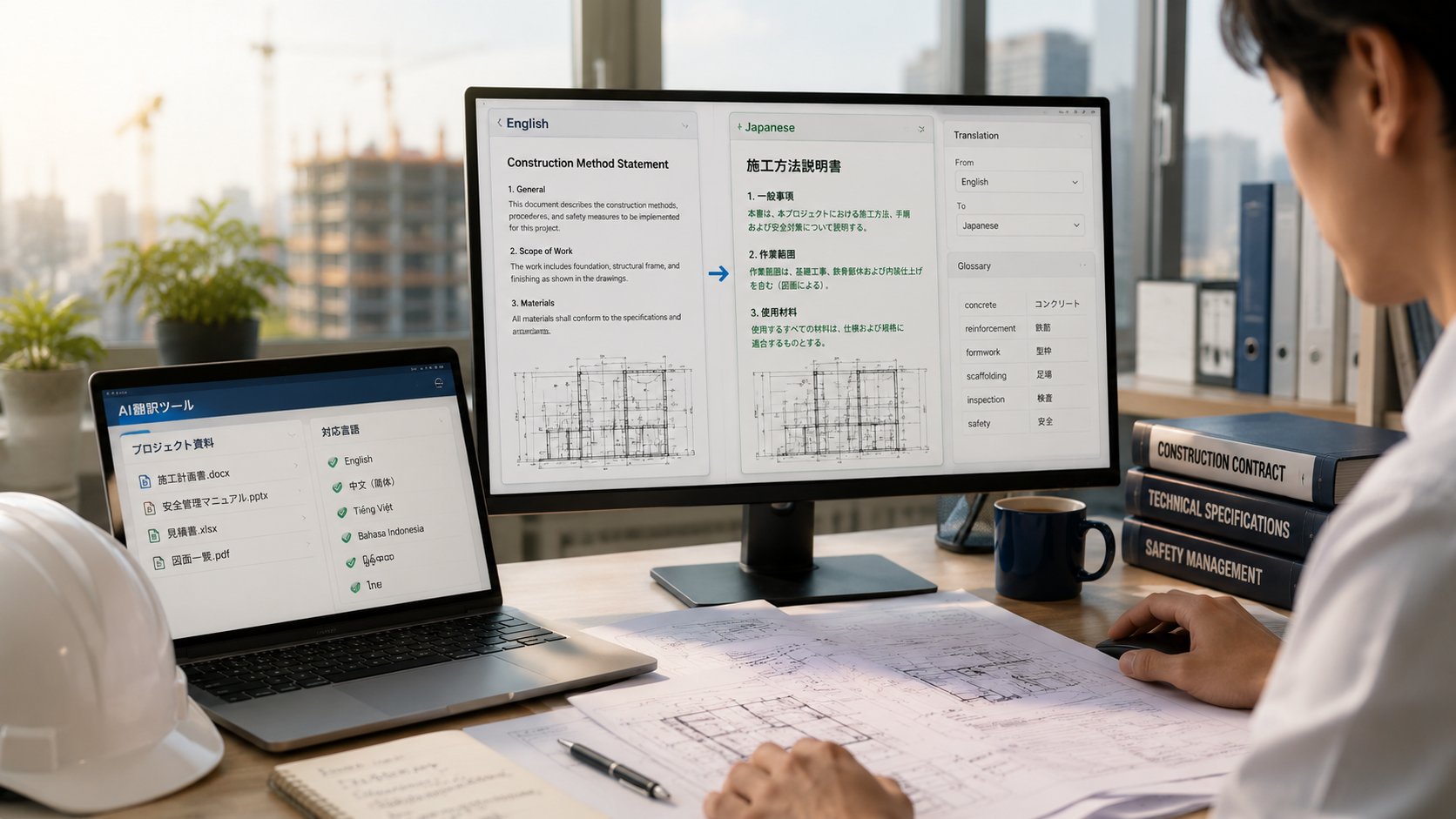
The construction industry is currently globalizing at an unprecedented speed. Under the government's infrastructure system overseas expansion strategy, Japanese construction companies are expanding their participation in overseas projects, mainly in Asia and Africa. Looking domestically, the acceptance of foreign personnel such as technical intern trainees and specified skilled workers is rapidly increasing, and the multinationalization of construction sites is accelerating year by year.
Along with these changes, the demand for translation in the construction industry is rapidly expanding both in volume and number of languages. There are a wide range of situations requiring translation, from the field to management levels, including English translations of bidding documents and construction plans, translations of safety manuals into Vietnamese and Burmese, and exchanges of contracts and technical documents with overseas partners.
However, outsourcing translation every time incurs both cost and time, and there is a risk that work sites may come to a halt waiting for translations each time there is a design change. This article systematically organizes the translation needs in the construction industry and introduces efficient solutions utilizing AI translation tools.
Table of Contents
- 1. Three Situations Where Translation Is Needed in the Construction Industry
- 2. Unique Challenges of Translation in the Construction Industry
- 3. Solving Construction Industry Translation Challenges with AI Translation Tools
- 4. The Optimal AI Translation Tool for Construction Industry Translation: "MTrans for Office"
- 5. Use Cases of MTrans for Office in the Construction Industry
- 6. Points to Note When Introducing AI Translation Tools
- 7. Summary
1. Three Situations Where Translation Is Needed in the Construction Industry
Translation needs in the construction industry arise mainly from three backgrounds. The types of documents required, languages, and quality levels differ in each situation.
Participation in Overseas Projects and Infrastructure Export
For Japanese construction companies to secure and execute overseas projects, it is necessary to translate a large volume of documents into the local language or English. In ODA (Official Development Assistance) projects and international bids, it is assumed that bidding documents, proposals, and estimates are prepared in English. Since international contract formats, including the FIDIC conditions, are used in construction contracts, it is required to distinguish the translation of legal expressions such as "shall," "should," and "may." High accuracy is essential because mistranslations can directly lead to contract disputes.
In the design and construction phases, translation of technical documents such as architectural specifications, construction plans, structural calculation reports, and environmental impact assessment reports occurs. Translation of text included in drawings is also necessary, and attention must be paid to unit conversions between the metric system and the yard-pound system, as well as differences in decimal point and digit grouping notation rules.
In addition, translations of brochures for overseas exhibitions, building material catalogs, and company introduction materials (Company Profile) frequently occur. The main target languages are English, Chinese, French, Arabic, Spanish, and others.
Related blog: How to translate contracts? Explanation of points to note during translation and methods to improve accuracy!
Acceptance of Foreign Workers (Multilingual Support at Domestic Sites)
The number of foreign workers in the construction industry has surged in recent years, making multilingual support an urgent issue directly linked to "safety management." The Ministry of Health, Labour and Welfare is also strengthening measures as a nation, such as preparing safety and health educational materials in 11 languages for foreign workers engaged in construction.
The most critical documents are safety management documents. Safety manuals, site rules, emergency response manuals, KY (Hazard Prediction) activity sheets, evacuation route maps, and the like must be provided in languages that foreign workers can fully understand. According to estimates by the U.S. Occupational Safety and Health Administration (OSHA), language barriers contribute to about 25% of labor accidents at construction sites, making the translation of safety documents a matter of life and death.
In addition to safety documents, translations are also required for labor contracts, work regulations, explanatory materials on social insurance and residence status, skill training texts (forklift, sling work, crane, etc.), morning meeting materials, work instructions, daily reports, and other documents related to daily operations.
The target languages mainly include Southeast Asian and South Asian languages other than English, such as Vietnamese, Chinese, Burmese, Filipino (Tagalog), Indonesian, Nepali, Thai, Cambodian, and Mongolian.
Collaboration with Overseas Companies and Import/Export of Materials
In collaboration with overseas general contractors and suppliers, translations of joint venture agreements (JV Agreement), procurement contracts, quality inspection reports, customs documents, and the like are required. Translations of construction material and equipment manuals, as well as Safety Data Sheets (SDS), are also necessary. During project progress, continuous translation of construction progress reports, meeting minutes, design change notifications, and claim response documents is also demanded.
2. Unique Challenges of Translation in the Construction Industry
Translation in the construction industry has unique difficulties not found in other industries. Here, we address six challenges that tend to be particularly problematic on site.
Mistranslations directly impact safety and quality
Translation in the construction industry differs from other industries in that the risk of mistranslation directly leads to physical damage. For example, mistranslating the tightening torque values can result in insufficient bolt strength, and mistranslating safety manuals increases the risk of occupational accidents. Translation accuracy must be managed at the same level as quality control and safety management.
Industry-Specific Terminology in Construction
The construction industry has many unique technical terms. Terms such as "Neko" (wheelbarrow), "Asagao" (fall prevention net), and "Manju" (mortar) are commonly used on site but are not found in general dictionaries. Accurately translating these terms requires a translation system well-versed in the industry, along with properly maintained glossaries integrated into translation tools.
Primarily multilingual and non-English languages
Translations for foreign workers require handling languages for which securing translation resources is difficult, such as Vietnamese, Burmese, and Nepali. Two-step translation via English (Japanese → English → Vietnamese) tends to degrade quality, so direct translation is preferred whenever possible.
Translation cannot keep up with the pace on site
Design changes and changes to work instructions frequently occur at construction sites. Each time, outsourcing the translation and waiting for delivery causes a delay of one to two days in sharing information on site. This delay not only leads to schedule setbacks but also poses safety risks.
Differences in Building Standards and Regulations by Country
In overseas projects, it is necessary to create documents that comply with different building standards and regulations depending on the country or region, such as JIS (Japanese Industrial Standards), ASTM (American Society for Testing and Materials standards), and EN (European standards). This requires not just language conversion but also adaptation to terminology and notation in accordance with the standards.
Concerns about Security
Documents requiring translation in the construction industry, such as structural calculation reports, bidding documents, contracts, and construction drawings, often contain highly confidential information. When using free online translation tools, there is a risk that input data may be reused, making them unsuitable for translating confidential documents.
3. Solving Construction Industry Translation Challenges with AI Translation Tools
Many of the challenges mentioned in the previous chapter can be significantly improved by breaking away from reliance on outsourcing translation and establishing an environment where translations can be done quickly and securely in-house. Thanks to recent advances in AI translation technology, the accuracy of business document translations has improved dramatically, and by combining appropriate tools with operational design, it is possible to streamline translation tasks in the construction industry.
However, when introducing AI translation tools, it is important to select tools that meet the specific requirements of the construction industry. Specifically, the following points serve as the selection criteria.
Ability to translate within the tools you normally use
Translation needs in the construction industry mainly involve Microsoft Office documents such as construction plans (Word), schedules and estimates (Excel), presentation materials (PowerPoint), and emails with overseas partners (Outlook). It is inefficient to open a separate tool just for translation and copy & paste text. Ideally, the tool should allow translation directly within the Office applications you regularly use.
Maintaining layout integrity
Construction plans and bidding documents contain complex formatting such as tables, diagrams, headings, bold text, and font colors. If the layout collapses after translation, significant time is required to readjust the formatting. The ability to translate while preserving the original layout and formatting greatly impacts work efficiency.
Ability to accurately translate technical terms
To accurately translate industry-specific terms, company product names, and project-specific abbreviations in the construction industry, a glossary function is essential. By pre-registering terms, the AI translation engine can generate translations that correctly reflect the technical terminology.
Security is ensured
Since confidential documents such as bid documents, contracts, and structural calculation reports are translated, it is essential to have a system that prevents translation data from being disclosed or shared externally. Key points to meet the construction industry's security requirements include ensuring no secondary use of translation data via API connections and supporting SSO (Single Sign-On) and IP address restrictions.
Support for multiple languages
In the construction industry, it is especially important to support a wide range of languages, not only English, Chinese, and Arabic for overseas projects but also Vietnamese, Burmese, Indonesian, Tagalog, and others for foreign workers.
Ability to compare multiple translation engines
Each translation engine has its strengths and weaknesses. The optimal engine varies depending on the type of document and language pair, such as engines strong in technical documents or those that generate natural writing styles. An ideal environment allows you to compare translations from multiple engines and select the most appropriate one.
Related blog: How accurate is translation with generative AI? Comparing ChatGPT, GNMT, DeepL, ChatGPT, Gemini, and Claude!
4. The Optimal AI Translation Tool for Construction Industry Translation: "MTrans for Office"
The AI translation tool that meets all the requirements for the construction industry is "MTrans for Office" provided by Human Science Co., Ltd. MTrans for Office is an AI translation software that operates as an add-in for Microsoft Office products (Word, Excel, PowerPoint, Outlook). You can execute translations with a single click directly from the Office applications you normally use.
Translate with one click, reducing workload by 30–45%
MTrans for Office operates as a plugin within Office applications, so there is no need to "open translation software," "copy and paste text," or "drag and drop files." Translation is completed with a single button, reducing translation workload by 30–45% (verified by Human Science Co., Ltd.).
You can complete everyday construction industry translation tasks within Office, such as translating Word files of construction plans while keeping them open, translating Excel schedules, and translating emails to overseas partners directly in Outlook.
Maintain layout and formatting as is
The original document's layout, structure, font size, bolding, and text color formatting are all preserved after translation. Even for documents where formatting is crucial, such as bidding documents and construction plans, there is no need to manually adjust the layout after translation.
Selectable and comparable from four translation engines
Equipped with four translation engines—DeepL, Google, Microsoft, and OpenAI—you can select the optimal engine according to the type of work or document. Switching engines is done with a single click, and it is also possible to display and compare translations from multiple engines simultaneously. For example, you can easily use Google for technical documents and OpenAI for marketing materials, allowing for convenient usage tailored to your needs.
Accurately translate technical terms with the glossary feature
By pre-registering industry-specific terms, proprietary product names, project names, and more in the glossary, the AI translation engine generates translations using the specified terms. This ensures consistency in terminology, so that "wheelbarrow" is correctly translated as "wheelbarrow" and "morning glory" as "protective canopy."
Supports 34 languages to accommodate multinational sites
MTrans for Office supports 34 languages. It covers a wide range of key languages required in the construction industry, including English, Chinese, Arabic, and French for overseas projects, as well as Vietnamese, Indonesian, Thai, and Portuguese for foreign workers.
Reliable security
MTrans for Office communicates with translation engines via API connection, so translation data is never disclosed or shared externally. Unlike free online translation tools, there is no risk of input data being reused, allowing you to safely translate confidential documents such as bid documents, contracts, and structural calculation reports. It also supports SSO (Single Sign-On) and IP address restrictions, enabling operation in accordance with corporate security policies.
Writing Assistance with OpenAI Integration
In addition to translation, it also features writing assistance functions utilizing OpenAI. You can directly perform tasks such as drafting English emails, summarizing texts, proofreading, and rewriting within Office applications. It contributes to improving work efficiency beyond translation, such as creating report emails for overseas partners and summarizing English reports.
Automatic Translation Style Conversion
It features functions that automatically adjust the document style during translation, such as unifying full-width and half-width characters, unifying punctuation marks, and automatically converting from polite form (desu/masu) to plain form (da/dearu). You can easily switch styles, for example, using plain form for technical documents and polite form for customer-facing materials.

5. Use Cases of MTrans for Office in the Construction Industry
We introduce specific scenarios on how MTrans for Office can be utilized at construction sites.
Overseas Bidding and Contracting Operations
You can draft bidding documents and proposals in Word while checking the English translation with a single click. For contracts compliant with FIDIC conditions, registering legal terms in the glossary ensures consistency in terminology. It is also possible to compare translations from multiple engines and select the best expression.
Multilingual Safety Documents for Foreign Workers
Safety manuals and KY activity sheets can be translated directly in Word and printed as is for posting at the site. Supporting 34 languages, it can instantly translate languages such as Vietnamese and Burmese, which usually take time to outsource to external translation companies. It also allows sharing of design changes and new safety precautions without waiting for translation.
Emails and Reports with Overseas Partners
Since it operates as an add-in for Outlook, you can translate emails with overseas general contractors and suppliers on the spot. Translation of construction progress reports and meeting minutes can also be performed while keeping Excel or Word open. By using OpenAI’s English transcription feature, you can automatically generate a draft of an English email simply by entering the summary of the email in Japanese.
Exhibition and Marketing Materials
You can translate PowerPoint files of building material catalogs and company introduction materials while maintaining the layout. This is highly effective in situations where multilingual materials need to be prepared in a short period, such as for overseas exhibitions.
6. Points to Note When Introducing AI Translation Tools
AI translation is not perfect. To maximize its effectiveness, please keep the following points in mind when using it.
Human review is indispensable
The accuracy of AI translation has improved dramatically, but for documents where mistranslation directly leads to risks, such as contracts and safety manuals, it is recommended to use AI translation output as a draft and have a specialist with expert knowledge perform the final check.
Glossary Maintenance Determines Quality
The quality of AI translation is greatly influenced by the state of glossary maintenance. By registering industry-specific technical terms unique to construction and company-specific terms in the glossary and maintaining it regularly, the accuracy and consistency of translations improve.
Differentiated Use According to Document Importance
It is not necessary to translate all documents using the same process. For internal reference documents, AI translation only; for on-site notices, AI translation plus internal review; for contracts and bidding documents, AI translation plus professional translator review. By selecting translation methods according to the importance of the document, you can optimize the balance between cost and quality.
7. Summary
The translation needs in the construction industry continue to expand in terms of volume, number of languages, and speed, driven by the growth of overseas projects, the increase in foreign workers, and deeper collaboration with overseas partners. On the other hand, there are unique challenges specific to the construction industry, such as the risk of mistranslations directly impacting safety and quality, specialized terminology unique to construction, handling multiple languages including non-English languages, and security requirements.
The AI translation tool "MTrans for Office" addresses these challenges, enabling more efficient translation workflows and cost reduction. With one-click translation within Office applications, layout preservation, four types of translation engines, glossary functionality, support for 34 languages, and reliable security, it meets a wide range of translation needs from construction sites to management levels.
MTrans for Office offers a 14-day free trial. Please feel free to try it first and experience how much it can streamline translation tasks in the construction industry using your actual business documents.





















 Return to the top of the page
 +81 35-321-3111[Tokyo Headquarters]
  Contact Us
 Request for Information