

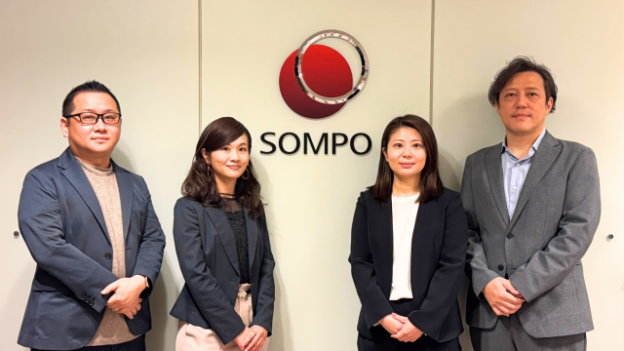

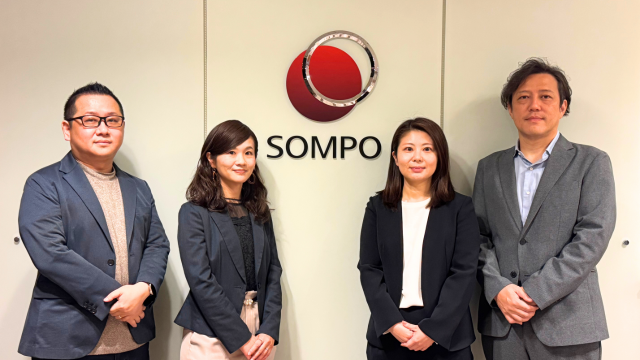
Interview Cooperation:
Sompo Japan Insurance Inc. Claims Service Support Department
Quality and Training Support Group: Mr. Yamamoto, Mr. Mayahara, Mr. Katsumata
Planning Group: Mr. Tsukamoto, Mr. Go
Sompo Japan Insurance Inc.
· Founded: October 1888
· Capital: 167.5 billion yen
· Number of employees: 20,731 (as of April 1, 2025)
· Business description: Non-life insurance business
Services and Initiatives
· Evaluation and analysis of existing manuals, report creation
· Manual system design
· Manual creation outsourcing
· Support for in-house manual creation (guideline and sample manual creation)
Project Overview
Manual Renewal That Began with Analysis Clearly Showing the Post-Improvement State
For the large-scale and complex business manuals of Sompo Japan Insurance Inc. (hereinafter referred to as Sompo Japan), Human Science consistently supported everything from analyzing existing manuals to system design, manual creation outsourcing, and establishing a self-sustaining framework.
Not only organizing the issues but also visualizing the "causes of difficulty in understanding" and the "concrete image after improvement," we realized a manual renewal process that involves the entire company.
Background of Implementation
Limits of In-House Production and the Complexity of Large-Scale Manuals
Sompo Japan utilized an extensive set of operational manuals across a wide range of insurance operations.
Insurance operations require high expertise and accuracy, and since many people across the country are involved in these tasks, manuals are indispensable tools for carrying out operations. However, manuals that have become complex through years of revisions accumulated challenges unique to large-scale and complex operations.
To resolve the issues that on-site users felt were "difficult to search for" and "hard to understand," it was considered meaningless to address only superficial problems such as "organizing hard-to-understand sentences." Instead, it was necessary to take stock of the operations and fundamentally review the structure from the ground up.
Initially, attempts were made to improve the manuals internally, including holding a retreat dedicated to improving the existing manuals. However, due to the enormous volume and the reality that employees who are "professionals in the work" are not necessarily "professionals in manual creation," they felt there were limits to internal improvements. For this reason, while they recognized the need to incorporate the expertise and know-how of external specialists, they also had concerns about outsourcing highly specialized insurance business manuals externally, wondering "to what extent can the complex tasks unique to our industry be understood and organized by an outside party?"
However, in order to see the manual improvement project through to the end, the company decided that it was essential to have external support manage the process rather than handling it concurrently with other duties themselves, and thus the project for manual renewal was launched.
Reasons for Choosing Human Science
Clear proposals that accurately grasp the issues
Among multiple candidates, the reasons for choosing Human Science included “the proposal content was very easy to understand” and “they most accurately grasped our company’s issues and what we wanted to achieve.”
The decisive factor was that the approach, which is not merely outsourcing manual creation but starts with analyzing the current situation and designing the manual systemically, matched the needs of Sompo Japan, which faces complex challenges.
Project Approach
Systematic Manual Renewal Starting with Analysis
① Evaluation and Analysis of Existing Manuals
The project started with evaluating and analyzing the content and structure of the existing manuals.
Human Science visualized the causes of confusion and structural issues in a report, enabling Sompo Japan to clearly understand and share the current situation. A key feature of this analysis report is that it not only organizes the issues but also presents specific improvement examples and explanations on how to address them.
By helping visualize the post-improvement state concretely, it became easier to share the direction for the manual renewal, which also facilitated internal explanations and the involvement of related departments for the next measures.
This analysis report became an important basis for making decisions to determine the direction of the manual renewal.
② Redesign of the Manual System
Based on the analysis results, we completely redesigned the overall structure of the manual from scratch.
We thoroughly examined the vast existing manuals and related materials, conducted a comprehensive inventory of the entire operations, and designed the system including the manual’s hierarchical structure, page layout, and internal publication methods. Additionally, even within a system where different departments are responsible for each type of insurance, we aimed for a structure that facilitates future revisions and maintenance by ensuring consistency in structure and writing style across departments.
③ Manual Creation Outsourcing and Quality Assurance
Initially, we were requested to handle the system design and the creation of guidelines and sample manuals, with plans for internal staff to proceed with writing thereafter. However, after reviewing the analysis report and the quality of the sample manual, it was determined that "reproducing this quality internally would be difficult," leading to an expansion of the scope to include support for manual creation outsourcing as well.
Scope Expansion and Project Impact
The Quality of the Completed Manuals Motivated the Entire Company
Initially limited to certain types of insurance, the scope of manual development expanded as the project progressed.
In addition to the insurance types under the responsibility of the person in charge, it extended to insurance types in other departments, ultimately becoming a large-scale manual renewal project with about 350 volumes and over 1,500 pages.
After seeing the organized manuals, other departments expressed a desire to improve their own manuals using the same system, and the finished product itself became a persuasive factor that motivated the entire company.
Creating a Self-Sustaining System
In this project, we provided guidelines summarizing the manual writing rules, as well as sample manuals created based on those rules. This established a self-sustaining system that allows Sompo Japan to continue improving their manuals with consistent quality even after the project’s completion.
Project Outcomes
After the manual release, feedback from the field included comments such as "It has become easier to read" and "Significantly clearer than before." Additionally, by utilizing the guidelines, efforts to create new manuals in other business areas have also begun, spreading the initiative for business standardization throughout the company.
Customer Feedback
"Human Science was not only a partner who shaped our requests but also someone who thought together with us about how to make things better. We were especially impressed by their high level of expertise in objectively organizing the complex tasks unique to our industry and translating them into manuals."
Initially, we planned to write the manuals in-house, but looking back now, we feel it would have been difficult to complete such a large-scale project on our own. Even as professionals in our field, we realized once again that we are not experts in manual creation. Additionally, having the guidelines created for us gave us the confidence that we can produce new manuals ourselves. We feel that this project has become a major turning point for improving the quality of our operations within the company.
From the Person in Charge at Human Science
In this project, a major theme was how to organize the vast and highly specialized tasks and create manuals in a sustainable manner. We are very honored that you chose our company to address the challenge of "there are limits to improvements within the company" and that you have experienced the effectiveness of our work.
We would like to continue providing ongoing support that accompanies you in standardizing operations and improving quality, rather than just "creating and finishing."
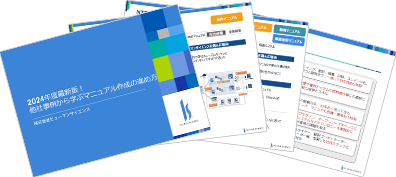
Thorough introduction of case studies on manual creation from other companies!Learn from case studies of other companies
How to proceed with manual creation
Before starting to create a manual, by learning about other companies' manual creation examples, you can understand the "key points of creation" and "common challenges" to gain hints for manual creation.
Recommended for
- I want to proceed with manual creation, but there is too much volume, and I don't know where to start.
- ・I am unsure if I can accomplish what I want to do in-house
- ・I want to know how other companies are progressing with manual creation
[Introducing Companies]
- TOTSUMEDIA Inc.
- BANDAI SPIRITS CO., LTD.
- NTT DATA KANSAI CORPORATION
- SBI SECURITIES Co.,Ltd.
- NNTTDATA CUSTOMER SERVICE CORPORATION
- WingArc1st Inc.
- Nippon Sheet Glass Co., Ltd.
 Download here
 +81 35-321-3111[Tokyo Headquarters]
  Contact Us
 Request for Information
 TOP
TOP SITE MENU