

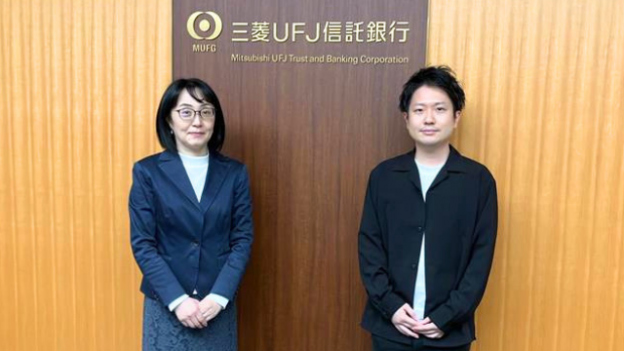
Interview Cooperation: Mitsubishi UFJ Trust and Banking Corporation
Corporate Planning Department, Planning Group
Ms. Hisako Ono
Digital Strategy Department, DX Promotion Office, AI Promotion Group
Mr. Shunta Hashino
Overview of Mitsubishi UFJ Trust and Banking Corporation
Establishment Date: March 10, 1927
Capital: 324.2 billion yen
Business Description: Trust services such as monetary trusts and pension trusts, banking services including deposits, loans, and domestic remittances, as well as intermediary services for real estate sales, securities agency services, and other ancillary businesses
Number of Employees: 6,372 (As of the end of March 2025)
Official Website: https://www.tr.mufg.jp/
As a member of the MUFG Group, a leading company in the financial industry, Mitsubishi UFJ Trust and Banking Corporation is promoting "Speed Reform." While aiming to improve productivity across the entire company, the firm began addressing the issue of improving its "manuals." Aiming to build a knowledge management system, they sought not only to organize documents but also to develop "documents that are easy to understand for both people and AI," anticipating future AI utilization.
By promoting manual improvements and AI utilization together, we are achieving company-wide operational efficiency and advanced knowledge utilization.
Why did manual improvement become the key to AI utilization? We spoke with Hisako Ono from the Corporate Planning Department and Shunta Hashino from the Digital Strategy Department about the reasons for selecting Human Science as a partner and the behind-the-scenes story of the project that supported the company-wide reform.
The Challenging "Manuals": Background of Reforms with an Eye on AI Utilization
――Please tell us about the background of the launch of this project. What missions and challenges did the Corporate Planning Department have?
Ms. Ono: The Planning Group of the Corporate Planning Department to which I belong is responsible for formulating basic management policies and company-wide initiatives, which include promoting business reforms that lead to improved productivity across the entire company. The MUFG Group as a whole is also promoting a major movement called "Speed Reform," focusing on speeding up decision-making and enhancing productivity.
Among these, the manuals were a major issue.
――Specifically, what kind of issues were there?
Ms. Ono: Actually, in the company-wide survey conducted once a year, we received many comments every year such as "The manuals are hard to understand" and "It takes time to find the information, and even after reading it, the problem wasn't resolved."
In particular, in recent years, the increase in mid-career hires has made it impossible to continue relying on tacit knowledge and verbal supplements to carry out work as before. If employees do not understand how to perform their tasks, productivity improvement cannot be achieved. There was a recognition of the issue that it is necessary to first establish a foundation so that all employees can access the same information and understand it correctly.
――Given that background, you decided to undertake a fundamental reform of the manuals. It was also impressive that you had AI utilization in mind from the very beginning.
Mr. Ono: Yes. When organizing the manuals, I thought they should not only be easy for people to read but also formatted in a way that AI, which will certainly be increasingly utilized in the future, can easily understand. By considering not only the "human perspective" but also the "AI perspective" in the organization, we believed this would smoothly lead to future AI utilization. That was the starting point of this project.
――With AI utilization in mind, from the perspective of the Digital Strategy Department, how did you get involved in this project?
Mr. Hashino: From the standpoint of promoting the use of generative AI, I was involved with a focus on whether the manuals were structured in a way that AI could also easily understand and utilize. Since the Corporate Planning Department was proactive about AI utilization and consulted us extensively from the stage of defining requirements, I feel that this effort went beyond mere manual revision and looked ahead to AI development and utilization.
The deciding factors were "concrete proposals" and "consistent, hands-on support"
● Concrete promotion plan based on expertise in manuals
――You set two themes: manual reform and AI utilization, and I believe you searched for a partner. What points did you prioritize in the selection?
Mr. Ono: To be honest, we are not professionals in manual creation, so we started without a clear sense of how to proceed or what the goal should be.
Human Science's proposal was very concrete, from the evaluation and analysis of the manual to the approach for improvement and goal setting, which allowed us to clearly envision how to proceed with the project. The proposal included abundant samples, and being able to concretely understand "this is the kind of output that will come out" was a significant factor.
● Seamless support throughout, with a view toward AI utilization
―― From the perspective of AI utilization, what did you expect from your partner?
Mr. Hashino: That was also an important point. With other companies, when it came to AI, there were cases where communication got fragmented, with comments like "That’s a different team" or "We’ll connect you to a subsidiary."
In that regard, the consultant from Human Science consistently served as the single point of contact and coordinated proposals internally. From our perspective, the communication was extremely smooth, and the fact that we felt we could proceed without stress was also one of the deciding factors.
●Cost-effectiveness achieved at a reasonable price
Mr. Ono: Also, compared to other companies, the cost for the expected output was reasonable.
The Corporate Planning Department takes the helm and collaborates with the Digital Strategy Department, engaging the entire company with a meticulous strategy
――I heard that this project was led by the Corporate Planning Department and that you also collaborated with the department responsible for DX in the AI area. How did you divide the roles and proceed?
Mr. Ono: Yes, the Corporate Planning Department took the lead role for the overall project, and for the specialized AI aspects, we worked together with the Digital Strategy Department, which oversees AI promotion. The two departments advanced the project collaboratively.
――I imagine there were difficulties in involving each department as the initiative expanded company-wide. How did you go about seeking their cooperation?
Mr. Ono: If we suddenly put out a company-wide call saying, "Departments that want to improve their manuals, please raise your hands," coordinating becomes extremely difficult. So this time, we first narrowed down the priority areas to be addressed by the Corporate Planning Department. Then, within the targeted departments, we had them decide the priority order of "which manuals for which tasks should be improved first," adopting this phased approach.
――I see, narrowing the scope top-down and having them decide the specific targets bottom-up. What do you think are the key points when expanding this to other business divisions in the future?
Mr. Ono: I believe it is important to clearly communicate the "benefits for themselves." The representatives of each department are all busy with their regular duties. To get their cooperation, it is essential that they actually feel the benefits, such as "using this chatbot will reduce inquiries to us and allow us to focus on our core tasks."
Consulting that achieved a "friendly" manual structure for both people and AI
――At the start of the project, you aimed to improve about 50 manuals totaling 3,000 pages within one year. Were there any concerns?
Mr. Ono: More than the volume, my biggest concern was whether external parties could truly understand our company's complex operations. Therefore, we first requested two pilot projects, and the output from these was outstanding.
In particular, the manual for the leave system had information scattered across 80 to 90 related files, making it difficult even for employees to grasp the full picture. Human Science carefully analyzed this and reconstructed it into a logical and easy-to-understand structure. Through this pilot, we became confident that "this will work well." I believe that Human Science's ability to comprehend and organize information was the key factor behind the overall success of the project.
――Thank you very much. This time, we aimed for a manual that is easy to understand for both humans and AI. Were there any aspects of our consulting that you found particularly helpful?
Mr. Hashino: There are two points. One is the handling of diagrams. People find it easier to understand when there are illustrations, but AI cannot interpret them. Therefore, it was very good that we received a proposal to keep the diagrams for people while supplementing their content as text information that AI can read, achieving a balance between the two.
Another point is the structure of the manual. Defining the premise of "who does what in this task" at the beginning. Organizing this logic, which is easy for people to understand, ultimately led to improved AI comprehension as well.
RAG Chatbot Dramatically Evolved
――I heard that the answer accuracy of the RAG chatbot utilizing that manual has improved.
Mr. Hashino: That's right. Actually, when we previously tested a chatbot developed in-house, we struggled with low accuracy despite inputting various related materials. However, by conducting AI development based on the manual structure organized by Human Science, the answer accuracy dramatically improved. We once again realized how crucial the quality and consistency of the input data are for enhancing AI accuracy.
The other day, we released the chatbot company-wide, and although it currently only supports the operations of a few departments, it has received very positive feedback for its accurate responses, with other departments eagerly requesting, "Please support our operations as well."
――This project focused not only on "clarity for AI" but also on "clarity for people," which was a very important theme. What kind of feedback have you received from employees regarding the improved manual?
Mr. Hashino: We have received very positive feedback. In particular, comments such as "I can now read while grasping the overall workflow" and "I understand which task I am currently working on and where I am headed next" were especially impressive.
Are you interested in the knowledge management utilizing generative AI realized by Mitsubishi UFJ Trust and Banking Corporation?
We introduce it in detail in this free downloadable material. Please take a look.
▶【Free Download Material】Knowledge Management Solution with a View to Utilizing Generative AI
What is the true goal of the "Speed Reform"? Time created through efficiency directed toward customers and future business
――That is wonderful news. Please tell us about your future outlook as well.
Mr. Ono: First, we will sequentially input the prepared manuals into the chatbot to expand its coverage. It is not just about implementation; we want to continuously improve both the manuals and operations while checking how they are actually used in daily work.
Mr. Hashino: The chatbot is equipped with a user feedback feature, which is a major characteristic that allows us to directly reflect those voices in AI development. By reviewing the accuracy and expressions of the responses and improving the AI and manuals as a set, we will continuously enhance the quality of knowledge.
――I understand that the manual reform and chatbot initiatives this time are part of the "Speed Reform" being promoted across the entire MUFG Group. Could you also share with us the vision and outlook the group as a whole aims for through this reform?
Mr. Ono: At the core of the "Speed Reform" is the fundamental idea of accelerating decision-making and using the time created by that acceleration to generate new businesses and deliver high value-added services to our customers.
This manual reform and the introduction of the chatbot are positioned as initiatives to establish an important "operational foundation" for that purpose.
The ultimate goal is not only to streamline daily operations but also to create "time to think about new businesses" and "time to speak directly with customers." The greatest purpose of the reform is to redirect the time and resources created toward higher value-added activities.
From the person in charge at Human Science
At Mitsubishi UFJ Trust and Banking Corporation, they are promoting the construction of a knowledge base that looks beyond document organization to future business transformation, and we are very honored to have been able to accompany them in this effort.
There were several important success factors behind the achievements of this initiative.
・Quality design of manuals that are easy to understand for both humans and AI
・Visualization of issues and prioritization using an evaluation analysis framework
・Step-by-step manual improvements through pilot implementation
Rather than considering manual improvements and AI utilization separately, designing and promoting them as an integrated effort was a key factor in improving the accuracy of the RAG chatbot.
The success or failure of AI utilization largely depends on the quality of the knowledge referenced. The insights gained through this project are believed to be applicable to business reforms in many companies. Moving forward, we will continue to support knowledge organization and AI utilization as an integrated effort, contributing to business transformation and value creation for enterprises.

 +81 35-321-3111[Tokyo Headquarters]
  Contact Us
 Request for Information
 TOP
TOP SITE MENU