


The deciding factor for adoption was the “proposal capability that supports from the framework creation stage even for our own unique system, allowing us to entrust it with confidence.”
In this initiative, business manuals and operation manuals were organized and unified into a single common document that anyone can follow with the same procedure.
After delivery, voices such as “It has become easier to understand” and “I can use it without hesitation” naturally arose within the company, gradually leading to the establishment of system understanding.
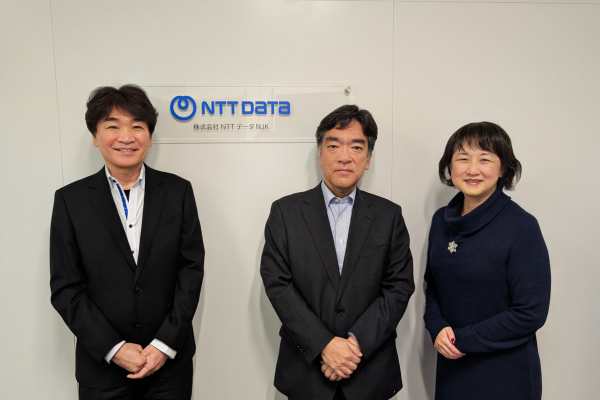
Interview Cooperation:
Corporate Services Department Manager, Mr. Fujie
Corporate Services Department Assistant Manager, Mr. Mitsui
Corporate Services Department Assistant Manager, Mr. Yamamoto
NTT DATA NJK Corporation Overview
・Established: November 1973
・Capital: 100 million yen
・Business Description: System Development, Embedded, Solutions & Services
Services Utilized
・Creation of Business Manuals
・Creation of Operation Manuals (Delivered in Word and PDF)
Project Background and Challenges
――HS: Please tell us about the background of your initial request to Human Science and the challenges at that time.
Mr. Fujie: The "Project Profit Management System" we use has been developed in-house for over 20 years and has managed the company's project revenues and expenditures.
However, despite using it for many years, there was no comprehensive manual, and the usage methods were only passed down orally from senior to junior staff.
The system creates projects based on contract units, but many employees did not understand how to create them, resulting in double the workload until they fully understood.
Mr. Yamamoto: Yes. There were complaints from the field saying, "We don't know how to use it."
We had no in-house know-how to create manuals, and we couldn't allocate resources, so we were unable to proceed with production. The president also strongly recognized this as an issue, saying, "We can't continue like this."
Reasons for Choosing Human Science — The Decisive Factors Were Proposal Capability and Reassurance
――HS: Among many production companies, please tell us why you chose our company.
Mr. Fujie: At first, I thought that manuals for proprietary systems couldn’t be created externally and that you had to fully understand the system to make one.
So, when I consulted the procurement department of NTT Data itself, they introduced Human Science. We didn’t approach any other companies and consulted only your company.
When we actually met, you first presented a draft outline saying, "We can create it following this flow."
Even though it was an unfamiliar system, you said, "We'll try making it first," which gave us a sense of reassurance. The feeling that "We can proceed together" was the deciding factor for our request.
Such words and the draft outline gave us great peace of mind, and we realized that even an external company could be entrusted to this extent.
Implementation Effects and Internal Feedback
――HS: What are your impressions of the delivered manual?
Mr. Fujie: First, I was impressed by how "well-organized and easy to read" it was. Manuals created by employees themselves tend to be just a collection of sentences, but the manual you created was organized like a booklet and looked professionally made.
I was surprised at how different it is when made by professionals. Since it was delivered in Word and PDF formats, it is also easy to update internally.
Also, after delivery, there was a spontaneous post on the internal website saying, "Thank you for creating such an easy-to-use manual." Even without conducting a survey, the fact that words of appreciation naturally came from the field was a significant achievement. There were no complaints or grievances, and the manual was smoothly accepted by users.
<Reactions After Delivery>
- ・Internal manuals were organized, making them easier to understand and use
- ・Users naturally expressed comments such as "Helpful" and "Easy to understand"
- ・The burden of manual creation was reduced
――HS: How was the approach during the production process?
Mr. Fujie: At first, I thought, "Won't it be impossible to proceed unless we provide all the information?" but Human Science first created the framework, and we were able to proceed by adding comments to it. This reduced our burden and allowed us to proceed with peace of mind.
Mr. Mitsui: Furthermore, even when the person in charge changed midway, the quality did not decline. It was reassuring to receive deliveries of the same quality regardless of who was responsible.
Mr. Fujie: That's right. The fact that "they respond the same way no matter who you work with" was very trustworthy.
Future Outlook
――HS: Could you share your thoughts on future manual development?
Mr. Fujie: We are currently working on creating multiple manuals tailored to different user groups. Initially, we assumed that the core parts would be handled in-house and only some sections outsourced, but after seeing the quality of the delivered manuals, our thinking changed to "we can entrust everything." We would like to continue working with you.
Furthermore, other departments in our company are also creating manuals, and the possibility of outsourcing those has expanded. Since there are limits to our internal structure alone, we hope to continue receiving your support as a partner going forward.
From Human Science Representatives
This project was a challenge to systematically develop a manual for a proprietary system that has been in use for over 20 years for the first time. Even with an unfamiliar system, we adopted an approach of first presenting a draft outline and then concretizing the content based on the comments received. This approach allowed us to shape the necessary manuals while minimizing the burden on the client side.
We sincerely appreciate the careful cooperation of all stakeholders despite the limited information available. Moving forward, we will continue to support the creation of business manuals, operation manuals, and further expand the scope of efficiency and information utilization through integration with AI and FAQs.
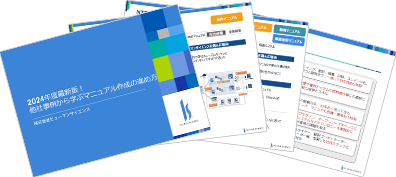
Thorough introduction of case studies on manual creation from other companies!Learn from case studies of other companies
How to proceed with manual creation
Before starting to create a manual, by learning about other companies' manual creation examples, you can understand the "key points of creation" and "common challenges" to gain hints for manual creation.
Recommended for
- I want to proceed with manual creation, but there is too much volume, and I don't know where to start.
- ・I am unsure if I can accomplish what I want to do in-house
- ・I want to know how other companies are progressing with manual creation
[Introducing Companies]
- TOTSUMEDIA Inc.
- BANDAI SPIRITS CO., LTD.
- NTT DATA KANSAI CORPORATION
- SBI SECURITIES Co.,Ltd.
- NNTTDATA CUSTOMER SERVICE CORPORATION
- WingArc1st Inc.
- Nippon Sheet Glass Co., Ltd.
 Download here
 +81 35-321-3111[Tokyo Headquarters]
  Contact Us
 Request for Information
 TOP
TOP SITE MENU