




- Table of Contents
As global procurement and expansion to overseas bases progress, the need to accurately translate technical documents into multiple languages is rapidly increasing in the manufacturing industry. However, technical translation presents difficulties different from general translation, such as the abundance of specialized terminology, risks of mistranslation, and large volumes of documents. This article organizes technical translation and explains the challenges faced by manufacturing sites, as well as how to choose tools that improve accuracy while streamlining translation tasks.
1. What is Technical Translation?
Technical translation is the process of translating technical documents such as instruction manuals, specifications, manuals, drawing notes, and data sheets into another language while accurately preserving specialized terminology, numerical values, and conditions. While general translation also emphasizes readability and natural expression, technical translation prioritizes ensuring that the meaning is conveyed correctly and without error.
Requirements for Technical Translation in Manufacturing
In manufacturing documents, a single misinterpreted term or an error in numbers or units can directly lead to product misuse, defects, or even safety issues. What is especially important is to use accuracy, precision, and technical terminology appropriately. It is required to translate specifications, numbers, units, and conditions accurately, leaving no room for misunderstanding. Additionally, it is essential to express industry- or product-specific terms with the correct translations and use them consistently throughout the entire document.
2. Main Challenges of Technical Translation in Manufacturing

The main challenges faced on-site in manufacturing translation are as follows.
Specialized knowledge of technical terminology is required
Technical documents contain a large number of industry-specific technical terms that are not found in general dictionaries. Even the same word "valve" can be translated as "valve" or "valve" depending on the context and field, so if translated without background knowledge of the target field, the content will not be conveyed correctly. Not only language skills but also an understanding of the product and technology are essential.
High Risk of Mistranslation
In manufacturing documents, even minor mistranslations in operation procedures or safety precautions can lead to serious consequences.
If the translation is inaccurate, it may result in operational errors on site or product accidents. In the worst cases, this can escalate into significant business risks such as quality issues or recalls. Therefore, technical documents must convey not only the meaning clearly but also the usage conditions and precautions accurately.
Inefficiency Due to the Large Volume and Variety of Documents
Documents requiring translation in the manufacturing industry are diverse in both format and volume.
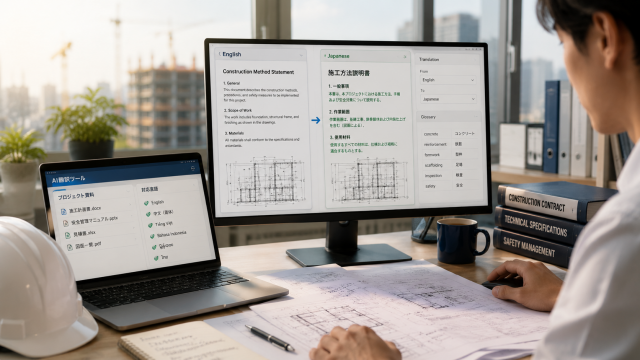
The documents subject to translation include manuals, specifications, catalogs, internal materials, emails, reports, and many other types. Furthermore, multiple file formats such as Word, Excel, PowerPoint, and PDF coexist, and the volume ranges widely from documents of a few pages to large-scale documents exceeding 100 pages. As a result, tasks such as formatting each document and translating them individually increase, which tends to reduce overall efficiency.
Accuracy and Usability of PDF Translation Tools Are Poor
While there is high demand for PDF translation on site, many tools can perform the translation itself but often cause layout disruptions or leave typographical errors, resulting in cases where manual corrections are ultimately necessary. Even if a tool claims to support PDF, the output PDF is not always usable as-is in practical work.
Difficulty in Terminology Standardization and Management of Technical Terms
In technical translation, many proper nouns such as product names, part names, and technical terms appear.
If the translated terms vary within or between documents, readers may mistakenly interpret the same item as different ones. The burden of maintaining terminology consistency increases as multilingual support becomes necessary. Especially when documents are created and translated across multiple departments or locations, the absence of a terminology management system tends to cause quality inconsistencies.
Frequent communication with overseas partners causes translation to take time
In workplaces with frequent interactions with overseas offices and business partners, there is a tendency to spend daily time reading and replying to English emails. The accumulation of translating daily communications often ends up putting pressure on the main tasks.
3. How to Improve the Accuracy of Technical Translation

Here, we introduce methods to improve accuracy while increasing efficiency according to each issue.
Issues requiring specialized knowledge and with high risk of mistranslation
→ Outsource to a specialized technical translation company
Accuracy of technical terms and addressing mistranslation risks can be resolved by outsourcing to a specialized company that understands the background of the relevant field. A company with translators familiar with the field and a terminology management and review system can correctly reflect technical nuances that literal translations cannot convey, preventing mistranslations that could lead to accidents.
Inefficiency due to the large volume and variety of documents
→ Choose a tool that can handle multiple formats collectively
By selecting a tool that supports various file formats, offers high convenience, and can translate multiple files together, you can reduce format conversions and manual work for each file, thereby streamlining the translation of large volumes of documents.
Accuracy and Usability of PDF Translation Tools
→ Choose a tool with high accuracy for PDF translation
When performing PDF translation, selecting a tool that is not only accurate in translation but also user-friendly in maintaining the layout after translation is key to reducing the amount of correction work.
Difficulty in terminology unification and management of technical terms
→ Choose a tool with a glossary function that allows management by department and product
By selecting a tool equipped with a glossary function that can register product names, part names, and technical terms and manage terminology by department and product, it becomes easier to maintain consistency of translations across entire documents and multiple languages.
Communication with overseas takes time
→ Choose a tool that can streamline email translation
If you frequently communicate with overseas, selecting a tool that supports translation of received and sent emails as well as the creation of English emails can significantly reduce the time required for reading English and handling emails.
Related blog: Points to Note When Translating Technical Documents into English with AI Translation | Tips for Natural English
4. Points for Choosing Technical Translation Tools
When choosing a technical translation tool, it is important not only to check whether it can perform AI translation but also to confirm if it suits the document formats and quality control methods used in actual work. In particular, whether manual translation, specification translation, PDF translation, Office translation, and email translation with overseas partners can be streamlined without significantly changing the current work environment is a major criterion in translation tasks in the manufacturing industry.
Specifically, check the supported file formats, layout preservation during PDF translation, management of technical terms using glossaries, security, and ease of integration with post-editing (MTPE). If a tool meets these criteria, it becomes easier to leverage the speed of AI translation while ensuring the accuracy and consistency required for technical documents.
Features of Tools Ideal for Technical Translation
• Supports a wide variety of file formats
• Can translate directly as an add-in for Word, Excel, and PowerPoint without copying and pasting
• Can translate multiple files together
• Supports PDF translation
• Has a glossary function that allows management by department and product
• Enables translation of received and sent emails and creation of English emails within Outlook, streamlining email translation for communication with overseas counterparts
"MTrans for Office" with these features
The translation tool suitable for technical translation that has the above features is "MTrans for Office," provided by Human Science Co., Ltd. It operates as an add-in for Microsoft Office products such as Word, Excel, PowerPoint, and Outlook, allowing you to execute translations with a single click from the Office screen you normally use. There is no need to separately launch translation software or copy and paste, reducing translation work man-hours by 30 to 45% (according to the company's verification).
The main specifications are as follows.
• One-click translation for Microsoft Office products Word, Excel, PowerPoint, and Outlook
• Translation engines selectable from four types: "DeepL," "Google," "Microsoft," and "OpenAI"
• Supports a total of 34 languages
• Glossary function allowing registration of product names and technical terms
• PDF translation function supporting both text-based and image-based content
• Layout and formatting are preserved after translation
• API connection with translation engines ensures no risk of secondary use of translation data, and supports security options such as SSO and IP address restrictions
Because you can compare translations from multiple engines side by side, it is easy to use Google for technical documents and OpenAI for external materials, depending on the purpose. By combining this with the glossary function, it becomes easier to unify technical terms and maintain consistency in expressions, contributing to improved draft quality of technical translations.
MTrans for Office is designed to easily address common challenges in technical translation within the manufacturing industry. When dealing with a large volume of documents, translating multiple files can streamline the workflow, and when terminology tends to vary, the glossary feature helps unify translations. The PDF translation maintains layout, reducing the effort needed for corrections, and for email correspondence with overseas contacts, translation support within Outlook helps lessen the burden of daily communication.

5. Summary
Technical translation targets specialized documents such as product instruction manuals, specifications, and manuals, prioritizing accuracy and consistency of terminology. In the manufacturing field, challenges include the need for specialized knowledge, risks of mistranslation, the large volume and variety of document formats, usability of PDF translation, difficulty in unifying terminology, and the time required for overseas correspondence.
These challenges can be addressed collectively across various formats, and by choosing tools equipped with glossary functions, email translation, and PDF translation, you can improve accuracy while enhancing efficiency. "MTrans for Office" is a translation tool that features capabilities to meet such technical translation needs.
On the other hand, for critical documents where mistranslations can directly lead to accidents or serious risks, there are situations where relying solely on AI translation causes concern. In such cases, combining the post-editing (MTPE) outsourcing service by Human Science Co., Ltd., where professionals with specialized knowledge review and correct AI-generated drafts, can achieve both efficiency and quality. While identifying which processes can be streamlined with tools and which require human intervention to ensure quality, why not consider the optimal translation system?
Related Services
>Office Translation Software Supporting Technical Translation: "MTrans for Office"
>Post-Editing (MTPE) Outsourcing Service to Improve AI Translation Quality
>Industrial and Manufacturing Translation – Translated by Engineers with Extensive On-site Knowledge
6. FAQ
- Q
What is the difference between technical translation and general translation?
- Q
Why is technical translation important in the manufacturing industry?
- Q
What are the challenges of technical translation?
- Q
How can the accuracy of technical translation be improved?
- Q
Please tell me about tools suitable for technical translation.
- Q
Is it possible to do technical translation using only AI translation?
- Q
Can PDF technical documents also be translated?
















 Return to the top of the page
 +81 35-321-3111[Tokyo Headquarters]
  Contact Us
 Request for Information