




- Table of Contents
-
- 1. What Is the Training Employment System? Multilingual Support Required in Manufacturing and Construction
- 2. What Documents Should Be Translated under the Training Employment System? Prioritizing Safety Education Materials and Work Procedures
- 3. Decide on Supported Languages and Communication Methods According to the Target Audience
- 4. System for Managing Updates of Multilingual Documents and Maintaining Translation Quality
- 5. Streamline Manual Creation and Translation with MTrans for Office
- 6. Utilize External Support When It Is Difficult to Handle In-House
- 7. Summary
- 8. Frequently Asked Questions About Multilingual Support for the Training Employment System
As the training employment system is set to begin, manufacturing and construction industries accepting foreign personnel face the challenge of how to proceed with multilingual support for safety education materials and work procedure manuals. If decisions are not made in advance about "what to translate," "which languages to use," and "to what extent AI will be utilized," it could lead to labor accidents, quality defects, construction errors, and delays in training. This article explains, based on practical operations in manufacturing and construction, the priority order of documents to be translated for the training employment system, selection of target languages, easy-to-update management, and methods for leveraging AI.
1. What Is the Training Employment System? Multilingual Support Required in Manufacturing and Construction
The core of system compliance is "providing information that the individual can understand and act upon"
The Developmental Employment System is designed to train foreign personnel in sectors facing labor shortages, aiming for their transition to the Specified Skilled Worker No. 1 level. With enforcement scheduled for April 1, 2027, accepting companies are required to provide guidance according to development plans, support Japanese language learning, and offer appropriate explanations regarding working conditions, occupational safety and health, and consultation methods. While the system does not uniformly mandate translation of all documents, conveying important information in a way that the individual can understand is a prerequisite for safe employment and skill development. Therefore, simplified Japanese, diagrams and photos, demonstrations, and multilingual translations are combined according to the importance of the information and the individual's level of understanding.
The highest priority information to convey is safety, work, and consultation
In manufacturing and construction industries, it is necessary to ensure accurate understanding not only of working conditions and internal rules but also of safety education, work procedures, quality and construction management, and emergency response. In factories, communication about equipment operation and quality standards is essential, while on construction sites, information about working at heights, operations around heavy machinery, use of protective gear, and site-specific restricted areas must be conveyed according to the industry and site. Working without sufficient understanding may lead to industrial accidents, work errors, defective products, construction defects, and project delays.
| Information to Convey | Risks if Not Understood | Examples of Company Measures |
|---|---|---|
| Safety Education and Emergency Response | Workplace Accidents, Delays in Evacuation and Initial Response | Use of Diagrams, Photos, Easy Japanese, and Multilingual Materials |
| Work Procedures, Quality Standards, and Construction Guidelines | Work Errors, Defective Products, Construction Defects, Rework | Unify terminology and cautionary expressions, and present them in a language that can be understood |
| Internal rules and consultation methods | Misunderstandings, overlooked issues, early resignation | Multilingualize orientation training and consultation desk guidance |
Multilingual support is not simply the task of replacing Japanese documents with foreign languages. It is important to create expressions that can be understood and acted upon on-site, taking into account the context in which the information is used and the comprehension level of the target audience. Use simplified Japanese and pictograms for short cautionary notices, and translate manuals including conditions and exceptions, labor conditions, and consultation methods into languages that the individual can fully understand. Additionally, it is necessary to coordinate revisions of the original text with each language version to ensure that outdated translations do not remain in the field.
Related services: Industrial and Manufacturing Translation – Translated by Engineers with Extensive On-site Knowledge
2. What Documents Should Be Translated under the Training Employment System? Prioritizing Safety Education Materials and Work Procedures

Translation Targets Identified by Industry
In the manufacturing industry, priority is given to safety procedures such as equipment shutdown, cleaning, and maintenance, as well as commonly used work standards and inspection criteria. In the construction industry, in addition to new entrant training, priority is given to procedures for tasks prone to serious accidents, such as working at heights, operations around heavy machinery, and sling handling. In all industries, emergency response—including evacuation methods and emergency contact information—must be understood before starting work or entering the site.
Priority is determined by the "magnitude of impact" and "frequency of use"
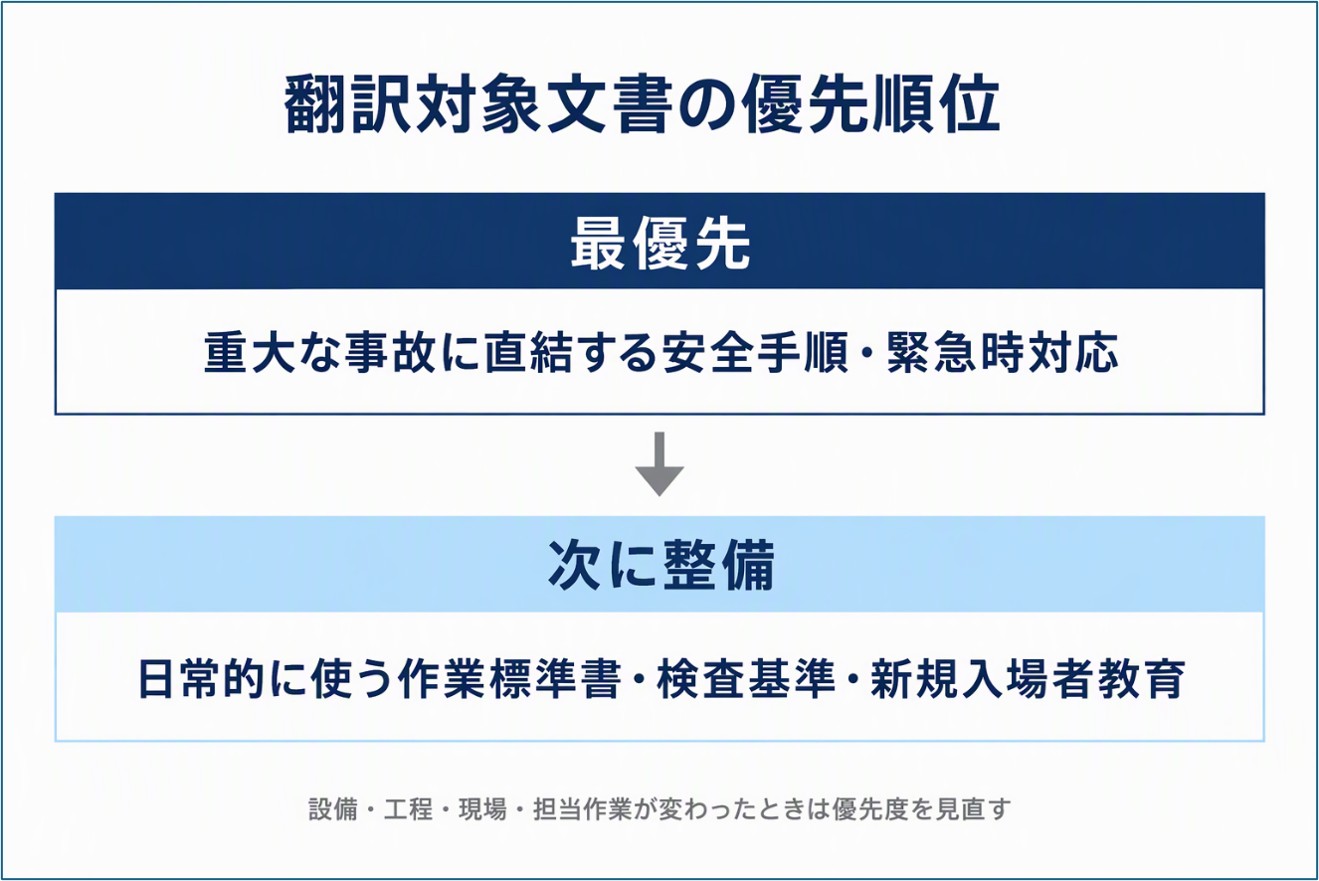
Priority is determined by the "impact if misunderstood" and "frequency of use." The highest priority is safety procedures and emergency response directly linked to serious accidents. Next, standard work instructions, inspection criteria, and new entrant training used daily are organized. When equipment, processes, sites, or assigned tasks change, the priority of related documents is reviewed.
Typical Documents for Translation in Manufacturing and Construction Industries
| Priority | Manufacturing industry | Construction Industry | Timing of Response |
|---|---|---|---|
| Top Priority | Safety Procedures for Equipment Shutdown, Cleaning, and Maintenance; Emergency Response | Safety Procedures for Work at Heights, Work Around Heavy Machinery, and Slinging; Emergency Response | Before Starting Work or Entering Site |
| Next to be Prepared | Work Standards, Inspection Criteria | New entrant education, daily work procedure manuals | Before daily use, when changing work procedures |
Related blog: Multilingual e-learning for foreign employees|In-house training conducted in English, Chinese, and Vietnamese
3. Decide on Supported Languages and Communication Methods According to the Target Audience

The required languages are determined not only by the country or region of origin of the incoming personnel but also by confirming the languages they use for reading and writing and can fully understand. It is important to select the appropriate language not based solely on nationality but through interviews at hiring or new entry and comprehension checks after training. For short caution signs and frequently used instructions, use simplified Japanese, diagrams, photos, and pictograms. Procedures including conditions and exceptions, labor conditions, and consultation methods are presented in languages the individual can fully understand. In manufacturing, information and appropriate communication methods are organized by equipment and process, and in construction, by site and work stage.
4. System for Managing Updates of Multilingual Documents and Maintaining Translation Quality
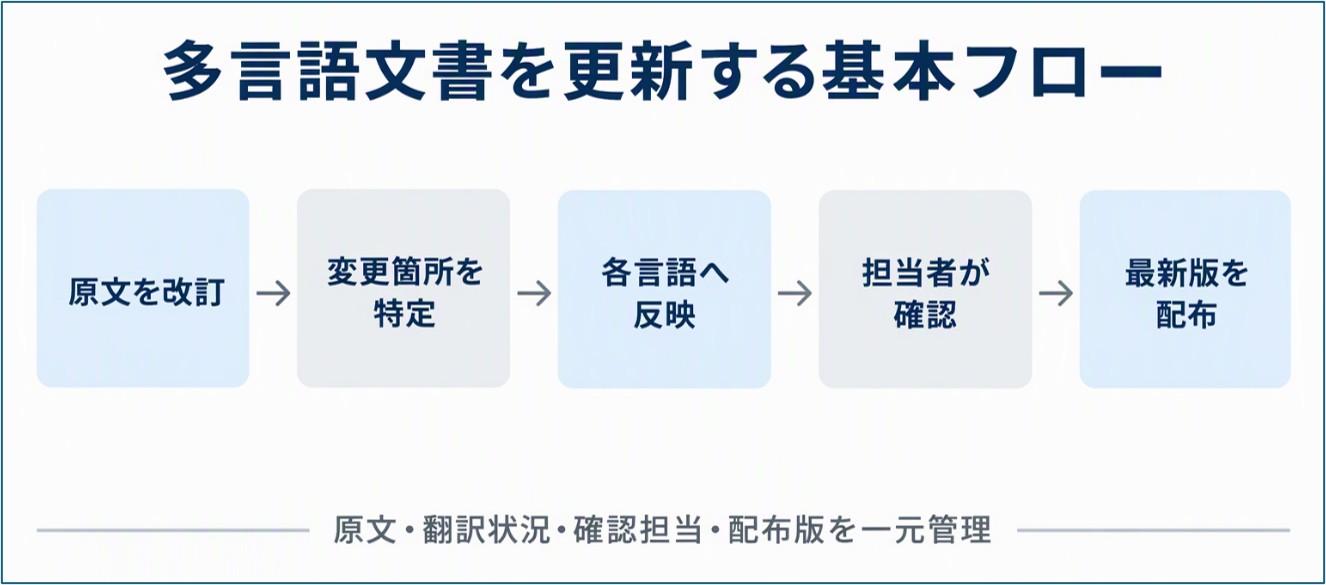
As the number of accepted personnel and factories or construction sites increases, the languages supported, documents to be translated, and frequency of updates also increase. In manufacturing, updates must be promptly made to each language version in accordance with changes in equipment, products, processes, and quality standards; in construction, updates must correspond to changes in construction content, schedules, work locations, and subcontractors. Common issues here include distribution of outdated versions, missed updates, and inconsistencies in terminology and cautionary expressions.
The basic approach is to unify terminology and expressions at the original text stage and centrally manage the locations of changes in the original text, the translation status for each language, the reviewers, the target factories/sites, and the distributed versions. By standardizing the common parts and structuring it so that only the differences for each equipment, process, or site can be updated, the revision workload can be reduced. Furthermore, by combining AI translation with human review according to the importance of the document, continuous multilingual operations can be made more efficient.
Related Blog: A Guide to Using AI Translation Tools to Solve Translation Challenges in the Construction Industry
5. Streamline Manual Creation and Translation with MTrans for Office

MTrans for Office is an AI tool that supports proofreading and translation of Office documents such as Word, Excel, and PowerPoint, which are routinely used in manufacturing departments and construction sites. Because safety training materials, equipment and tool operation procedures, construction manuals, and training slides can be proofread and translated directly within Office, it reduces the effort required for copying and pasting into other tools and for formatting adjustments after translation.
Safety education materials, equipment operation manuals, and construction procedure manuals have the potential for mistranslations to lead to labor accidents, quality issues, and construction defects. Therefore, they are not completed solely with AI translation but combined with human verification. AI translation is utilized to improve work efficiency, while important cautions, numerical values, conditions, and technical terms are checked by in-house technical staff, construction management personnel, safety and health officers, and those proficient in the target languages. By classifying documents according to their importance—those handled only by AI translation, those reviewed and corrected by responsible personnel, and those outsourced to specialized translation companies—it is possible to balance efficiency and quality.

6. Utilize External Support When It Is Difficult to Handle In-House

At Human Science, in addition to supporting the introduction of MTrans for Office, we assist with manual creation tailored to document quality requirements, including manual production in Japanese by human editors and multilingual translation. We provide proposals based on the current documents, target languages, and usage scenarios to address challenges such as "how to unify terminology," "how to differentiate between AI translation and human translation," and "how to reflect revisions in each language." If you have any issues regarding the launch of the training and employment system, please contact us using the form below.
7. Summary
In responding to the training and employment system, it is important to continuously deliver the necessary information in languages and formats that foreign personnel can understand, so they can work safely at factories and construction sites and acquire skills. By appropriately combining AI tools with human verification and establishing a system that reliably reflects revisions in each language version, the continuity of safety, quality, construction, and education can be supported.
8. Frequently Asked Questions About Multilingual Support for the Training Employment System
- Q
Which languages are required for responding to the Training and Employment Program?
- Q
In manufacturing and construction industries, which documents should be translated first?
- Q
Is it necessary to recreate materials for each construction site?
- Q
Is it okay to create safety training materials using only AI translation?



















 Return to the top of the page

 +81 35-321-3111[Tokyo Headquarters]
 Contact Us
 Request for Information