




In recent years, with the advancement of generative AI and machine translation technologies, there has been an increase in cases where AI translation is performed in-house, and only review and quality assurance are outsourced to translation companies.
Requests such as "We have created translations using in-house AI translation, so we would like to ask only for quality checks" and "We want to leave the translation work to AI and combine it with human review" have also been increasing. This process of reviewing and correcting after AI translation is also called "post-editing." Many companies are adopting this workflow because it can reduce the workload and costs compared to traditional human translation.
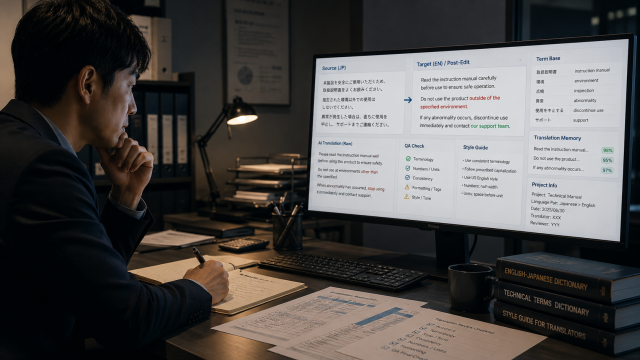
Of course, if you have the original text and the AI translation result, you can conduct a review from basic perspectives such as the naturalness of the English expressions, the presence or absence of mistranslations, and whether the original intent is correctly reflected. However, in the case of technical documents in fields such as IT, FA, software, and manufacturing, it is often not enough that "the original content is correctly translated" and "the English is correct." There are various quality-related factors such as terminology consistency, adherence to style guides, consistency with existing manuals and specifications, and expressions tailored to the intended audience.
In this article, we introduce five pieces of information that are helpful to prepare in advance to realize reviews based on these perspectives.
- Table of Contents
1. Information on Terminology
Terminology consistency is one of the crucial factors that affect the quality of technical documents.
In AI translation, different terms may be chosen depending on the context, even when referring to the same concept or function. (This is considered a result of AI optimizing collocations for each context.) Although all options may sound natural and be understandable in English, manuals and specifications require consistency in terminology, so leaving it as is may fail to meet quality standards.
In such cases, by sharing glossaries, in-house standard terms, product names, function names, and UI names, it becomes possible to conduct reviews that take into account consistency with existing documents.
Also, even if there is no established glossary within the company, it is possible to request a translation agency to extract and organize important terms from the target documents and create a glossary defining recommended translations. Especially when continuously translating and managing multiple documents, maintaining a glossary helps stabilize and improve the efficiency of subsequent translation and review quality.
2. Past Translation Assets

Alongside terminology consistency, alignment with existing documents is also important.
When products or services have been developed over many years, consistency with expressions used in past manuals, specifications, and online help is often required.
AI translation selects natural expressions according to the context; however, it naturally does not take into account expressions used in past documents. (While it is possible to instruct this via prompts, the more expressions and instructions that need to be considered, the more complex the prompts become, increasing the effort required for creation and management, making it impractical.) Therefore, even if a translation is fine on its own, inconsistencies in terminology and expressions may arise when compared with existing documents.
In such cases, by sharing translation assets such as past English manuals, specifications, and translation memories, it becomes possible to conduct reviews that take into account consistency with existing documents. (These translation assets can be referenced during reviews using dedicated tools.) This is especially effective when continuously managing multiple documents or translating documents for the same product series.
>Related Blog: What Are CAT Tools? Introducing the Benefits and Drawbacks
3. Expression Rules and Style Guide

Expression rules and style guides are also important factors that affect translation quality.
Writing style and notation rules, the use of uppercase and lowercase letters, heading formats, handling of abbreviations, and the notation of numbers and units vary by company and product. It is also not uncommon for policies to be established regarding whether to adopt American or British English and how to standardize UI terminology.
By sharing these rules in advance, you can achieve a result that is not only natural English but also aligned with the desired expressions and style.
Additionally, style guides and notation rules can be organized as prompts and incorporated into proprietary tools like LLM proofreading tools, enabling partial automation of QA checks for compliance. Combining this with human review leads to more efficient and comprehensive quality assurance.
Even if a style guide is not yet established, you can request the translation company to create one along with the review. Once established, it helps stabilize and streamline the quality of subsequent translation and review processes.
4. Document Purpose and Target Audience

Even if terminology and expression rules are established, appropriate expressions vary depending on the document’s purpose and target audience.
The level of expressions and technical terms required differs between manuals for end users and specifications for developers. Similarly, the clarity and style of writing vary between marketing materials and technical documents. Additionally, appropriate vocabulary and sentence complexity differ depending on whether the audience is native English speakers or readers using English as a second language.
For example, the phrase "Failure to comply with the above precautions may result in equipment malfunction." is natural for native English readers, but it can feel complex for readers using English as a second language. In such cases, using a simple structure of "subordinate clause + main clause" and rewriting it as "If you do not follow these precautions, the equipment may malfunction." makes it easier to understand.
By sharing this information in advance, reviewers can more easily choose expressions that are not just "correct English" but are clear to the readers and appropriate for the document's purpose.
By the way, such consideration for the target audience can also be reflected in AI translation by adding appropriate instructions to the prompt. However, it is recommended to verify during the review whether this is consistently applied throughout the entire document.
5. Customer-Specific Quality Standards and Preferences

Apart from style guides and notation rules, what is surprisingly easy to overlook are unique quality standards and particular preferences in expression.
For example, even the handling of the pronoun "you" in manuals varies depending on the company or product. Some prefer to use it to create a sense of familiarity and clarity in operation by addressing the reader directly, while others avoid it to emphasize conciseness and an objective tone.
Here is an example.
* You can scroll horizontally.
| Source | Please create a backup before updating the software. |
|---|---|
| Example using "you" | Before you update the software, create a backup of your data. |
| Example without using "you" | Before updating the software, create a backup of the data. |
Another point where policies differ is how closely the sentence structures of the source and target texts should correspond. Some prioritize managing translation memory and future revision work, requiring one sentence in the source to be expressed as one sentence in the translation, while others prioritize readability and allow splitting into multiple sentences as needed.
Here is an example.
* You can scroll horizontally.
| Source | It adopts a dual-support structure using a main wire and an auxiliary wire, and even if the main wire breaks, it is supported by the auxiliary wire. |
|---|---|
| Example expressed in one sentence | The device employs a dual-support structure consisting of a main wire and an auxiliary wire and remains supported by the auxiliary wire even if the main wire breaks. |
| Example of splitting into multiple sentences | The device employs a dual-support structure consisting of a main wire and an auxiliary wire. Even if the main wire breaks, the device remains supported by the auxiliary wire. |
The handling of Latin-derived abbreviations such as "e.g.", "i.e.", and "etc." also varies depending on the policy. In some cases, their use is recommended, while in others, a policy is adopted to prioritize clarity by using phrases like "for example", "that is", and "and similar [components/devices/items]" to avoid abbreviations.
By sharing these preferences and particularities in advance, you can achieve a result that better meets your expectations.
>Related Blog: How to Streamline Post-Editing After Machine Translation?
6. Summary
Finally, we summarize the contents introduced in this article in a list.
* You can scroll horizontally.
| Information to Share in Advance | What to Expect from AI Translation Review |
|---|---|
| Information Regarding Terminology | Terminology Consistency |
| Past Translation Assets | Consistency with Existing Documents |
| Style Guide | Consistency in Writing Style and Notation Rules |
| Purpose of the Document and Target Audience | Expressions Suitable for the Audience |
| Quality Standards and Preferences | Meeting Expected Quality |
Even as the accuracy of AI translation improves, the definition of "high-quality translation" varies by project. Only by taking into account factors such as terminology consistency, alignment with existing documents, adherence to style guides, and unique expression rules can the quality as technical documentation be ensured.
Some of the information introduced this time can be reflected in AI translation by utilizing prompts for AI tools, but it is recommended to verify through review whether it has been reflected as intended.
When requesting a review, sharing the original text and AI translation results along with the materials and information introduced this time will lead to deliverables that more closely meet your expectations.
Although the accuracy of AI translation is improving, human review plays a crucial role in technical documents for terminology consistency, alignment with existing documents, and adherence to style guides.
At Human Science, we also offer review services after AI translation, conducting reviews tailored to your quality standards by utilizing glossaries, translation memories, style guides, and more.
If you have concerns about the quality despite implementing AI translation or if you only want to request a review, please feel free to contact us.
Related Services
Translation Services
Post-Editing and Operation Support Services
Machine Translation / Automatic Translation
7. Frequently Asked Questions about AI Translation Review
- QIs AI translation alone sufficient for quality?
- QCan I request only a review after AI translation?
- QIs it okay if there is no translation memory?



















 Return to the top of the page

 +81 35-321-3111[Tokyo Headquarters]
  Contact Us
 Request for Information