




- Table of Contents
-
- 1. Do You Have These Concerns About AI Translation Quality Management?
- 2. The Challenge of AI Translation: Quality Management Rules, Not Performance
- 3. Five Common AI Translation Challenges and First Steps Toward Improvement
- 4. Identifying AI Translation Problems by Cause
- 5. What Is a Translation Checkup? Assessing AI Translation Quality and Workflows
- 6. Conclusion: From Being Able to Use AI to Trusting It with Confidence
- FAQ on AI Translation and Translation Checkups
Have you ever hesitated over a text translated into English by Copilot?
Even if the English looks natural, you may not be able to tell whether it is really safe to send to a customer as is. And if your manager asks, “Is this okay?” you may not be able to answer with confidence.
With the adoption of generative AI, translation is shifting from something people outsource to something they do themselves. While this has increased speed, responsibility for quality checks, once handled by translation departments or translation companies, now falls on individual employees.
This article explains how to evaluate translation quality, manage terminology, improve source texts, write prompts, and establish a review process to safely use translations generated by tools such as Copilot in business.
> Related blog: How Accurate Is Generative AI Translation? Comparing Google, DeepL, ChatGPT, Gemini, and Claude!
1. Do You Have These Concerns About AI Translation Quality Management?
We often hear the following concerns from employees at companies that have adopted generative AI.
• “The translation looks polished, but I have no way to check whether it is accurate.”
• “Even within the same document, product names are translated differently depending on the department or person responsible.”
• “My colleague gets good results translating with Copilot, but when I use it, the translations are not quite right.”
• “We found a mistranslation, but we don't know whether the AI or the source text is to blame.”
• “When we used a translation company, we could leave the checking to them, but now no one has been assigned to do the final check.”
• “There are so many things we want to improve, but we don't know where to start.”
If any of these concerns sound familiar, it may be time to review your translation quality management practices. AI has changed how translations are produced, but the processes for verifying their quality are not yet fully established. This is a challenge shared by many companies.
2. The Challenge of AI Translation: Quality Management Rules, Not Performance
It is tempting to think that AI translation problems can be solved by switching to a more powerful AI. In many cases, however, the cause lies elsewhere. When translations were outsourced to a translation company, the provider handled the quality management processes and responsibilities, including translation, review, and terminology checks. With Copilot enabling in-house translation, however, translations may be produced without those processes in place.
“How much checking is enough?” “Who decides whether the translation is acceptable?” “Which terms should be used?”
A common cause of many of these problems is that these questions remain unresolved, leaving individuals to make their own decisions. Establishing the necessary rules one by one can reduce uncertainty.
3. Five Common AI Translation Challenges and First Steps Toward Improvement
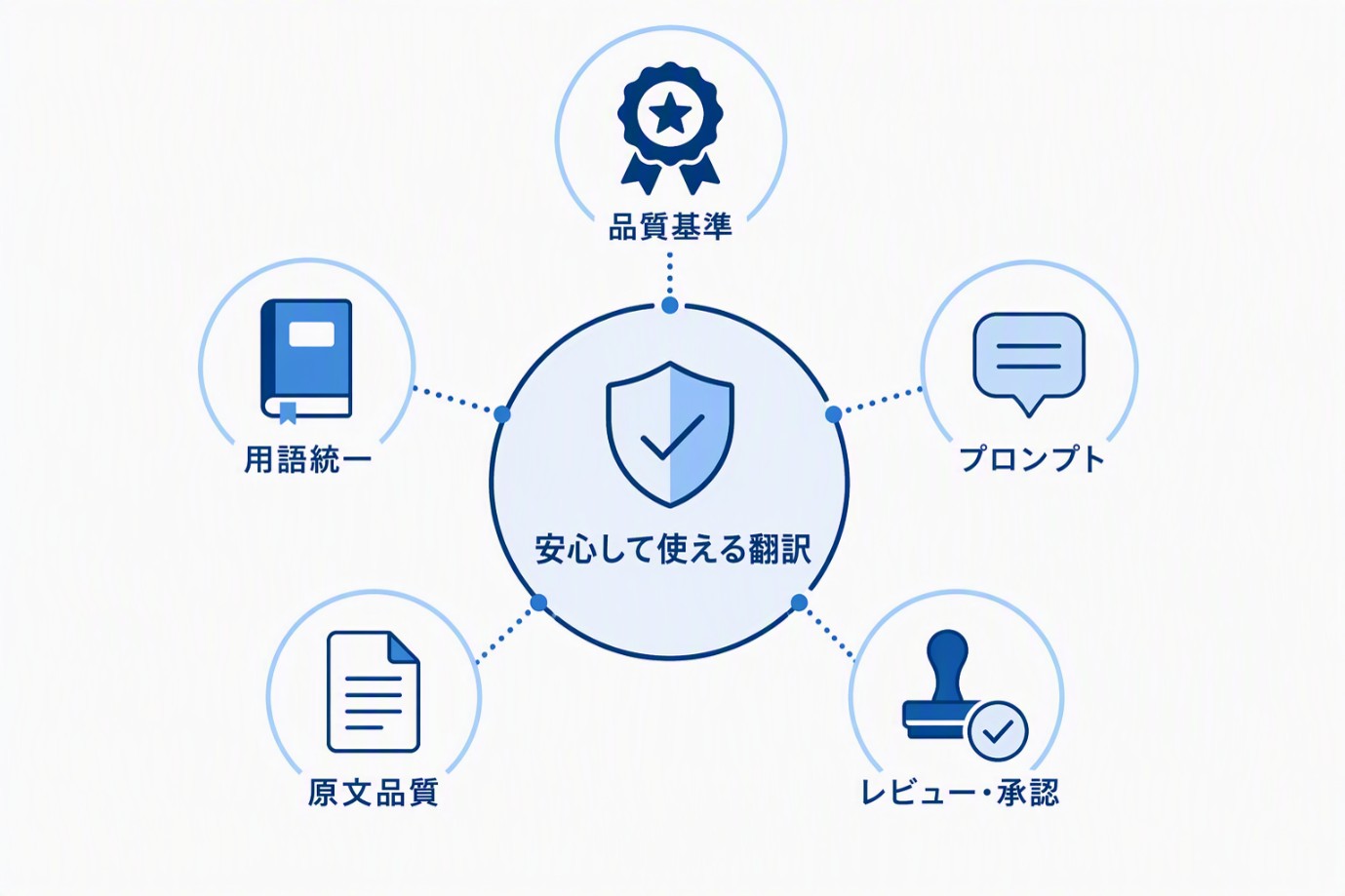
Here, we divide common concerns into five challenges and explore their causes and potential solutions.
Challenge 1: Unable to determine whether a translation is good enough
| Common concern | The more natural a translation sounds, the harder it is to spot errors. Even after reviewing it, you can only conclude that it is probably good enough. |
|---|---|
| Cause | Because translations produced by generative AI are fluent, it is easy to confuse readability with accuracy. Numerical errors and omissions can also go unnoticed when they are embedded in natural-sounding text. In addition, without acceptance criteria, judgments vary from person to person. |
| First Step Toward Improvement | Document what needs to be checked. Even a simple checklist can reduce inconsistencies in judgment. For guidance on quality assessment, ISO 5060:2024, the international standard for translation evaluation, is also a useful reference. For details, see the blog post below.
What Is ISO 5060? An Approach to Objectively Evaluate Translation Quality in Manufacturing |
Challenge 2: Inconsistent Company Terminology and Usage
| Common concern | Terms such as “user” and “end user” or “device” and “equipment” vary across departments and documents, prompting customers to ask, “Are these the same thing?” |
|---|---|
| Cause | AI does not automatically know your company's product names or style conventions. Without instructions, it selects a common translation each time. Glossaries may also be outdated or shared with only some departments. |
| First Step Toward Improvement | Create a list of 20 to 30 key terms where mistranslation would have a significant impact, and share it somewhere everyone can access. Start with frequently used terms that would cause problems if translated incorrectly to see results quickly. Also decide who will manage the list and when it will be updated. |
Challenge 3: Translation quality varies from person to person
| Common concern | Even when using the same Copilot, translation quality and the amount of editing required vary greatly from person to person. |
|---|---|
| Cause | Generative AI output depends on the instructions (prompts) it receives. Simply asking it to translate into English produces very different results from specifying the target audience, required terminology, and writing style. Quality depends on how each person gives instructions. |
| First Step Toward Improvement | Share effective prompts as templates for the entire department. Including the target audience, writing style, required terminology, proper nouns to leave untranslated, and how to handle numbers and units makes it easier to achieve consistent quality. |
Challenge 4: Not knowing why translations are inaccurate
| Common concern | We change the AI tool or the instructions every time a mistranslation occurs, but the results do not improve. |
|---|---|
| Cause | Sometimes the problem lies in the source text. For example, in “After checking, please report it to the responsible department,” it is unclear to the AI what “it” refers to. Omitted subjects and ambiguous references can lead to different interpretations. |
| First Step Toward Improvement | Review the source text. Establishing rules such as specifying the subject, clarifying what pronouns refer to, and keeping sentences short will make translations more consistent. |
Challenge 5: Responsibility has not been assigned
| Common concern | People translate and check documents themselves and use them as is, so it is unclear who is responsible when problems arise. |
|---|---|
| Cause | As translation has shifted from outsourcing to in-house AI translation, responsibility for quality checks and approval has also moved in-house. However, it is not clear who should take on these roles. |
| First Step Toward Improvement | Establish risk-based procedures with different levels of review according to the importance of each document. For example, have employees check their own routine internal documents, have knowledgeable reviewers assess customer-facing materials, and require expert review and approval by the person in charge for contracts and safety-related documents. |
4. Identifying AI Translation Problems by Cause

As the five challenges show, translation problems can have multiple causes. Even for the same mistranslation, the appropriate solution depends on the cause.
• For problems with how AI is used, review the prompts and reference materials
• For problems with the source text, establish writing guidelines
• For problems with terminology and language assets, develop and share glossaries and style guides
• For workflow problems, define review procedures and approval workflows
Taking action without identifying the underlying causes adds work without improving results. Likewise, focusing on who made a mistake when a problem occurs does not improve the process. Instead, focus on what can be changed to prevent the problem from recurring.
>Related blog: Using Tools for Multilingual Translation Quality Management: What Should You Check?
5. What Is a Translation Checkup? Assessing AI Translation Quality and Workflows

In the course of daily operations, it is not easy to identify quality risks in AI translation on your own. The Translation Checkup assesses translation quality and workflows, identifying issues and setting priorities for improvement.
Just as a comprehensive medical checkup assesses your overall health, the Translation Checkup examines your translation operations from the following perspectives.
• Translation quality: Where and to what extent issues such as mistranslations, omissions, terminology errors, and numerical errors occur
• Source text quality: Whether ambiguous expressions or complex structures make translation difficult
• Terminology and language assets: Whether glossaries and style guides are maintained, kept up to date, and shared
• Use of AI: Whether it is clear which documents are translated using AI and when human review begins
• Translation process: Whether the workflow and responsibilities for translation, review, approval, and implementation of revisions are clear
What the Translation Health Check involves
The Translation Health Check assesses your current situation using actual source texts and translations, glossaries, review procedures, and other materials. Rather than relying on impressions, it aims to identify quality risks and prioritize improvements.
1. Preliminary review: We review the documents and languages in scope, the intended use of the documents, and the current translation workflow.
2. Assessment: We examine the quality of the source texts and translations, terminology consistency, and the review and approval process.
3. Results report: We summarize the issues identified and recommend improvements to prioritize.
The assessment results can lead to concrete improvements, such as creating review criteria, revising glossaries and instructions, and developing review policies for different types of documents. The scope and approach can be tailored to your current workflows and challenges.
Start by assessing your current situation with the free Translation Checkup
You can use the service even if you are unsure where to start improving. Begin with the free version of Translation Dock to assess your current situation and identify a starting point for improvement.
Turn a vague sense of unease into a clear understanding of where problems exist and how serious they are.
Understanding your current situation helps you distinguish between areas where you can rely on AI translation and those that require more thorough human review.
>Service website: Translation Dock: Translation Quality Assessment and Improvement Service for Businesses
6. Conclusion: From Being Able to Use AI to Trusting It with Confidence
As generative AI becomes more widespread, the challenge in translation is shifting from “how to translate” to “how to review and manage translations.” To use AI translation confidently in business, organizations need to establish quality standards, terminology, source-text writing guidelines, review procedures, and clear responsibilities. If you are unsure where to start or have concerns about your current processes, begin by gaining a clear picture of the current situation.
Why not use the free version of Translation Dock to identify your company's translation challenges? For more information and instructions on how to use it, please contact us using the form below.
FAQ on AI Translation and Translation Checkups
- Q1
Can AI translations be used for business purposes without review?
- Q2
What is needed to ensure consistent translation quality with Copilot?
- Q3
How do you check AI translations for errors?
- Q4
Is a glossary necessary for AI translation?
- Q5
What does the Translation Checkup assess?
- Q6
What types of companies is the free Translation Checkup suitable for?
















 Return to the top of the page

 +81 35-321-3111[Tokyo Headquarters]
 Contact Us
 Request for Information