




- Table of Contents
-
- 1. What Is ISO 11669?
- 2. The Translation Project Workflow Covered by ISO 11669
- 3. The Most Important Concept: Translation Project Specifications
- 4. Start with Needs Analysis and Risk Assessment
- 5. Five Points to Consider Before Designing a Project
- 6. Five Steps to Incorporate ISO 11669 into Your Workflow
- 7. Why ISO 11669 Matters in the Age of AI Translation
- 8. Differences Between ISO 11669 and ISO 17100, ISO 5060, and ISO 18587
- 9. Conclusion: Plan for Translation Quality Before Translation Begins
- ISO 11669 FAQ
As the use of AI and machine translation expands, the way translations are produced is changing significantly. At the same time, many companies face operational challenges, such as deciding which documents to translate using AI, what level of quality is required, and who will review and approve the translations.
ISO 11669 is an international standard that provides a useful reference for designing and managing translation projects as a whole. It offers general guidance on each stage of a translation project, from needs analysis and specification development before translation begins to execution, delivery, and feedback.
This article provides an overview of ISO 11669 and its core principles, then explains needs analysis, practical implementation, the use of AI translation, and the differences between related standards.
> Related blog post: A Comprehensive Comparison of Recommended Translation Tools: How to Choose Free, AI, and Business Solutions
1. What Is ISO 11669?
The official title of ISO 11669 is “Translation projects — General guidance.” ISO 11669:2024 was published in March 2024 and provides general guidance on all stages of a translation project. Its primary purpose is to improve communication among the parties involved in a translation project and enhance efficiency and quality. The standard is primarily intended for clients of translation services, but it is also relevant to translation service providers and users of translated content.
2. The Translation Project Workflow Covered by ISO 11669
ISO 11669 divides a translation project into four stages.
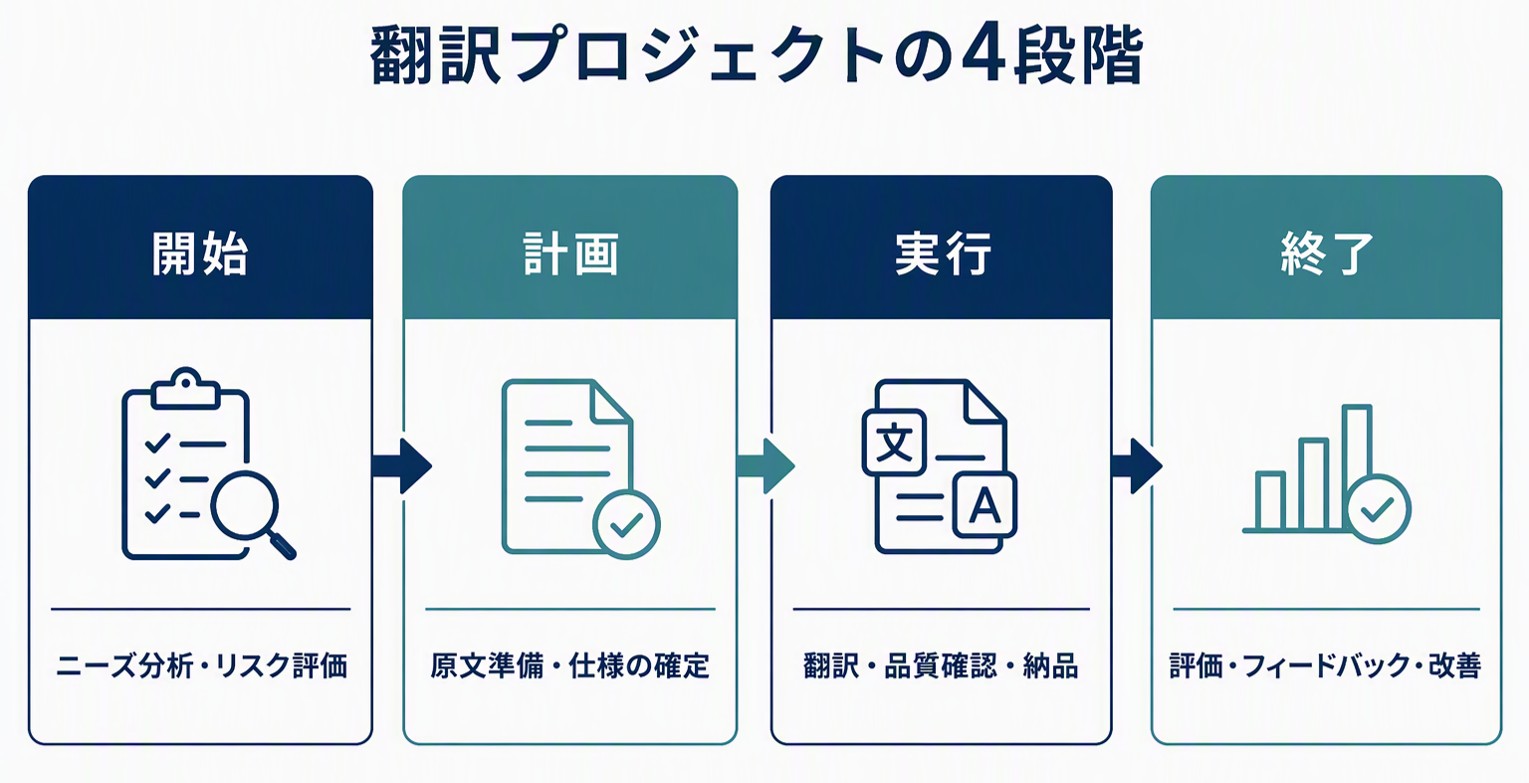
| Stage | Key considerations |
|---|---|
| Initiation | Initial needs analysis and risk assessment |
| Planning | Source text preparation and finalization and documentation of the translation project specifications |
| Execution | Translation technology, glossary preparation, preprocessing, in-process quality checks, verification, and delivery |
| End | Evaluate the translation deliverables, exchange feedback between the translation requester and provider, and use the results to improve future translation projects |
A defining feature of these four stages is that they manage not only the translation work itself, but also everything from defining requirements before work begins to evaluation and improvement after delivery, as a single project. Next, we will examine the central mechanism that supports all of these stages.
3. The Most Important Concept: Translation Project Specifications

The translation project specification is central to understanding ISO 11669. It sets out the conditions for requesting, setting up, managing, and evaluating a translation. For example, a request such as “Please translate this manual into English” leaves many decisions to the translator or translation company. At a minimum, the following conditions need to be defined in advance.
• Purpose and intended use of the translation
• Target audience and their level of knowledge
• Target language, region, and locale
• Expected quality
• Glossaries, style guides, and translation memories (or previous translations) to be used
• Production methods, such as human translation, AI translation, and post-editing
• Delivery method
Define quality requirements before translating, rather than checking quality only after translation. This is a key practical principle of ISO 11669.
>Related service: Translation Services Company with Extensive Experience | Human Science
4. Start with Needs Analysis and Risk Assessment

Clarify the purpose of the translation and its intended users
Even for the same product information, the required quality, wording, and review methods differ depending on whether it appears in internal review materials, a website, sales materials, or an instruction manual. It is important to clarify not only what will be translated, but also who will use it, in what context, and how.
Consider the impact of errors
The impact of translation errors also varies by document. Materials intended to provide an internal overview and instruction manuals containing safety warnings do not need to be translated using the same process. Identify risks such as mistranslations, omissions, and errors in numbers or units, then determine the translation method and review steps according to the importance of the document.
5. Five Points to Consider Before Designing a Project

Before applying the results of the needs analysis to your work, assess your current translation practices from the following five perspectives. The goal is to determine whether each point is being addressed and identify any issues.
1. Is the purpose of the translation documented?
Clearly define the target audience, intended use, and scope of distribution, and share this information with translators and translation companies.
2. Are quality requirements based solely on the experience of the person in charge?
Document terminology, style, review items, and other requirements as specifications.
3. Are translation methods selected according to the risks associated with each document?
Rather than applying the same process to every document, choose among AI translation, human translation, post-editing, and review according to the document's importance.
4. Are inquiries and changes being managed?
Record questions, answers, and specification changes during translation so that everyone involved can access the same information.
5. Are evaluation results being applied to the next project?
Incorporate post-delivery feedback into glossaries, style guides, translation memories, and translation project specifications.
6. Five Steps to Incorporate ISO 11669 into Your Workflow
Address the issues identified during the assessment by incorporating them into specifications and workflows in the following five steps. This approach connects the assessment items to actual deliverables and continuous improvement.
| Step | Implementation Details | Examples of Deliverables |
|---|---|---|
| 1. Assess the Current Situation | Identify document types, target languages, vendors, tools used, and review methods | Translation task inventory, current workflow |
| 2. Classification | Classify documents by purpose, importance, and risk | Document classification table, risk categories |
| 3. Specification | Define the target audience, quality requirements, terminology, production methods, and review and approval methods | Translation project specification |
| 4. Execution and Documentation | Record inquiries, changes, and review results | Inquiry history, review records |
| 5. Evaluation and improvement | Review the deliverables and process, and incorporate the findings into the next project specification | Evaluation report, improvement plan |
By defining the purpose, risks, quality requirements, and verification methods in advance, you can select a production method, including AI translation, based on its intended use rather than solely on the tool's performance.
7. Why ISO 11669 Matters in the Age of AI Translation
AI translation has expanded the range of translation options. However, as more technologies become available, it is necessary to decide not only what to use, but also under what conditions to use it. The key is not to adopt or prohibit AI translation across the board, but to choose appropriate production methods and workflows based on needs and risks.
• Internal documents for understanding content: Use AI translation alone, with users checking the content
• Customer-facing materials: Have a designated staff member or expert review the AI translation
• Contracts and safety-related documents: Have a qualified expert review them and the person responsible approve them
• High-volume, repetitive content: Develop glossaries and translation memories, and combine AI translation with post-editing
Once you have planned how to use AI translation, the final step is to clarify the respective roles of related standards. Combining standards that address processes, post-editing, and evaluation of deliverables can help make implementation more concrete.
8. Differences Between ISO 11669 and ISO 17100, ISO 5060, and ISO 18587
Each international translation standard serves a different purpose. Using ISO 11669 as a reference point, we will clarify how it differs from standards covering the provision of translation services, machine translation post-editing, and evaluation of deliverables.
| Standard and title | Content and purpose | Target audience |
|---|---|---|
| ISO 11669 Translation projects — General guidance |
General guidance on all stages of a translation project. It aims to improve the design and management of the project as a whole. | Primarily clients of translation services; translation service providers and users of translated content |
| ISO 17100 Translation services — Requirements for translation services |
Requirements for Localization processes, resources, and related aspects. The aim is to ensure appropriate Localization delivery processes and quality. | Localization providers |
| ISO 18587 Translation services — Post-editing of machine translation output — Requirements (Localization — Post-editing of machine translation output — Requirements) |
Requirements for the full post-editing of machine translation output and the competence of post-editors. The aim is to ensure that machine translation output is revised by a human to meet the required quality standards. | Translation service providers and post-editors |
| ISO 5060 Translation services — Evaluation of translation output — General guidance |
General guidance on evaluating completed translation output. It aims to support the objective and systematic evaluation of translation output. For details, please see the following page.
What Is ISO 5060? An Approach to Objectively Evaluate Translation Quality in Manufacturing |
Translation clients, evaluators, and translation service providers |
ISO 11669 addresses the design and management of the entire translation project. By referring to ISO 17100 for the execution process, ISO 18587 for full post-editing of machine translation output, and ISO 5060 for evaluating completed output, you can organize design, execution, evaluation, and improvement into a continuous workflow.
9. Conclusion: Plan for Translation Quality Before Translation Begins
ISO 11669 provides general guidance for consistently designing and managing the initiation, planning, execution, and closure of translation projects. At its core is the sharing of project specifications among stakeholders, including the purpose, target audience, quality requirements, production methods, and review and approval procedures.
When implementing this approach, first assess the current situation and classify documents by intended use and risk. Then proceed to defining specifications, execution and documentation, and evaluation and improvement. This approach is also effective when using AI translation. Rather than starting with the tool, define the scope of human review and responsibilities according to the intended use and acceptable level of risk. This makes it easier to establish a repeatable translation process that balances quality, cost, and delivery time.
Human Science Co., Ltd. offers a “Translation Checkup” service that assesses your current situation in terms of translation quality, source text quality, terminology and language assets, AI use, and translation processes, and identifies priorities for improvement. Please contact us for more information.
ISO 11669 FAQ
- Q1
Is ISO 11669 a standard for certification?
- Q2
Is ISO 11669 intended only for translation companies?
- Q3
Does it also cover AI translation and machine translation?
- Q4
How does it differ from ISO 5060?
- Q5
What is the first step in implementing it?



















 Return to the top of the page

 +81 35-321-3111[Tokyo Headquarters]
 Contact Us
 Request for Information