




In translation work within the pharmaceutical and medical fields, "difference translation" due to document revisions occurs routinely.
However, in reality,
• It takes time to identify the changes
• Although there is a desire to utilize past translations, much of the work is manual
• The review burden is high to maintain quality
There are quite a few cases facing such challenges.
Therefore, our company conducted a demonstration experiment on the differential translation process utilizing MTrans for Trados.
In this article, we will introduce the details of that initiative and the insights gained.
- Table of Contents
-
- 1. Reasons Why Differential Translation Tends to Be Inefficient
- 2. What Changes with MTrans for Trados
- 3. Results Seen from the Demonstration Experiment
- 4. Emerging Issues and Key Points for Utilization
- 5. Achieving Results in Differential Translation
- 6. Summary: Differential Translation Is a "Process with Significant Room for Improvement"
1. Reasons Why Differential Translation Tends to Be Inefficient
Difference translation refers to the task of comparing the old version and the revised version and translating only the changed parts.
In pharmaceutical translations and manual translations, by reusing previous translations and translating only the changed sections, it is possible to achieve both cost reduction and quality maintenance.
Especially in pharmaceutical regulatory documents,
• High frequency of revisions
• Reuse of previous translations is a prerequisite
• Consistency in terminology, style, and formatting is required
These are the characteristics.
Therefore, there are cases where 80 to 90% of the entire translation work involves handling differences.
Challenges Occurring on Site
In many workplaces, the following tasks occur.
• Visually checking Word's track changes
• Verifying differences that CAT tools (computer-assisted translation tools) cannot fully detect
• Rechecking to confirm "there really are no changes"
The more a process needs to be streamlined, the more it relies on manual labor.
>Related Blog: What Are CAT Tools? Introducing the Benefits and Drawbacks
2. What Changes with MTrans for Trados
Trados is a CAT tool (computer-assisted translation tool) provided by RWS. By utilizing translation memories and glossaries, it supports improving translation quality consistency and work efficiency, and it is widely used in specialized fields including pharmaceutical translation.
"MTrans for Trados" is a machine translation solution developed by our company.
Please refer to the following for more details.
>Trados-linked Machine Translation Solution MTrans for Trados
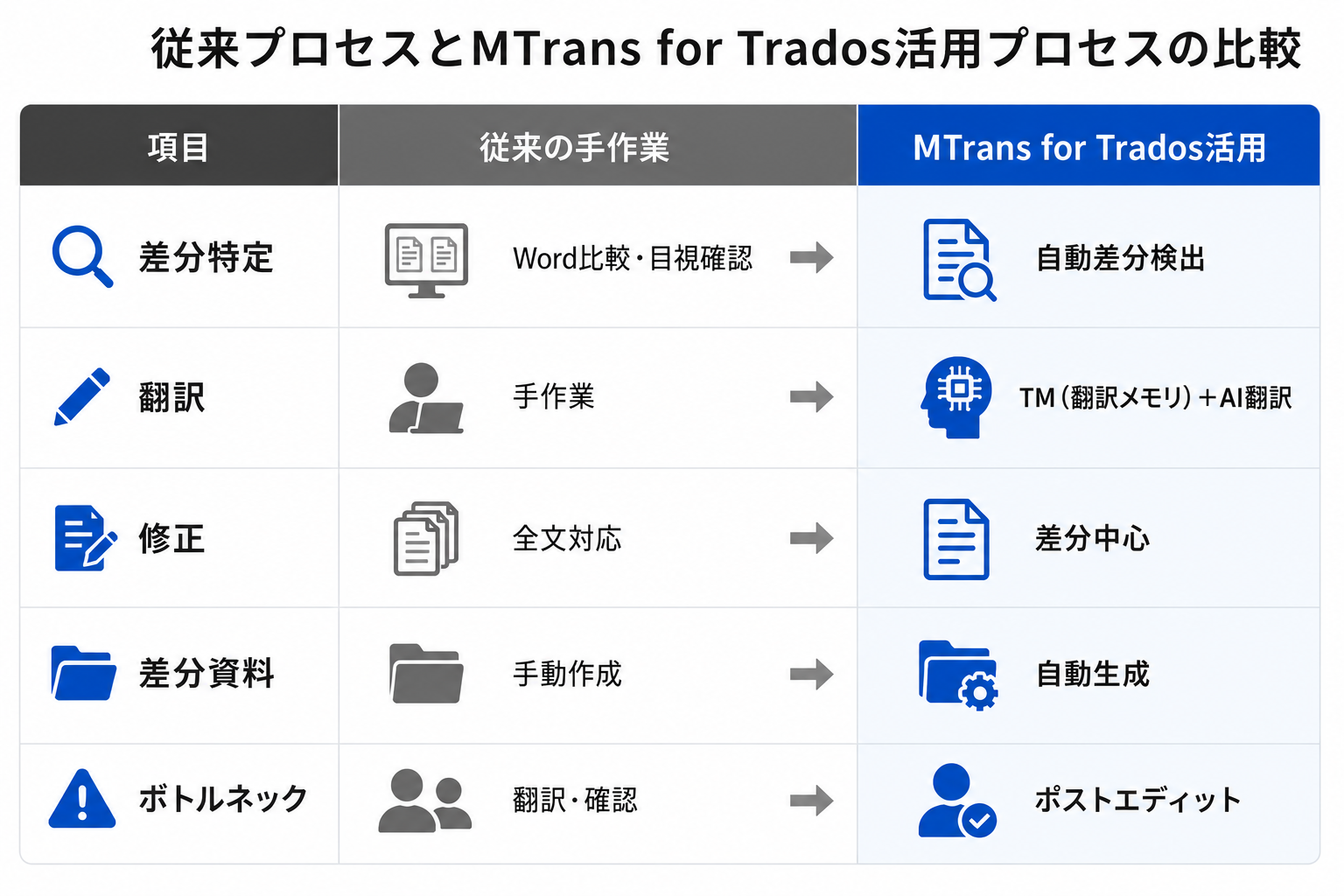
In this demonstration experiment, assuming the use of MTrans for Trados, we redesigned the differential translation process as follows.
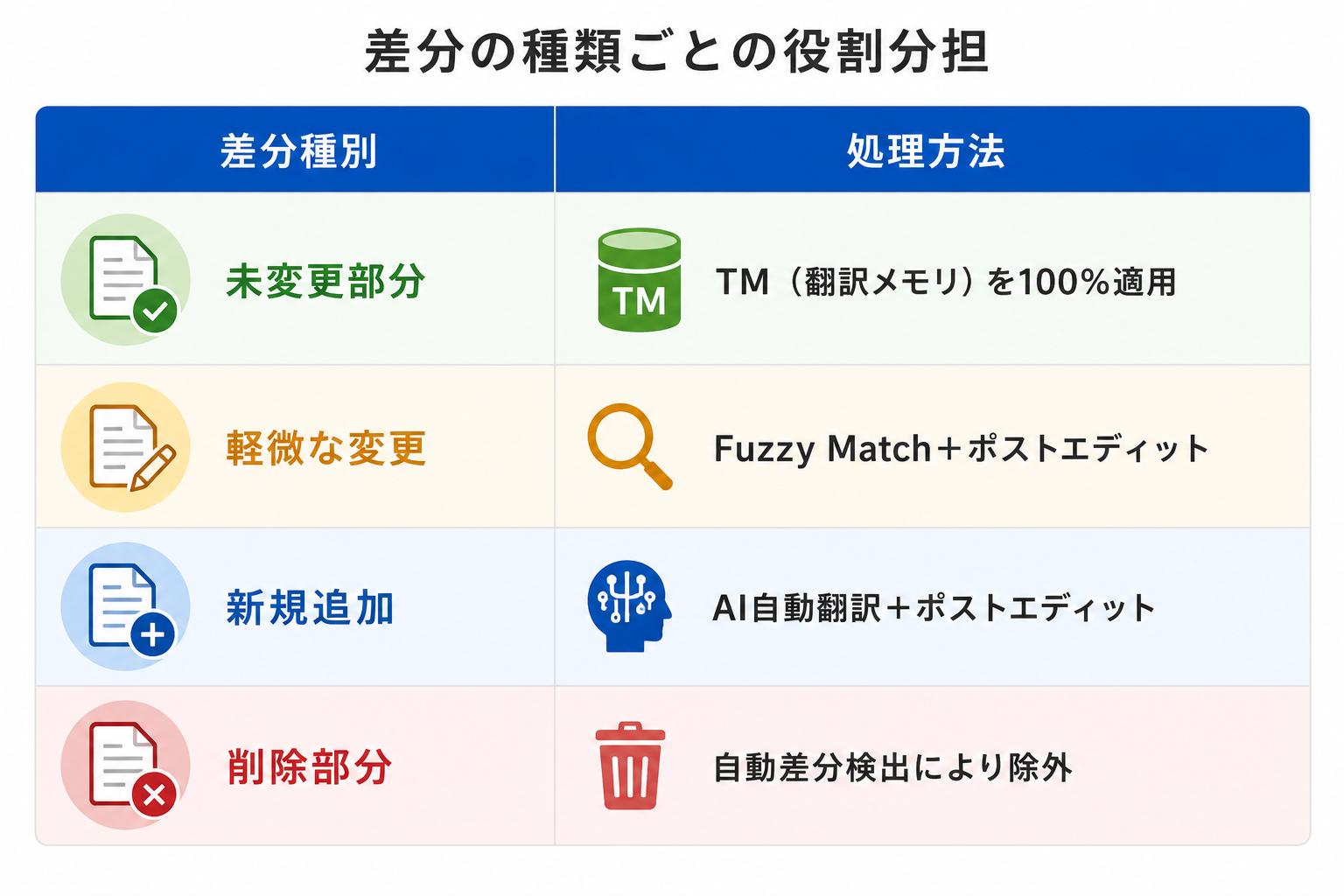
By processing these seamlessly within Trados, we aimed to reduce the very task of "searching for differences."
Comparison with the Conventional Process
>Related Blog: What Is Trados? The Features and Benefits of Using Trados for Translation
3. Results Seen from the Demonstration Experiment
Comparison of Working Time
The following results were obtained in the demonstration experiment.
• Manual process: approximately 12.5 hours
• Process utilizing MTrans for Trados: approximately 11.1 hours
An approximately 11% reduction in time was confirmed.
Depending on the refinement of AI translation prompts and TM (Translation Memory), a 20-30% time reduction can also be expected.
Translation Memory is a system that accumulates and reuses bilingual data of past source and target texts.
Because it can automatically suggest identical or similar sentences, it helps to standardize translation quality and shorten working time.
4. Emerging Issues and Key Points for Utilization
The demonstration experiment revealed not only achievements but also challenges.
Issue
• Variations in style and terminology may require manual checks after post-editing
• Manual checking workload may increase during the initial implementation phase
Important Insights
On the other hand, it was also found that the following points greatly influence the outcomes.
• TM (Translation Memory), glossary, and prompt preparation
• The idea of investing initially and recovering costs from the second time onward
5. Achieving Results in Differential Translation
What became clear through this initiative is that not only the "tool itself" but also the "operation design" is important.
Specifically,
• Design based on differences rather than just capturing differences
• Spend time on preparation before translation
• Separate processes that require human intervention from those that can be automated
This way of thinking is important.
By doing so, continuous efficiency improvements can be achieved while maintaining quality.
6. Summary: Differential Translation Is a "Process with Significant Room for Improvement"
Differential translation is not a "process that inevitably takes time," but rather a "process where the greatest improvement effects can be expected depending on the design."
Through this demonstration experiment, it was confirmed that MTrans for Trados is one effective option to support its realization. If you feel there are challenges with differential translation, why not review the entire translation process once?
Related Services
>Trados-linked Machine Translation Solution MTrans for Trados
>Post-editing Agency and Operational Support Services






















 Return to the top of the page

 +81 35-321-3111[Tokyo Headquarters]
  Contact Us
 Request for Information