




The Japanese market is an attractive market with one of the largest economic scales and purchasing power in the world. On the other hand, for overseas companies aiming to enter the Japanese market, the "language barrier" is the first and biggest hurdle. Many companies may have experienced translating their products or services into Japanese and launching them, only to feel that "for some reason, it doesn’t resonate with Japanese customers" or "the appeal of the brand is not being conveyed."
The root cause of this often lies not in the quality of the translation itself, but in the absence of a localization strategy that takes into account the cultural and linguistic requirements unique to the Japanese market. Japanese is a language with complexities not found in other languages, such as its grammatical structure, honorific system, and three types of writing systems (kanji, hiragana, katakana). Additionally, Japanese business culture is high-context (highly dependent on context), making communication based on literal translation difficult to succeed.
This article systematically organizes the situations in which overseas companies need translation and localization in the Japanese market, and explains the challenges and solutions unique to the Japanese market. Furthermore, it delves into why the approach of having a translation company’s project manager (PM) stationed within the company is effective for overseas companies expanding into Japan.
- Table of Contents
-
- 1. Situations Where Overseas Companies Need Translation and Localization in the Japanese Market
- 2. Localization Challenges Unique to the Japanese Market
- 3. Approaches to Solving Localization Challenges in the Japanese Market
- 4. Why Having a Dedicated Translation PM Is Effective for Overseas Companies Expanding into Japan
- 5. Human Science, Inc.'s On-site Translation PM Service
- 6. Summary
1. Situations Where Overseas Companies Need Translation and Localization in the Japanese Market

When overseas companies enter the Japanese market, there are many situations where translation is required. Moreover, the Japanese market has numerous unique requirements that do not exist in other markets. First, let's organize the types of tasks where translation and localization occur.
Japanese Localization of Products and Services
Localization into Japanese is required for all texts related to products and services, such as software UI/UX texts, product manuals, online help, and e-learning materials. Compared to English, Japanese text length tends to vary more, necessitating support for full-width characters and layout readjustments. Additionally, compliance with JIS (Japanese Industrial Standards) and Japanese safety standards is often required, meaning that not only linguistic accuracy but also expressions and structures aligned with Japan-specific standards are necessary.
Localization of Marketing and Sales Materials
Translations in the marketing domain, such as websites, product catalogs, sales materials, white papers, press releases, advertising copy, and SNS content, are particularly challenging in the Japanese market. Simply substituting words does not effectively encourage action from Japanese customers.
Even if you directly translate sales materials created in English by the head office, the logic structure is Western-style, making it difficult for Japanese businesspeople to understand, and the literal Japanese translation tends to give an impression of being "unnatural" and "distant." For the Japanese market, it is essential to adopt a transcreation approach (translation × copywriting) that reconstructs expressions based on the culture and business customs of the target audience.
Legal and Regulatory Compliance Documents
To conduct business in the Japanese market, it is necessary to prepare documents that comply with Japanese legal systems. This includes creating Japanese versions of contracts and terms of use, adapting privacy policies to Japan's Personal Information Protection Law, and translating industry-specific regulatory documents.
Particularly challenging is compliance with industry-specific regulations. For pharmaceuticals and medical devices, this includes application documents to the PMDA (Pharmaceuticals and Medical Devices Agency); for food and cosmetics, compliance with Japan’s ingredient labeling and labeling regulations; and for chemicals, the creation of Japan-specific Safety Data Sheets (SDS). This requires specialized knowledge and a deep understanding of Japanese laws and regulations.
Internal Communication and Human Resources
With the establishment of a Japanese subsidiary, it is necessary to translate work rules and employment contracts into Japanese in compliance with Japanese labor laws. Translations related to internal communication, such as notifications and policy documents from headquarters, training materials, and the internal portal, also occur continuously. Since these documents are used daily by Japanese employees, having natural and accurate Japanese affects employee engagement.
Customer Support
Localization of customer-facing content such as FAQs, help centers, support email templates, and chatbot responses into Japanese is also important. Japanese consumers have high expectations for support quality, and unnatural Japanese support content directly leads to a loss of trust in the product or service.
Japanese SEO Measures
To establish an online presence in the Japanese market, SEO (Search Engine Optimization) in Japanese is indispensable. Direct translations of English keywords often fail to match the search behavior of Japanese users, and it is also necessary to address variations in kanji, hiragana, and katakana spellings (e.g., "server" and "sābā"). In the Japanese market, platforms such as Yahoo! JAPAN and LINE, which differ from global ones, are important channels, so optimization for these should also be considered.
2. Localization Challenges Unique to the Japanese Market

After understanding the situations that require translation, the next step is to grasp the unique challenges of localization specific to the Japanese market. Many overseas companies try to apply translation processes that succeeded in other markets directly to Japan, only to find that they do not achieve the expected results. Here, we outline the challenges unique to the Japanese market behind this issue.
Japanese in a "translated style" undermines trust
The grammatical structure of Japanese is significantly different from English (SOV word order, omission of the subject, predicate at the end of the sentence), and if English syntax is transferred directly into Japanese, it results in an unnatural style called "translated style," even if grammatically correct. Japanese consumers and business people are sensitive to translated-style sentences, and unnatural Japanese can give the impression that "this company is neglecting the Japanese market."
The complexity of honorifics and style differentiation
Japanese has a three-tiered honorific system consisting of respectful language, humble language, and polite language, which must be used appropriately depending on the relationship with the reader and the nature of the document. The writing style differs between B2B technical documents and B2C marketing copy, and the tone also changes between official documents for external audiences and internal communications. Misusing these distinctions can give customers an impression of rudeness or, conversely, an overly formal and stiff impression.
Adaptation to a High-Context Culture
Japan has a culture of "reading between the lines," where more reserved and nuanced expressions are often preferred over direct statements. The "assertive and powerful appeals" effective in Western marketing can be perceived as "pushy" in Japan. Even when conveying product superiority, an approach that carefully demonstrates "reliability," "peace of mind," and "track record" is effective in the Japanese market.
Balance of the Three Writing Systems
Japanese uses three types of writing systems: kanji, hiragana, and katakana. It is common to write loanwords in katakana, but texts with too much katakana become difficult to read and give a superficial impression. On the other hand, too many kanji make the text feel rigid and unapproachable. Maintaining a comfortable balance for the reader is important in creating natural Japanese content.
Response to Japan-specific Standards and Legal Regulations
Technical documents require terminology and unit notation based on JIS (Japanese Industrial Standards), and medical-related documents need expressions compliant with the Pharmaceutical and Medical Device Act. Since these standards and laws have different criteria from other countries, experts familiar with Japanese legal regulations must be involved in the translation process.
Governance Coordination with Headquarters
A unique challenge for overseas companies is how to balance "global brand consistency" with "optimization for the Japanese market." While adhering to the brand guidelines set by headquarters, it is necessary to decide how far to localize according to Japanese culture and business practices. This decision requires the involvement of personnel who understand both the global brand strategy and the Japanese market.
3. Approaches to Solving Localization Challenges in the Japanese Market

These challenges cannot be resolved by translators' language skills alone. To achieve results in the Japanese market, it is necessary to design and operate the entire translation process tailored to the Japanese market. Here, we introduce specific approaches to solving these issues.
Shifting the mindset from "Translation" to "Localization"
Localization is not merely language conversion; it is the optimization of products and content to align with the culture, customs, and laws of the target market. In expanding into the Japanese market, translation is only one element of localization. Reframing it as a comprehensive adaptation process—including design adjustments, conversion of dates, currency, and units, as well as cultural considerations—is the first step toward success.
Incorporate a rewriting process into marketing translation
In the translation of marketing materials, it is effective to add a "rewriting" step after the usual translation and review. In the rewriting process, the text is restructured from the perspective of whether it sounds natural as a Japanese marketing document and whether it resonates with Japanese readers, without being constrained by the original English structure. While maintaining translation accuracy, refining the expression to be appealing to Japanese readers enhances the persuasive power of the brand message.
Establish Japanese Style Guides and Glossaries Early
For style guides aimed at the Japanese market, it is necessary to define guidelines for levels of polite language, unify writing styles (whether to use desu/masu form or da/dearu form), set rules for katakana word notation, and establish policies for kanji usage. By preparing these at the early stages of translation, you can reduce quality variations among translators and ensure brand consistency. Similarly, it is important to finalize the Japanese notation of product names and technical terms in the glossary early on.
Establish a Translation System Well-Versed in Japanese Laws and Regulations
For the translation of legal documents and regulatory compliance materials, it is necessary to assign specialized translators who are well-versed in Japanese laws and industry standards. The required expertise varies by field, such as expressions in technical documents based on JIS standards and descriptions in medical documents compliant with the Pharmaceutical and Medical Device Act. Prioritizing specialization from the translator selection stage helps mitigate risks.
Appropriate Use of AI Translation
AI translation is an effective tool for efficiently handling large volumes of text, such as internal documents and support content. However, using AI translation output as-is for documents where naturalness and accuracy of expression are critically important—such as marketing materials and legal documents—poses risks. It is essential to design an operational approach that differentiates between AI translation plus post-editing, AI translation plus rewriting, and professional translation according to the type of document and the required quality level.
Establish a governance system that balances global and Japanese needs
To reconcile the headquarters' brand guidelines with optimization for the Japanese market, it is necessary to have personnel and processes that can mediate between the global marketing team and the Japanese subsidiary, aligning the intentions of both parties. By agreeing in advance on the criteria for "how far localization is acceptable," you can reduce the adjustment costs for each project.
4. Why Having a Dedicated Translation PM Is Effective for Overseas Companies Expanding into Japan

For overseas companies that have just entered Japan or companies whose Japanese subsidiaries have limited translation resources, it is not easy to implement these solutions on their own. It is common to have no personnel within the company who can assess the quality of Japanese, no staff familiar with Japanese regulations and business practices, and to be so busy coordinating with headquarters that there is no time to improve the translation process. Such situations are not uncommon.
An effective approach is to have a project manager (PM) from a translation company stationed within the Japanese subsidiary. By placing translation and localization experts in-house, you can fundamentally resolve the unique challenges faced by overseas companies.
The reassurance of having a Japanese market "connoisseur" in-house
The resident PM directly checks the Japanese quality of translations within the company and can instantly judge "how this expression will be perceived by Japanese readers." By evaluating translation quality from a native Japanese perspective and providing prompt feedback to translators, they prevent situations where "the translation fails to resonate."
The "Bridge" Between Headquarters and the Japanese Subsidiary
In translation projects for overseas companies, collaboration with the headquarters' marketing and product teams is indispensable. The resident PM, well-versed in the Japanese market conditions and also understanding the headquarters' brand guidelines and quality standards, functions as a bridge that identifies the balance point between "global consistency" and "optimization for the Japanese market."
Creation and Management of Japanese Style Guides and Glossaries
For companies newly entering the Japanese market, Japanese style guides and glossaries are often not yet established. The resident PM deepens their understanding of the products and business while building Japanese style guides and glossaries from scratch that align with the company’s brand, continuously updating them in line with new product releases and organizational changes. This establishes a solid foundation for translation quality.
Design and Standardization of Translation Workflows
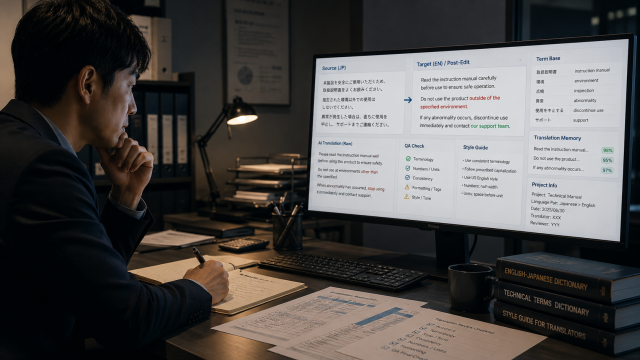
The resident PM closely observes internal workflows and designs the optimal translation process for each type of document. For marketing materials, a rewriting step is incorporated; for technical documents, a JIS standard check is added; and for internal documents, AI translation plus post-editing is applied, enabling optimization of the balance between quality and cost according to document type.
Reduction of Communication Costs
In the Japanese branches of overseas companies, it is often the case that the staff requesting translations are not native Japanese speakers. With an on-site PM, after receiving briefings in English, the Japanese translation requirements can be accurately conveyed to the translators. This simplifies the multi-step transmission of information—"Headquarters → Japanese branch staff → translation agency sales → PM → translator"—and prevents information degradation.
Navigation of Japanese Regulatory Compliance
Translation requirements related to Japan-specific standards and regulations are areas that are difficult for overseas companies to grasp. The resident PM utilizes the translation company's network to appropriately assign specialized translators in each field and routinely makes judgments such as "This document requires JIS compliance" and "This notation poses issues under the Pharmaceuticals and Medical Devices Act," thereby reducing compliance risks.
Introduction and Operational Design of AI Translation
For overseas companies with large volumes of translation, utilizing AI translation is an important means of cost reduction. The resident PM gradually implements the introduction while considering the internal situation, from selecting AI translation engines suitable for the target languages, setting quality standards for post-editing, to establishing operational rules for each document type. To maximize the effect of AI translation implementation, operational design is more important than tool selection, and this is a role that only a resident PM who is well-versed in internal operations can fulfill.
Cost Visualization and Reporting to Headquarters
In Japanese subsidiaries of overseas companies, it is often necessary to report the appropriateness of translation costs to headquarters. The resident PM accumulates and analyzes data such as translation order volume, unit price, translation memory utilization rate, and quality scores, and can create reports that clearly justify cost optimization. Being able to quantitatively explain the value of translation investment in the Japanese market to decision-makers at headquarters is a significant advantage.
5. Human Science, Inc.'s On-site Translation PM Service

Since its founding in 1985, Human Science Co., Ltd. has provided a wide range of services in the field of technical communication, including manual production, translation and localization, and e-learning production. Since starting its translation services in 1994, the company has accumulated over 20,000 translation projects spanning more than 30 years. With extensive experience working with global companies such as Apple, Microsoft, and HP (Hewlett-Packard), Human Science has handled numerous localizations from English to Japanese, primarily in the IT, manufacturing, pharmaceutical, and medical device sectors.
Strengths Supporting the Expansion of Overseas Companies into Japan
Human Science's Japanese translation and localization services are characterized by providing translations that fully comply with Japanese laws and standards. Translators familiar with Japan-specific regulatory requirements handle technical documents based on JIS and medical-related documents compliant with the Pharmaceutical and Medical Device Act.
In marketing translation, we adopt an approach that adds a "rewrite" step to the usual translation flow, reconstructing the text into natural Japanese expressions that are not bound by the original English structure. In fact, in a case where we supported the localization of marketing materials for the Japanese market of a certain US IT company, we improved materials that felt "unconvincing" due to literal translation through the rewrite process, contributing to an enhanced presence in the Japanese market.
Overview of the On-site PM Service
Human Science provides a service where translation project managers and multilingual translation coordinators/directors are stationed within the client's company to support the optimization of the entire translation workflow. The on-site PM is not just a translation contact point but a partner who transforms the client's translation operations from within.
The biggest difference from typical staffing services is that behind the on-site staff stands Human Science’s production department as a technical team. We have established a system that allows us to directly provide not only the individual skills of the on-site staff but also the know-how and translation technology that Human Science has cultivated as an organization to our clients.
Tasks Handled by the Resident PM
・Development and Management of Japanese Style Guides and Glossaries: We design the foundation for translation quality tailored to the Japanese market from scratch.
・Design and Standardization of Translation Processes: We set quality standards for each document type, differentiate translation methods (professional translation / AI translation + post-editing / rewriting), and build workflows.
・Translation Direction and Coordination: We manage the entire translation project process, including selecting and instructing translators, schedule management, quality checks, and layout verification after DTP.
・Coordination and Governance with Headquarters: We balance global brand guidelines with optimization for the Japanese market, and also handle reporting to headquarters and cost analysis.
・Support for AI Translation and CAT Tool Implementation: We provide hands-on support from the introduction to operational design of AI translation tools such as "MTrans Team" and "MTrans for Office," as well as translation support tools and workflow systems like Trados and Phrase.
>Related Material: Why Do Multilingual Projects Fail? Six Skills Required for Translation Directors
Customer Feedback
[Major Electronics Manufacturer] Multilingual Manual Production Project
"To establish a production system with strict confidentiality measures, we had a translation coordinator dispatched. Due to the high security requirements, we could not outsource externally, but by having a translation coordinator stationed from Human Science, multiple production lines were smoothly managed leveraging many years of experience."
[Data Analysis & Analytics Software Company] Web Marketing Localization
"They are exclusively responsible for coordinating and managing all web-related translation projects across APAC. They handle a wide range of tasks including managing translations with external companies, copywriting, SEO measures, updating the glossary, and supporting the implementation of translation systems. They have now become an indispensable presence for our company."
6. Summary
For overseas companies to succeed in the Japanese market, mere translation is not enough; localization optimized for Japanese culture, language, and regulations is essential. Japanese that sounds like a translation undermines trust, incorrect use of honorifics and writing styles hinders relationship building with customers, and overlooking Japan-specific regulatory requirements leads to compliance risks.
The approach of stationing a project manager from the translation company within the Japanese subsidiary comprehensively addresses these challenges. The greatest value lies in being able to solve translation issues unique to the Japanese market "from within," including judging Japanese language quality, coordinating governance with headquarters, building style guides, designing translation processes, managing AI translation operations, and visualizing costs.
If you feel challenges in strengthening your presence in the Japanese market or improving translation quality, please do not hesitate to consult Human Science. We will propose the optimal localization system tailored to your situation.

















 Return to the top of the page
 +81 35-321-3111[Tokyo Headquarters]
  Contact Us
 Request for Information