


 Text Annotation
 Audio Annotation
 Image & Video Annotation
 Generative AI, LLM, RAG Data Structuring
 AI Model Development
 In-House Support
 For the medical industry
 For the automotive industry
 For the IT industry
 For the manufacturing industry

For those considering outsourcing the recording of Japanese voice data for AI training
Do you have these concerns?
- ・I want to collect voice data for AI training, but I don’t know how to decide the requirements
- ・I want to know if it is possible to outsource speaker recruitment and attribute management.
- ・I am worried about frequent quality non-conformities after recording.
- ・I want to collect a large amount of Japanese voice data within a short deadline.
This article explains practical points to address these challenges based on the insights gained from a conversation recording project of approximately 249 hours that our company handled.

- Table of Contents
-
- 1. Overview of the Voice Data Recording Project
- 1-1. Key Points for Defining Requirements to Prevent Backtracking
- 1-2. Recruiting Design to Ensure Attribute Distribution
- 1-3. Speaker-Specific Track Management Important in Conversation Recording
- 1-4. Operational Instructions and Innovations at the Recording Site
- 1-5. Pilot Projects and Pre-Quality Checks
- 1-6. Progress Management to Achieve Short-Deadline Projects
- 2. Summary
1. Overview of the Voice Data Recording Project
As expectations for speech recognition and voice interaction using AI increase, voice training data has become a crucial element to meet those needs.
In collecting conversational voice data, it is necessary to record in a format and quality suitable for AI training while reproducing natural conversations between people in conditions close to actual usage environments. High-quality voice data that meets diverse requirements—not only the spoken content but also speaker attributes and recording conditions—is required. Even seemingly simple requirements for AI training voice data recording, such as "as long as it is intelligible" or "background noise is acceptable," can lead to discrepancies in quality perception at the delivery stage. The diagram below shows the overall flow from requirement definition to delivery. The following chapters explain key points for each process.


▼Related Blog
What is AI Speech Recognition? — Mechanisms of Speech Recognition and 4 Use Case Examples —
1-1. Key Points for Defining Requirements to Prevent Backtracking
Consultations for recording audio data for AI training are increasing, but there are many cases where progress is requested before the requirements are fully finalized, and new conditions are added after delivery.
In fact, even in the 249 hours of audio recording projects handled by our company, how concretely the recording conditions, speaker attributes, noise standards, and rework procedures could be defined in advance determined the overall success or failure of the project.
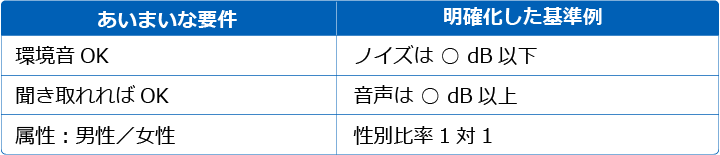
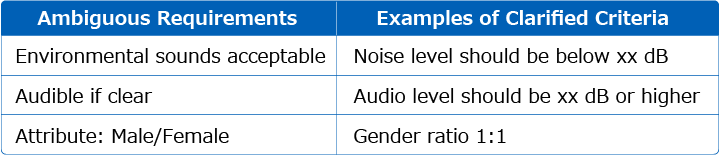
In actual projects, the following types of misunderstandings occurred. For parts that the client may not have fully anticipated, it is necessary to standardize and verbalize them numerically and reach agreement with ambiguity minimized as much as possible.
Common examples of misunderstandings during outsourcing:
- ・"Background noise was allowed," but after delivery, it was pointed out that the noise was too loud
- ・"As long as it was audible, it was okay," but it was pointed out that the volume was too low
- ・Only "male/female attribute specification" was given, but a 1:1 gender ratio was required
1-2. Recruiting Design to Ensure Attribute Distribution
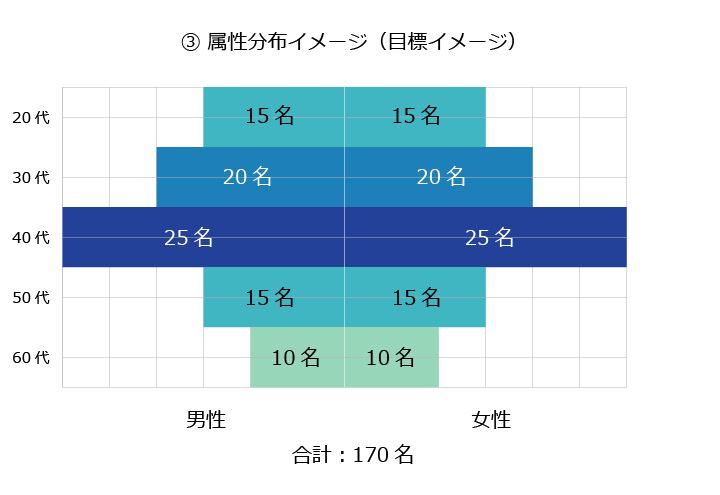
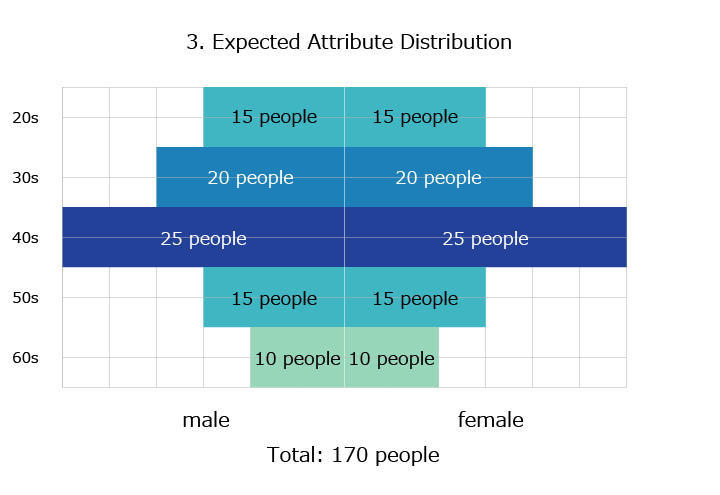
As attribute requirements, distributions such as gender, age, region, and educational background are requested. When actually proceeding with speaker recruitment, attributes that are difficult to secure can become bottlenecks. For example, in online recordings, participants familiar with PC operation tend to gather easily, while securing participants in their 70s and 80s can be challenging.
Additionally, due to Japan’s population distribution, restrictions based on residential area are significant, making dialect recordings often difficult. Regarding distribution design, it is reassuring to identify bottlenecks at an early stage and coordinate with the client in advance about distribution ratios and acceptable ranges. Also, the recording time available per person (limit) greatly affects the workload. Since the number of required participants doubles when the available recording time per person is 1 hour compared to 2 hours, this point also requires attention.
1-3. Speaker-Specific Track Management Important in Conversation Recording
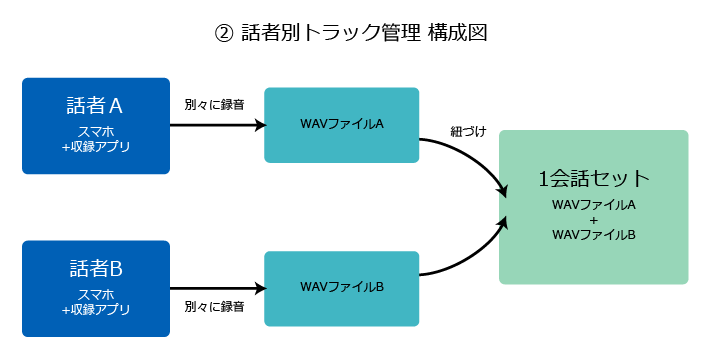
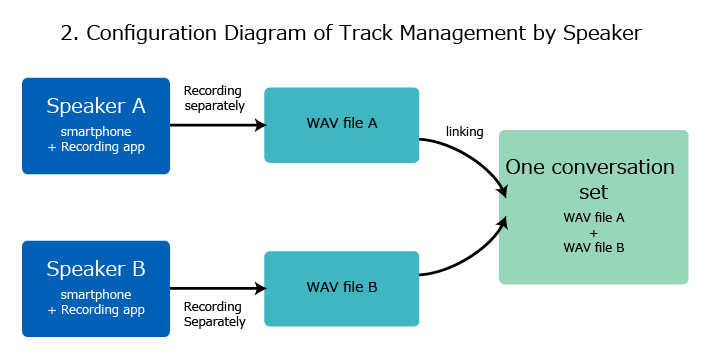
In conversation recordings for AI training, it is necessary to deliver the audio in a state where the speech of each speaker can be individually extracted. Therefore, even in a single conversation, microphones are separated by speaker, and the audio is recorded separately. By creating individual WAV files for each speaker, it becomes possible to isolate the necessary audio as training data.
・Options for Recording Methods
In actual recordings, we use different methods depending on participants’ environments and technical hurdles.
| Recording Method | Overview | Benefits | Points to Note |
|---|---|---|---|
| Smartphone + Recording App |
Install the specified recording app on each speaker’s smartphone and record using the device’s microphone | No special equipment required, reducing participant burden. Easier to expand recruitment targets | Sound quality tends to vary due to differences in microphone performance across devices |
| PC + Recording App + Headset |
Install the recording app on the PC and use a headset for recording | Easier to maintain stable volume. Less likely for audio interference to occur | High barrier for participants unfamiliar with PC operation |
・Key Points for File Management
Establishing a naming convention in advance that includes conversation ID, category ID, speaker ID, etc., helps prevent confusion when managing a large number of files. (Example: Tokyo001_spk01.wav)
1-4. Operational Instructions and Innovations at the Recording Site
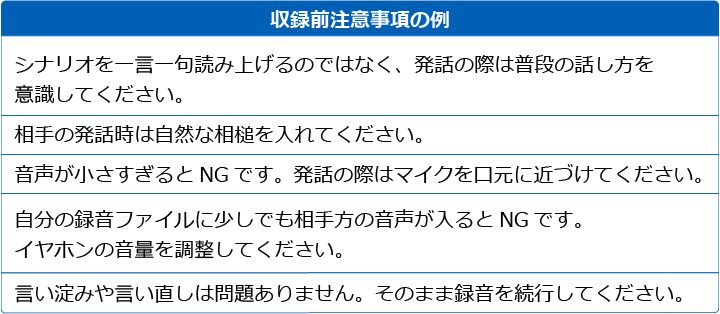
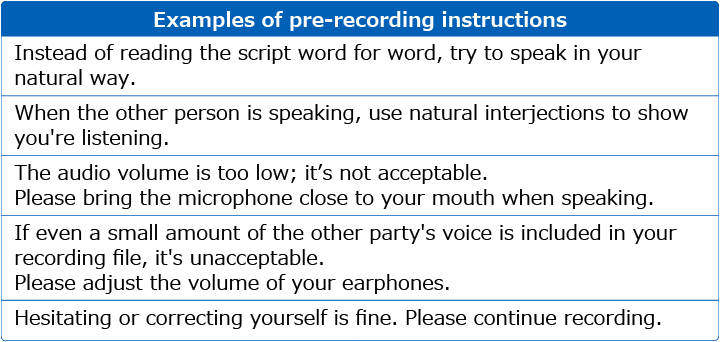
In actual voice recording settings, there can be issues such as participants stumbling over words or noise being too loud to meet the learning data requirements, causing things not to go smoothly. It is necessary to prepare scenarios and topics in advance and provide instructions on points to note, among other practical measures for recording.
Below is an example of pre-recording precautions used in an actual project. During recording, conveying specific operational points rather than numerical standards helps reduce the rate of audio rejections.
1-5. Pilot Projects and Pre-Quality Checks
Since it is often difficult to align requirements for voice data recording, we ask clients to conduct a pilot project before the main recording. In the pilot, a small number of participants (e.g., about 2 to 3 pairs) go through the entire actual recording flow to verify the following points.
- ✓ Whether the set noise and volume standards are realistic
- ✓ Whether there are any issues with the recording procedures or app operation
- ✓ Whether natural conversations as expected are being recorded
- ✓ To what extent the rejection rate occurs
Separately from the pilot, all participants in the recording are asked to submit voice samples in advance, and pass/fail judgments are made based on numerical criteria. Based on the pilot results, standards and procedures are adjusted, and after reaching an agreement with the client, the main recording proceeds.
However, since it is difficult to completely prevent rejections, a buffer is set assuming that a certain amount of rejections will occur, and the necessary recording time is determined accordingly.
1-6. Progress Management to Achieve Short-Deadline Projects
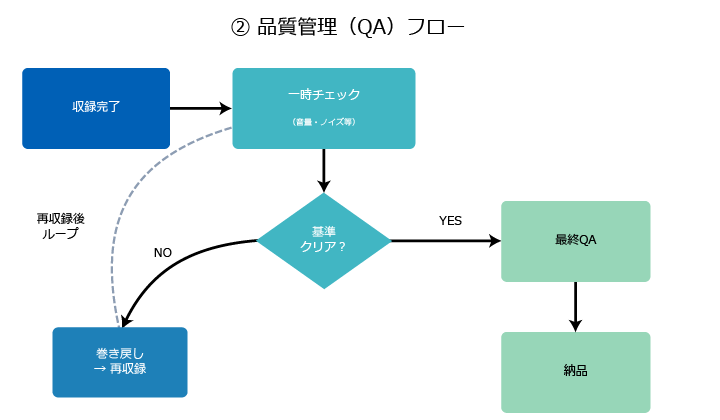
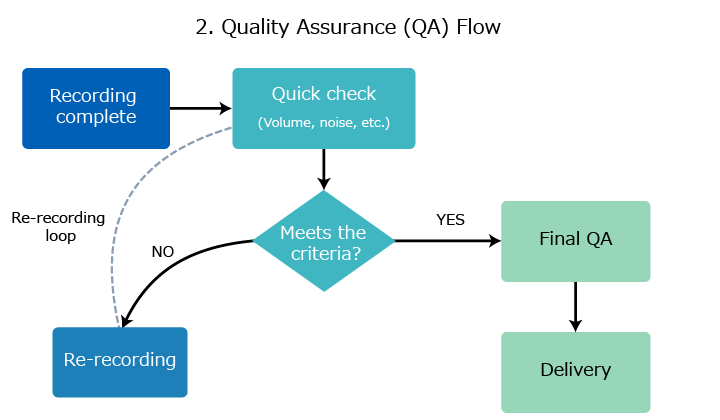
In short-deadline projects, a management system that allows recording, verification, and rework handling to proceed concurrently is crucial. A sequential flow where quality checks are conducted only after all recordings are completed risks delayed problem detection and schedule breakdown.
In this project, we advanced the process concurrently with the following operations.
- ✓Conduct quality checks sequentially from the completed recordings, and promptly send back any audio that does not meet the standards
- ✓Aggregate the recording status by attribute weekly and prioritize recruiting for attributes that are lacking
- ✓Pre-schedule re-recording slots for any returned audio
By visualizing progress and early identification of attributes and recording conditions that tend to become bottlenecks, the risk of delivery delays can be minimized even for projects on the scale of 249 hours.
2. Summary
In audio data recording for AI training, the design and management before and after the recording itself have a greater impact on the success or failure of the project than the act of recording. Let’s review the key points of this article.
- ✓Requirement Definition: Standardize ambiguous requirements numerically to prevent misunderstandings in advance
- ✓Recruiting Design: Identify hard-to-secure attributes early and align distribution ratios
- ✓Speaker-Specific Track Management: Prevent management errors of large data by selecting recording methods and unifying file naming conventions
- ✓Operational instructions: Communicate specific work-related precautions rather than numerical criteria to reduce the rate of rejections
- ✓Quality control: Prepare for the risk of rejections through prior sample checks and buffer design
- ✓Pilot implementation: Verify with a small group before the main recording to confirm the validity of standards and procedures
- ✓Progress Management: Parallelize processes to identify bottlenecks early and prevent delivery delays
By addressing these points, it becomes possible to achieve both quality and delivery deadlines.
Our company provides comprehensive support from organizing recording requirements, speaker recruiting, recording operations, quality checks, to handling rejections. Even if your requirements are not fully finalized, please feel free to consult us starting with identifying the necessary conditions.









































































































 Return to the top of the page
 +81 35-321-3111[Tokyo Headquarters]
  Contact Us
 Request for Information
 TOP
TOP SITE MENU