


- Table of Contents
-
- 1. What is Machine Translation?
- 2. The Mechanism of Machine Translation
- 3. Pros and Cons of Machine Translation
- 4. The Latest Trends in Machine Translation
- 5. The Leading Machine Translation Services: DeepL and Google Translate
- 6. Comparison of Translation Accuracy
- 7. Points to Note When Using Machine Translation for Business
- 8. Summary
1. What is Machine Translation?
Machine translation is a technology that uses computer programs to automatically translate text written in one language into another language. It is also known as automatic translation, MT (Machine Translation), or AI translation. Well-known services include DeepL and Google Translate. Currently, it is used not only in research and business but also in everyday situations such as browsing foreign news and during travel. Machine translation can be easily accessed through built-in translation features in web browsers and translation apps for smartphones, and its convenience has led to its widespread adoption.
Thanks to machine translation, information gathering and communication have become easier. Regardless of language, it has become simple to access information and content from around the world, allowing the latest information to be obtained instantly. Additionally, communication with people who speak different languages has become possible, making international exchange more familiar. Machine translation is utilized in education and business, not only helping with studying abroad and overseas business trips but also contributing to information gathering for research and development, as well as improving the efficiency of communication with overseas counterparts.
The terms "machine translation" and "automatic translation" are often used interchangeably, but they are strictly distinguished. First, the term "machine translation" generally refers to the translation technology or the translation process itself. For example, the latest translation algorithms utilizing neural networks and research and development activities aimed at improving translation accuracy fall under "machine translation." This term focuses on the technical aspects and processes.
On the other hand, "automatic translation" often refers to translation systems or services provided mainly for users. It especially refers to systems that perform real-time translation without user intervention, such as translation functions built into web browsers or real-time voice translation features in smartphone apps. Since these perform translations automatically without requiring special actions from the user, the term "automatic translation" is appropriate.
2. The Mechanism of Machine Translation
There are mainly three types of mechanisms for machine translation.
• Rule-based machine translation
Translation is performed using linguistic rules and dictionaries. It generates sentences in the target language through morphological analysis, syntactic analysis, and semantic analysis.
• Statistical machine translation
It learns statistical patterns from a large bilingual corpus and performs translation using a probabilistic model. There are approaches based on words, phrases, and syntax.
• Neural Translation
Using deep learning technology, it learns language conversion with neural networks. It captures the meaning of sentences and grammatical relationships in comprehensive vector representations, enabling more natural translations.
For details on these translation methods, please see the page below.
3. Pros and Cons of Machine Translation
One of the advantages of machine translation is its speed. Machine translation operates much faster than human translators, making it possible to translate large volumes of text in a short time. Additionally, it is more cost-effective compared to outsourcing to translation companies. Furthermore, it supports multiple languages, with some services capable of translating over 100 languages.
A disadvantage of machine translation is the issue of accuracy. Machine translation is not perfect, and it can be particularly difficult to accurately capture cultural backgrounds and idiomatic expressions. As a result, the translated text may sometimes sound awkward. Additionally, texts that heavily depend on context are more prone to mistranslations. Therefore, it is not recommended to use machine-translated documents as-is, and human review is essential. For especially important documents such as contracts, it is advisable to outsource to professional translation companies.
4. The Latest Trends in Machine Translation
The machine translation market was valued at 153.8 million USD in 2020, is expected to grow at an average annual rate of 7.1% from 2021 to 2026, and is projected to reach 230.67 million USD by 2026 (Source: Mordor Intelligence, "Machine Translation Market - Growth, Trends, COVID-19 Impact, and Forecast (2022-2027)"). In Japan as well, DeepL has recently gained attention, and the adoption of machine translation by companies is increasing.
5. The Leading Machine Translation Services: DeepL and Google Translate
DeepL is a machine translation service released in 2017 by the German company DeepL. Initially, it supported only European languages, but in March 2020, Japanese was newly added. DeepL has long provided the bilingual search engine Linguee, and by combining the bilingual data collected there with deep learning, it has realized a highly accurate machine translation service.
Google Translate is a machine translation service released by Google in 2006. Although its initial translation accuracy was not very high, it was revamped in November 2016 with a system called Google Neural Machine Translation (GNMT), which uses deep learning, significantly improving accuracy especially for Chinese and Japanese. Machine translation has been used for over 20 years, but the introduction of Google Neural Machine Translation has further accelerated the utilization of machine translation.
6. Comparison of Translation Accuracy
Our company evaluated the machine translation services of DeepL, Google, Microsoft, and Amazon across various fields including IT, medical, machinery, contracts, and patents, and calculated BLEU scores. The BLEU score is a numerical measure of similarity obtained by mechanically comparing the machine-translated text with a human-translated reference text. The range is from 0 to 1, with values closer to 1 indicating greater similarity to the reference translation. Even if the meaning is the same, differences in words or expressions can lower the score, but it correlates with human evaluation, and higher values are considered to indicate higher machine translation accuracy. As a guideline, if the score is 0.3 or above, it is generally faster to revise the machine-translated text than to translate from scratch by a human (though this depends on quality requirements).
The evaluation results are as follows.
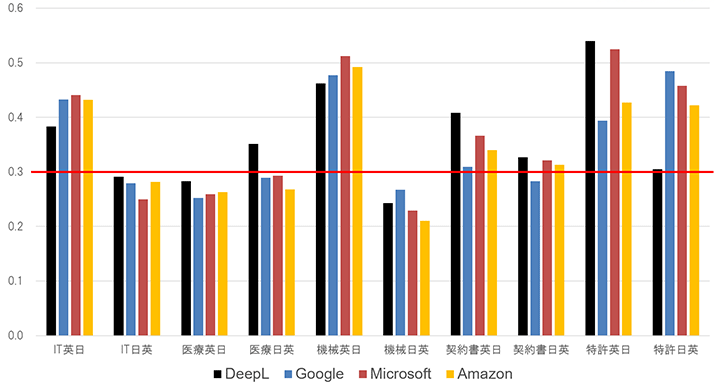
DeepL excels in IT Japanese-English, medical English-Japanese and Japanese-English, contract English-Japanese and Japanese-English, and patent English-Japanese translations. Although DeepL has a good reputation, it is clear that other machine translation services such as Google and Microsoft outperform it depending on the field and language direction. It is recommended to use different machine translation services according to the field and language direction. Also, even within the same field, the types of documents vary, and the required translation quality differs. For a reliable evaluation, it is recommended to translate and assess actual business documents.
For information on the translation accuracy of emails, please see the following article.
>How accurate is DeepL? Comparison results with Google and Microsoft for business emails
7. Points to Note When Using Machine Translation for Business
When introducing machine translation into business, it is important to consider security aspects. Although many automatic translation services are offered for free on the internet, confidentiality is not guaranteed by most free services. Using free services may result in the input text or documents being reused, and DeepL and Google Translate are no exceptions. Translating confidential information using free machine translation services carries the risk of information leakage and is prohibited by many companies.
For more details on DeepL’s security, please see "Is confidentiality maintained with DeepL translation? What about security?".
When using machine translation, business terms may not be translated correctly. Misinterpretation of terms is especially common in highly specialized fields and cutting-edge areas. Machine translation services are equipped with glossary functions that allow you to specify the corresponding translations for particular terms. To avoid mistranslation of terms, it is recommended to use the glossary function.
For more details about DeepL's glossary, please see "DeepL's Glossary Now Supports Japanese".
8. Summary
The emergence of DeepL has brought attention to machine translation services, accelerating their use in corporations. Multiple companies offer machine translation services, and the translation accuracy varies depending on the field and documents being translated. From the perspective of confidentiality, it is not recommended for corporations to use free machine translation services.
Human Science offers an automatic translation software called "MTrans for Office" that utilizes translation engines from DeepL, Google, Microsoft, and OpenAI. OpenAI can not only translate but also generate, rewrite, and proofread text depending on the prompt, supporting business efficiency and multilingual capabilities. MTrans for Office also offers a 14-day free trial. Please feel free to contact us.
Features of MTrans for Office
- ① Unlimited number of file translations and glossary integration for a fixed fee
- ② One-click translation from Office products!
- ③ Security is assured with API connection
・For customers who want further enhancement, we also offer SSO, IP restrictions, and more - ④ Support in Japanese by a Japanese company
・We can also accommodate security check sheets
・Payment by bank transfer is available
MTrans for Office is an easy-to-use translation software for Office.











 Return to the top of the page
 +81 35-321-3111[Tokyo Headquarters]
  Contact Us
 Request for Information