


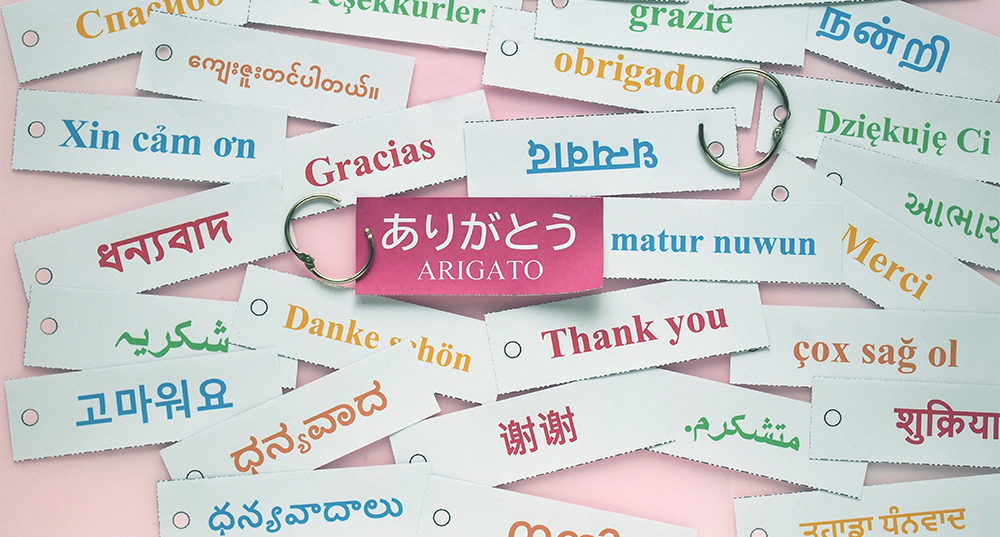
In recent years, the number of foreign tourists visiting Japan has been increasing year by year, presenting a significant business opportunity for the tourism industry. However, on the other hand, communication challenges caused by the "language barrier" have become apparent. Multilingual support is an essential element for tourists to enjoy their stay in Japan with peace of mind, but in practice, various issues are occurring on site. This article clearly explains the main challenges of multilingual support for foreign tourists and their solutions.
- Table of Contents
-
- 1. The Necessity of Multilingual Support for Foreign Tourists
1-1. Increase in Foreign Tourists
1-2. The Need for Clear Information Delivery
1-3. Avoiding Missed Opportunities
1-4. Eliminating Language Barriers
1-5. Impact on Satisfaction
- 2. Key Points for Multilingual Support for Foreign Tourists
2-1. Multilingual Displays on Signage, Guides, Websites, and Social Media
2-2. Tailoring Approaches by Language
2-3. Utilization of Digital Tools
- 3. Challenges in Advancing Multilingual Support
3-1. Increasing Translation Costs and Labor Shortages
3-2. Consideration of Cultural Backgrounds
3-3. The Need for Effectiveness Measurement
- 4. Key Points for Solving Multilingual Support Challenges
4-1. Points for Addressing Increased Translation Costs and Labor Shortages
4-2. Points for Considering Cultural Backgrounds
4-3. Importance of Effectiveness Measurement and Key Points
- 5. What is "MTrans for Office," Recommended for Solving Multilingual Support Challenges?
- 6. Summary
- 1. The Necessity of Multilingual Support for Foreign Tourists
1. The Necessity of Multilingual Support for Foreign Tourists

1-1. Increase in Foreign Tourists
According to the Japan National Tourism Organization, the number of foreign tourists visiting Japan has been increasing significantly year by year. In October 2025, the number reached 3,896,300, marking a 17.6% increase compared to the same month the previous year, setting a record high for October. Especially during the autumn foliage season and consecutive holidays, visits from diverse countries and regions such as South Korea, Indonesia, and the United States have increased. This trend is expected to continue, making it urgent to improve the environment to accommodate travelers of various nationalities, particularly by strengthening multilingual support.
1-2. The Necessity of Clear Information Delivery
Providing accurate and easy-to-understand information is essential for the increasing number of foreign tourists. By clearly guiding them in languages other than Japanese about transportation methods, facility usage, emergency responses, local culture, and manners, travelers can enjoy their stay in Japan with peace of mind. Insufficient information or incorrect guidance can cause confusion and trouble for travelers.
1-3. Avoiding Opportunity Loss
If the appeal of products or services is not conveyed due to language barriers, or if usage methods are unclear, it directly leads to opportunity loss. Providing menus, signage, and websites in multiple languages enables foreign tourists to make purchases and use services smoothly, contributing to maximizing travel expenditure. This is also essential for achieving the government's goal of "expanding consumption."
1-4. Eliminating Language Barriers
Multilingual support removes the "language barrier" for foreign tourists and greatly enhances the quality of their travel experience. This not only allows for sightseeing at tourist spots but also invites travelers to engage with local people and have deeper experiences. Eliminating language barriers serves as a strong motivation for visitors to want to "come to Japan again."
1-5. Impact on Satisfaction
An environment where information can be obtained without stress and services can be used smoothly greatly influences the overall satisfaction of foreign tourists. Especially as the inbound market expands, with single-month records being set in countries like Canada and Mexico, maintaining high satisfaction leads to improved evaluations of Japan as a tourist destination and the acquisition of repeat visitors. Warm hospitality through multilingual support can be said to be one of Japan's proudest forms of top-notch hospitality.
2. Key Points for Multilingual Support for Foreign Tourists

We will introduce the key points of multilingual support that are important when accepting foreign tourists.
2-1. Multilingual Displays on Signage, Guides, Websites, and Social Media
To effectively advance multilingual support, it is essential to strengthen support at both on-site (real) touchpoints and online touchpoints.
On-site, it is important to prepare signage and information boards such as station names, facility names, usage instructions, and emergency guidance in major languages like English, Simplified Chinese, and Korean, while also using language-independent pictograms to enhance visual clarity. Additionally, restaurants and retail stores can prevent lost opportunities by multilingualizing menus and brochures for products and services, thereby promoting smooth purchasing and usage.
On the other hand, online, it is essential to multilingualize websites, apps, and reservation systems to support advance information gathering and booking. Especially on SNS, which directly drives customer attraction, actively disseminating information in the languages of the target countries or regions and introducing multilingual chatbots enables customer support 24/7, greatly enhancing the convenience of the service.
2-2. Changing Approaches by Language
Rather than responding uniformly in all languages, the key to success is strategically adjusting the approach according to the characteristics and needs of the target countries or regions. First, based on existing customer data and market trends, prioritize languages spoken by many visitors to Japan to improve efficiency in response. Beyond simple translation, it is important to pursue "cultural adaptation" by understanding the culture, customs, and religious backgrounds of each language group and optimizing expressions and content accordingly.
For example, since the purposes of travel and the information sought often differ between Western countries, Australia, and East Asia, it is effective to optimize the content itself for each language region. Also, rather than perfectly multilingualizing all information, it is a realistic and effective approach to prioritize handling highly urgent and important information such as safety information and basic usage guidance first, and then gradually expand the scope and quality.
2-3. Utilization of Digital Tools
To address the shortage of human resources and cost challenges, and to improve the quality of service for foreign tourists, the active use of digital tools is essential. Specifically, by having staff utilize voice translators and translation apps, language barriers during conversations can be resolved on the spot, enabling smooth customer service. Furthermore, by introducing AI chatbots and FAQ systems on websites and within facilities, frequently asked questions from foreign tourists can be automatically handled, significantly reducing the burden on staff.
Additionally, by utilizing digital signage, it becomes possible to display and update multilingual information in real time, allowing flexible communication of congestion status and emergency information. Furthermore, by leveraging AR (augmented reality) technology, simply pointing a smartphone can display detailed explanations of historic sites and exhibits in multiple languages, providing new experiential value. Moreover, the introduction of digital payments and tickets, such as mobile payments and electronic tickets, is essential to greatly enhance convenience for foreign tourists and to facilitate smoother use at tourist destinations.
3. Challenges in Advancing Multilingual Support

There are several important challenges that must be overcome when promoting multilingual support.
3-1. Increasing Translation Costs and Shortage of Human Resources
First, the increase in costs and the shortage of personnel are major obstacles. To provide high-quality information, expenses for outsourcing translation to experts and the costs of introducing and operating digital tools such as multilingual audio guides will rise. Moreover, multilingual support is not completed by simply introducing tools; it is also essential to secure personnel who can manage and promote translation tasks, as well as staff with language skills capable of smoothly communicating with foreign tourists on-site. Since recruiting and training such personnel require time and money, this becomes a factor that delays the speed of response.
3-2. Consideration of Cultural Backgrounds
It is necessary not only to translate the language but also to give sufficient consideration to the cultural background of the other party. Careful examination is required to ensure that the choice of words and expressions are not inappropriate to the other party’s culture, religion, or customs. Furthermore, not only language but also colors, gestures, and icons or pictograms used on signage can be interpreted differently depending on the country or region, so utmost care is needed to avoid misunderstandings. Ensuring such cultural appropriateness directly leads to improved user satisfaction.
3-3. The Necessity of Effectiveness Measurement
Even if significant costs and efforts are invested in implementing multilingual support, it becomes difficult to make continuous improvements or investment decisions if the effectiveness of these efforts cannot be understood. Therefore, a key challenge is to establish a system that measures how much multilingual initiatives actually contribute to goals such as increasing the number of foreign tourists, boosting spending, improving satisfaction, and avoiding missed opportunities, and to visualize the cost-effectiveness. Based on the data obtained from effectiveness measurement, it is necessary to review the priority of supported languages and provided information, and to proceed with strategic improvements.
4. Key Points for Solving Multilingual Support Challenges

To overcome the challenges in multilingual support and implement effective measures, a strategic approach is essential.
4-1. Key Points for Addressing Increasing Translation Costs and Labor Shortages
To solve the issues of rising translation costs and labor shortages, actively introducing easy-to-use automatic translation tools is effective. For example, by utilizing tools like our "MTrans for Office," the scope of documents that can be handled in-house expands, except for those requiring specialized translation, thereby reducing outsourcing costs. This makes it possible to secure the speed and volume of basic information provision even when human resources are limited. The important point is to use automatic translation tools as support for everyday communication and basic tasks, improving operational efficiency while keeping costs down.
4-2. Key Points for Considering Cultural Backgrounds
To prevent misunderstandings and inappropriate expressions caused by differences in cultural backgrounds, it is essential to utilize the expertise of professional translators and native speakers. Their professionalism and cultural insights allow localization into expressions that are easy to understand and appropriate, tailored to the culture of the target country or region, rather than mere literal translations. Additionally, by actively using icons and photos instead of relying solely on language, it becomes possible to convey information beyond language barriers and prevent cultural misunderstandings in advance.
4-3. The Importance of Effectiveness Measurement and Key Points
To maximize the return on investment in multilingual support, it is essential to have a system that continuously measures the effectiveness of initiatives and leads to improvements. Specifically, conducting surveys targeting foreign tourists and using analysis tools to monitor mentions and evaluations on social media helps gather satisfaction levels and specific needs regarding the support provided. Furthermore, analyzing access to multilingual pages on the website allows understanding which countries' users are interested in which information. Additionally, analyzing the number and content of inquiries in multiple languages helps identify gaps in information provision and particular difficulties faced by foreign tourists, which is crucial for making concrete improvements to the initiatives.
5. What is "MTrans for Office," Recommended for Solving Multilingual Support Challenges?
Introducing "MTrans for Office" as a tool to solve the challenges of multilingual support. MTrans for Office is directly integrated into the Word, Excel, PowerPoint, and Outlook applications you regularly use, so there is no need to learn how to use new software. You can utilize the translation functions without changing your existing workflow.
For example, to create an English email in Outlook, write the body in Japanese first, then click the "Execute Translation" button. Multiple English translations from various translation services will appear in the translation panel on the right. By simply clicking the "Replace" button, you can replace the Japanese text in the body with English.
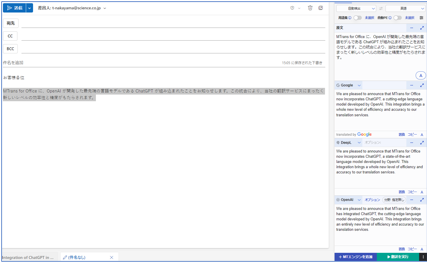
Additionally, MTrans for Office is equipped with OpenAI's generative AI, which is also used in ChatGPT. You can write the summary of an email in Japanese, select the text, and then click the execute button to automatically create an English email based on the Japanese summary. By clicking the "Replace" button, the result is reflected in the email body, and simply changing details like the customer's name completes the English email.
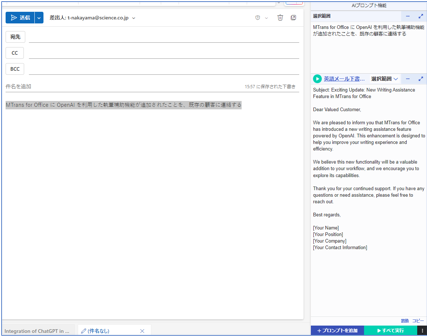
MTrans for Office offers intuitive operability, allowing you to utilize translation and AI functions within Office applications without special IT knowledge, which can reduce translation workload and improve operational efficiency.
6. Summary
With the increase in foreign tourists, multilingual support has become an increasingly important issue in Japan's tourism industry. By removing language barriers and providing clear information along with cultural considerations, it is expected to improve tourist satisfaction, increase repeat visitors, and even expand spending. On the other hand, challenges such as translation costs, labor shortages, handling cultural differences, and difficulties in measuring effectiveness also exist. To address these challenges, it is essential to utilize automatic translation tools and digital technologies, localize with the help of experts, and conduct continuous effectiveness measurement.
To achieve efficient multilingual support, utilizing the translation add-in "MTrans for Office" available for Office apps is effective. Since you can translate directly from the Office apps you are accustomed to using, you can easily advance multilingual support without any special knowledge. By strategically promoting multilingual support, the appeal as a tourist destination will be further enhanced, and sustainable growth can be expected.
MTrans for Office offers a 14-day free trial. Please give it a try.
Features of MTrans for Office
- ① Unlimited number of file translations and glossary integration for a fixed fee
- ② One-click translation from Office products!
- ③ Secure API connection
・For customers who want further security enhancement, we also offer SSO, IP restrictions, and so on. - ④ Support in Japanese by a Japanese company
・Support for security check sheets is also available
・Payment by bank transfer is available
MTrans for Office is an easy-to-use translation software for Office.



















 Return to the top of the page

 +81 35-321-3111[Tokyo Headquarters]
  Contact Us
 Request for Information