

Human Science has received translation requests from many domestic and foreign companies in a wide range of fields such as software, manufacturing, IT, automotive, and distribution for the translation of manuals, GUI, UI,
software, systems, instruction manuals, and help guides.
We also offer translation for educational materials such as e-learning.
We will propose the optimal balance of quality, cost, and schedule for our clients.
| Japanese | |
| English (US, UK, Australian) | |
| Asian languages | Chinese (simplified/traditional), Korean, Thai, Lao, Malay, Vietnamese, Burmese, Tagalog, Indonesian, Turkish, Hindi, Kazakh |
| Western languages | French, Italian, German, Spanish, Iberian Portuguese, Dutch, Greek |
| Eastern European languages | Czech, Polish, Russian, Romanian, Bulgarian, Hungarian, Slovenian, Slovak, Estonian, Ukrainian, Lithuanian, Latvian, Belarusian, Georgian, Bosnian, Croatian, Serbian, Armenian, Macedonian |
From the production of Japanese documents to system development and e-learning development, Human Science is a full-service document provider with a unique focus on Japanese translation and localization, along with our other exceptional strengths. Here they are, summarized in five categories.
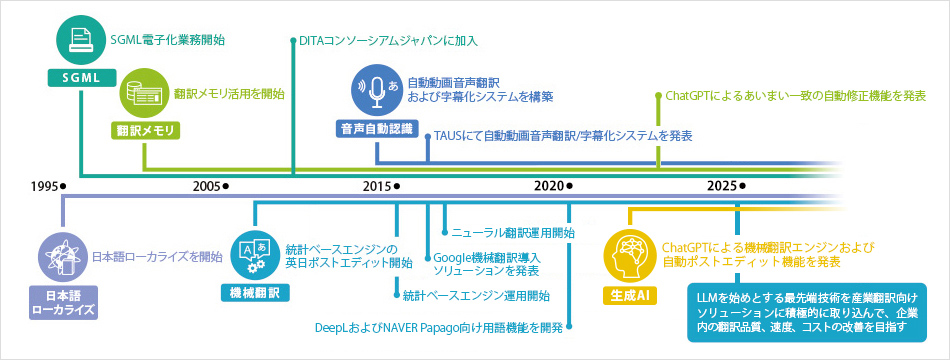
Many new translation technologies are developed in Europe and the United States and are subsequently adopted throughout the globe.
Human Science belongs to international industry associations, including the Globalization and Localization Association (GALA), to stay at the forefront of the translation industry, pushing the development of the Japanese market while keeping up with the latest technology trends.
In addition to individual technologies, we deploy unique language technology services that combine multiple technologies and tools to greatly improve translation efficiency and quality. We are able to maximize the cost performance of our business by utilizing various technologies at each stage of translation.
In the field of translation, background knowledge about the subject matter is essential.
For example, someone who has not studied law cannot accurately translate legal documents. Similarly, someone without technical knowledge about systems cannot properly translate IT documents.
In addition, when translating software manuals, the content of the manual must align with the operation of the software itself. For that purpose, we conduct "testing" or "QA" to verify that the software's advanced operations can be reproduced on the system and that these operations match the manual. This type of work requires engineers with extensive technical skills.
At Human Science, we have a specialized system development team in-house and have been working on development projects of various types for approximately 30 years. Through close collaboration between engineers and translation/localization specialists with various technical skills, we can provide quick, high level solutions to many technical challenges.
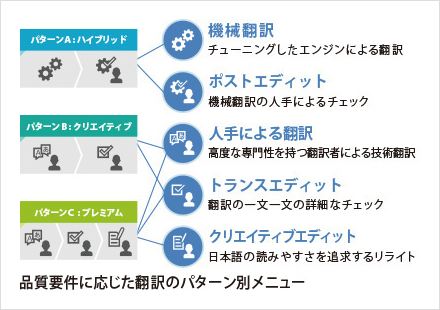
Human Science got its start with manual creation, which instilled in us an unrelenting desire to provide our customers with the best possible Japanese documents.
This spirit also lives on in our translation and localization services, where we have dedicated technical reviewers and linguistic reviewers in-house, ensuring thorough quality control by reviewing every sentence in every project.
In addition, we have a systematic, company-wide quality assurance plan, rather than relying on a handful experienced translators. This allows us to consistently provide high-quality services for both large-scale and specialized projects.
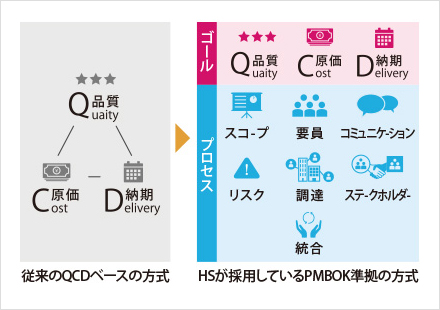
At Human Science, we assign a dedicated project manager to each project, regardless of the size, and systematically ensure that the same person serves as a customer's contact from the beginning to the end of the project.
We prefer this over systems where the point of contact changes at every stage of work and no one can offer perspective or provide oversight over the project as a whole.
In addition, the project management methods upheld by each of our project managers are not individualistic, but follow the international standard system for project management, PMBOK, and were carefully constructed according to widely accepted procedures. (See the figure on the right.)
Thanks to such measures, our clients find no cause to complain about a point of contact changing and the quality of our work diminishing.
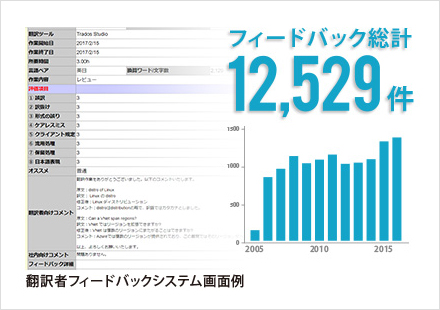
Translation is an important profession that greatly influences the final quality of translations and localizations. For that reason, we believe that an education system for translators is of great importance.
Human Science quantifies the work of translators for each project with over 100 unique criteria, and stores all the results in a database to manage the translators' levels.
Translators are able to check their numerical results for each job, as well as review specific feedback documents that detail correction points, suggestions, and guidance, which helps them improve on their next tasks.
The current amount of feedback in our database totals 12,529 cases.
This is six times the amount of exercises performed in a one-year course at a translation school.
From the start, our translators are already an elite group who managed to pass our demanding trial period, with a narrow pass rate of less than 8%, but by further developing their skills through our feedback system, we are able to achieve even higher levels of quality.
The following lists achievements we have made in translating operation manuals and instruction manuals by industry.
The following lists achievements we have made in translating technical manuals and SDK by industry.
The following lists achievents we have made in translating software, GUI, and UI (user interface) by industry.
The following lists achievents we have made in translating educational materials, training materials, and e-learning content.
The following lists achievements we have made in translating business manuals.
We have received various positive feedback from major global companies.

Since the Office 2000 series, we have been supporting the content of "First Step - Office.com" for over 10 years.
Content originating from Japan is gaining attention overseas. In the Asia-Pacific region alone, it is available in 18 languages, and worldwide it is available in over 40 languages.

We request large translations, translations with quick turnover, manual writing, multimedia localization, interpretation, and all manner of other tasks.
In addition to the translation quality, the careful support from the local staff in the Tokyo office is greatly appreciated.
Always courteous and sincere response, which helps us to smoothly advance translation projects.
We ask our translators to have as much understanding of the product as possible, but we feel assured that the translations are adjusted consistently.
Contact Us / Request for Materials
 +81 35-321-3111[Tokyo Headquarters]
  Contact Us
 Request for Information
 TOP
TOP SITE MENU