



This seminar has closed for applications.
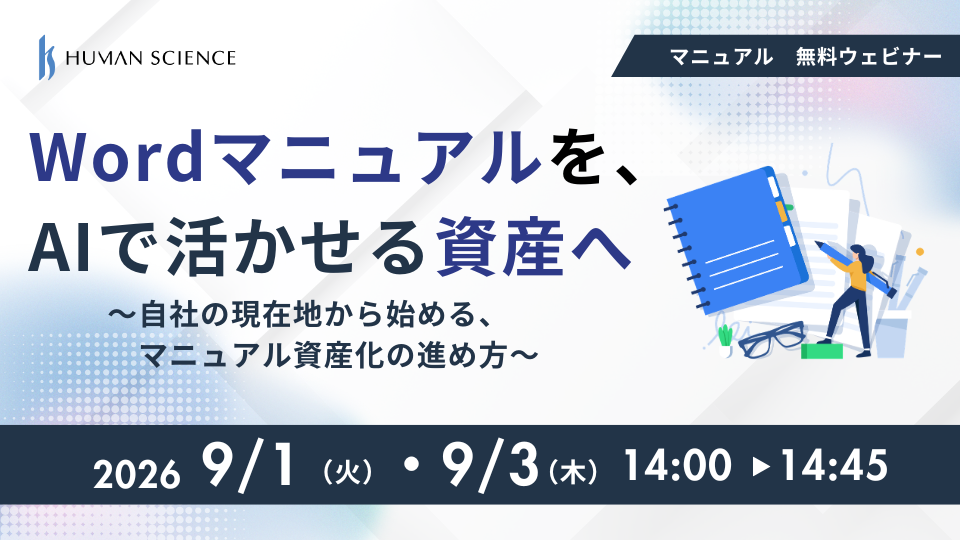
* This webinar is a sequel to the one held in June and July titled "Feeling the Limits of Word Manuals? — The First Step to Manual 'Assetization' Starting with AsciiDoc/Markdown."
Seminar Details
The success or failure of AI utilization is determined more by the "structure of the manual" than by the performance of the AI itself. This is because AI finds it difficult to interpret the content of Word or PDF files with fixed layouts.
That said, there is no need to aim for AI utilization all at once. This is because each company’s "current position" is different.
Urgent issues such as "wanting to first create a searchable web manual," "not knowing the latest version," "only that person in charge can fix it," and "documentation rules are not yet established" — even starting by solving these “current issues,” that investment can become the foundation for future assetization and generative AI utilization.
Building on the previous webinar, we will present steps to transform manuals from a “liability” into an “asset” in order to move beyond the limitations of Word usage and reach the “next stage.” This will be easy to understand not only for those who have participated continuously but also for first-timers, allowing you to take home a clear path forward starting tomorrow.
In this seminar,
① Why “assetization” is a prerequisite for utilizing generative AI
② A practical approach starting from the current challenges of searchability and web conversion
③ How to choose the “first step” that fits your company’s current situation
Our company offers multiple solutions tailored to your current situation and objectives. From WebWorks ePublisher and Adobe RoboHelp, which can convert Word assets “as is” into web manuals (output is AI-ready and can be utilized by generative AI), to full-scale asset creation using lightweight markup languages such as Markdown and AsciiDoc (enabling one source to produce multi-media and multi-language outputs, the most suitable format for generative AI). All of these address the current challenges of “searchability and web conversion” while laying the foundation for generative AI utilization.
Since its founding in 1985, Human Science has been engaged for nearly 40 years in manual creation, assetization, and multilingual deployment, and will share practical insights based on field expertise. The content is valuable for everyone involved with documentation, from management to on-site personnel.
*This is a follow-up to the previous "Limits of Word Manuals..." webinar, but you can fully understand the content by attending this seminar alone. Please feel free to join us!
*Please note that participation by competitors and individuals is not allowed.
Application
This seminar has closed for applications.
This Seminar is Recommended for These Personnel
・Those who want to utilize manuals with generative AI or internal AI search and want to prepare the prerequisites
・Those who want to first convert manuals into highly searchable web manuals
・Those who want to reduce inquiries about "what is written in the manual"
・Those who want to eliminate the personalization of manual creation (work concentrated on specific individuals / difficult to edit simultaneously / individual differences in Word skills)
・Those considering converting from Word to web and multilingual deployment (such as manuals for manufacturing products, services, and maintenance)
・Those who want to organize a large amount of existing Word assets with a view to future AI utilization
・Those interested in asset creation using Markdown/AsciiDoc (lightweight markup languages) or docs as code
・Those who want to know how to proceed according to their company’s current status and what to start with
Program
Part 1: Why “Assetization” is a Prerequisite for Utilizing Generative AI
・Can AI not understand the “appearance” of Word or PDF? What “assetization (semantic tagging)” means to enable AI to answer accurately
・The impact of document “format and structure” on AI’s answer accuracy
・The future achievable by turning manuals into assets
Part 2: Starting from “Current Issues” — A Practical Entry Point of Searchability and Web Conversion
・Understanding your company’s current position with the “Manual Maturity Map” (From moving away from Word operations to a roadmap for AI utilization)
・The immediate effectiveness brought by searchable web manuals (always sharing the latest version, multi-device support, reduction of inquiries)
・An approach to directly convert existing Word documents to the web (utilizing WebWorks ePublisher / Adobe RoboHelp)
・Approach to nurturing manuals as “assets” (Utilizing Markdown/AsciiDoc to create an optimal form from a single source for multiple media and generative AI)
・[Most popular in the last seminar] How to create a “team-driven system” that doesn’t rely on individual skills (Text conversion, difference review, template utilization)
・Why investing in solving immediate issues (web conversion) directly becomes the foundation for future generative AI utilization
Part 3: How to choose the first step and “solutions” that fit your company’s current position
・How to select the optimal tools according to the challenges (tools that immediately enhance searchability vs lightweight markup designed for multilingual support and reuse)
・Five criteria to determine the approach that suits your company (asset scale, revision frequency, multilingual support, in-house system, timing of AI utilization)
・Tips for a “small start” and operational establishment to avoid failure (role division, formulation of operational rules, common success and failure patterns)
* The program is subject to change without notice.
Event Details
- Date and Time
-
- September 1, 2026 (Tues), 2:00 p.m. to 2:45 p.m.
- September 3, 2026 (Thurs), 2:00 p.m. to 2:45 p.m.
- Main session 30 minutes + Q&A 15 minutes (Q&A participation optional)
- Cost
- Free
- How to Participate
-
- This seminar is a web seminar using Zoom.
- We will contact those who have applied separately by email regarding how to participate.
- For information about the Zoom playback environment, please check here.
Exclusive for webinar participants
Manual Asset Conversion & Diagnosis Campaign
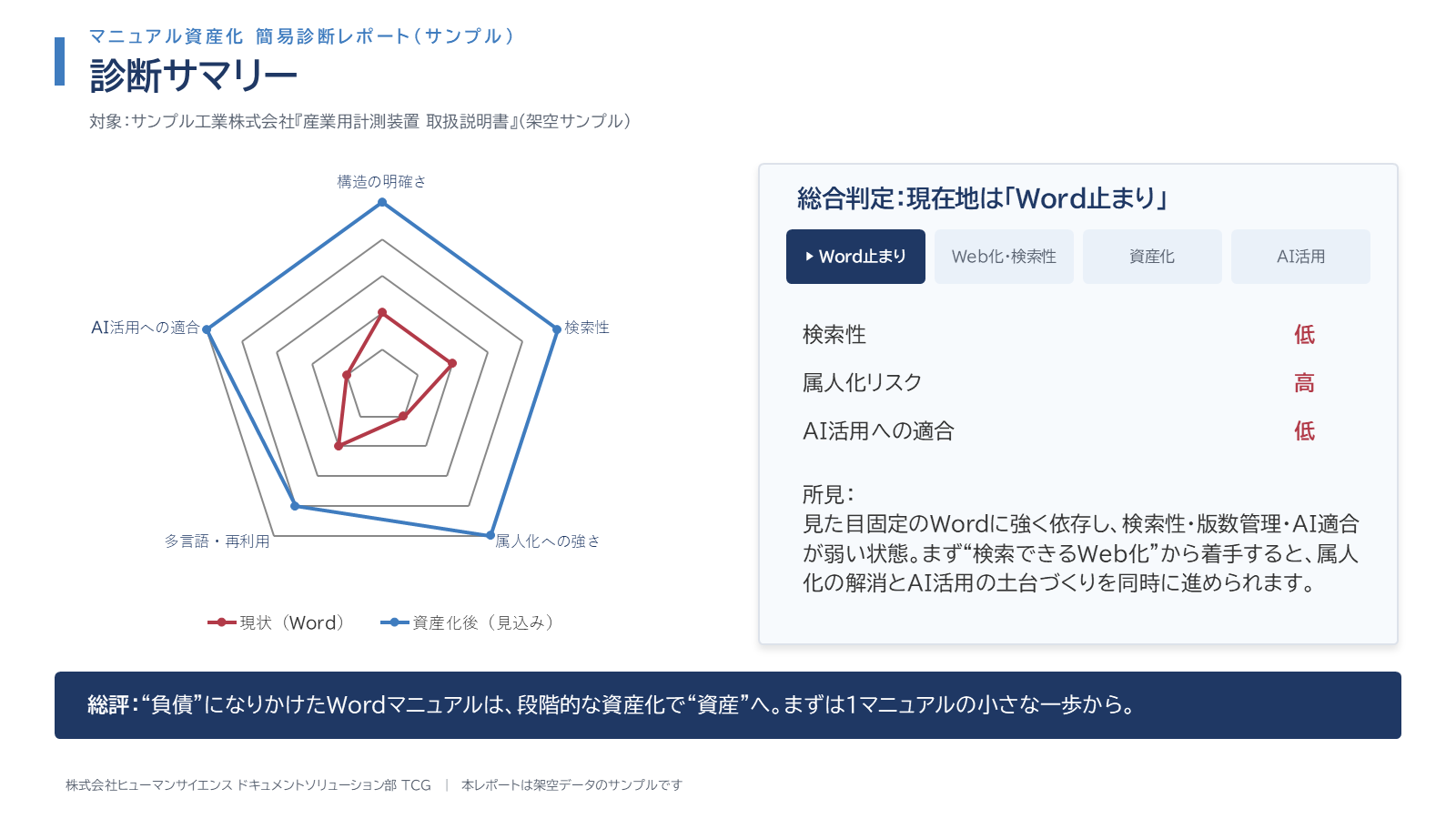
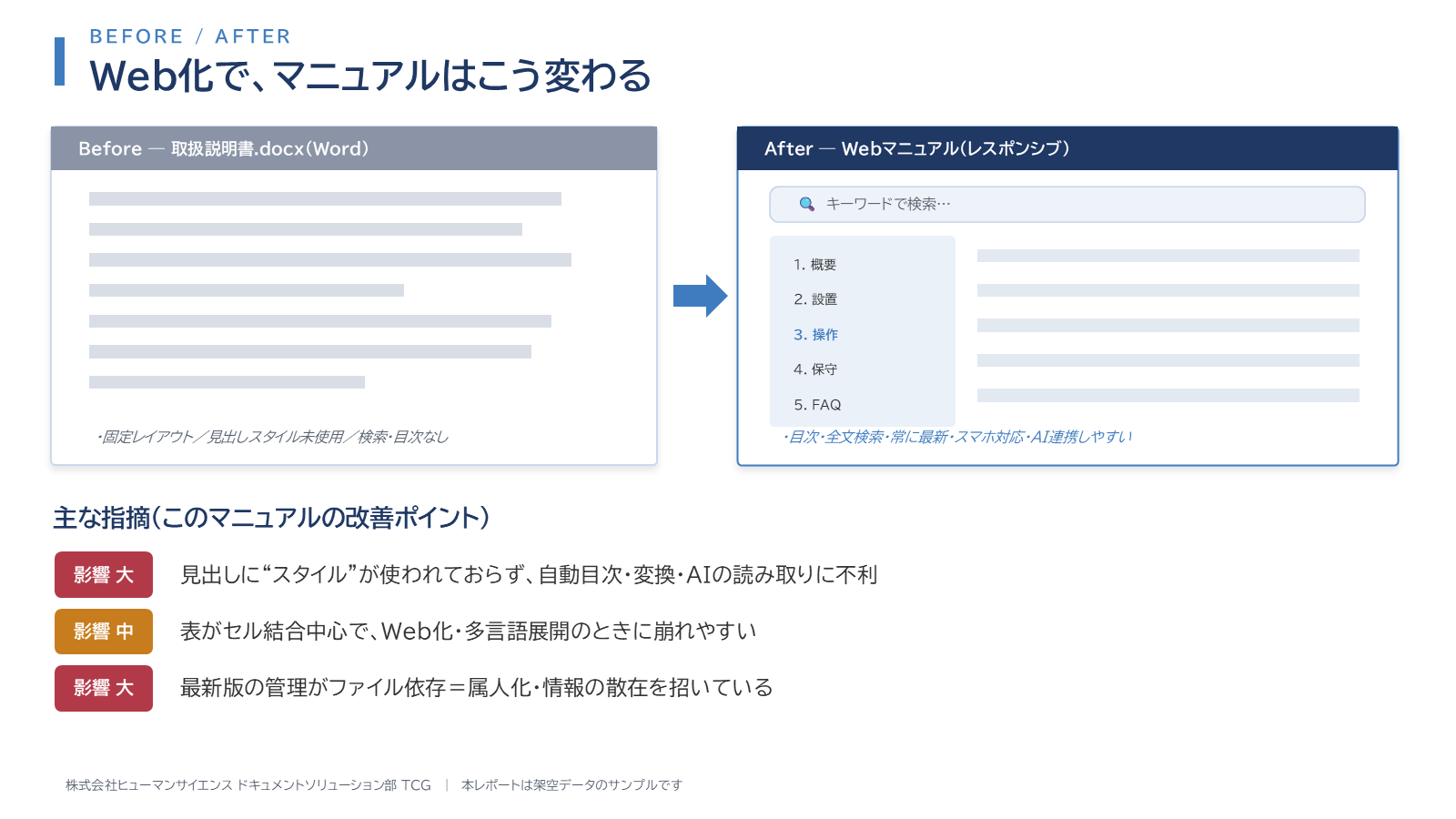
"Is your company's Word manual truly suitable for web conversion and AI utilization?" To answer this question, we will take a portion of your current Word manual and provide a free "simple output" to a web manual aimed at solving issues.
Diagnosis Details: Ease of structuring, changes in searchability, suitability for AI utilization
What you will receive: A sample web manual using your company’s data, along with a proposal for an improvement roadmap
If you want to "first see how to overcome the limitations of Word using your own data," please make use of the individual consultation after this webinar.
▼Image of the simple diagnosis
Application
This seminar has closed for applications.
Lecturer
Kunio Sakamoto
Human Science Co., Ltd.
Document Solutions Department, Technical Communication Group
At Human Science, he has been in charge of numerous projects involving manual creation, assetization (structuring), and multilingual deployment. He provides support based on on-site expertise that addresses the challenges of service and support departments, including assistance with migrating to structured documents using AsciiDoc, projects to move away from DITA/XML, and converting Word manuals to web manuals (WebWorks ePublisher, Adobe RoboHelp).
 Return to the top of the page
 +81 35-321-3111[Tokyo Headquarters]
  Contact Us
 Request for Information
 TOP
TOP SITE MENU